
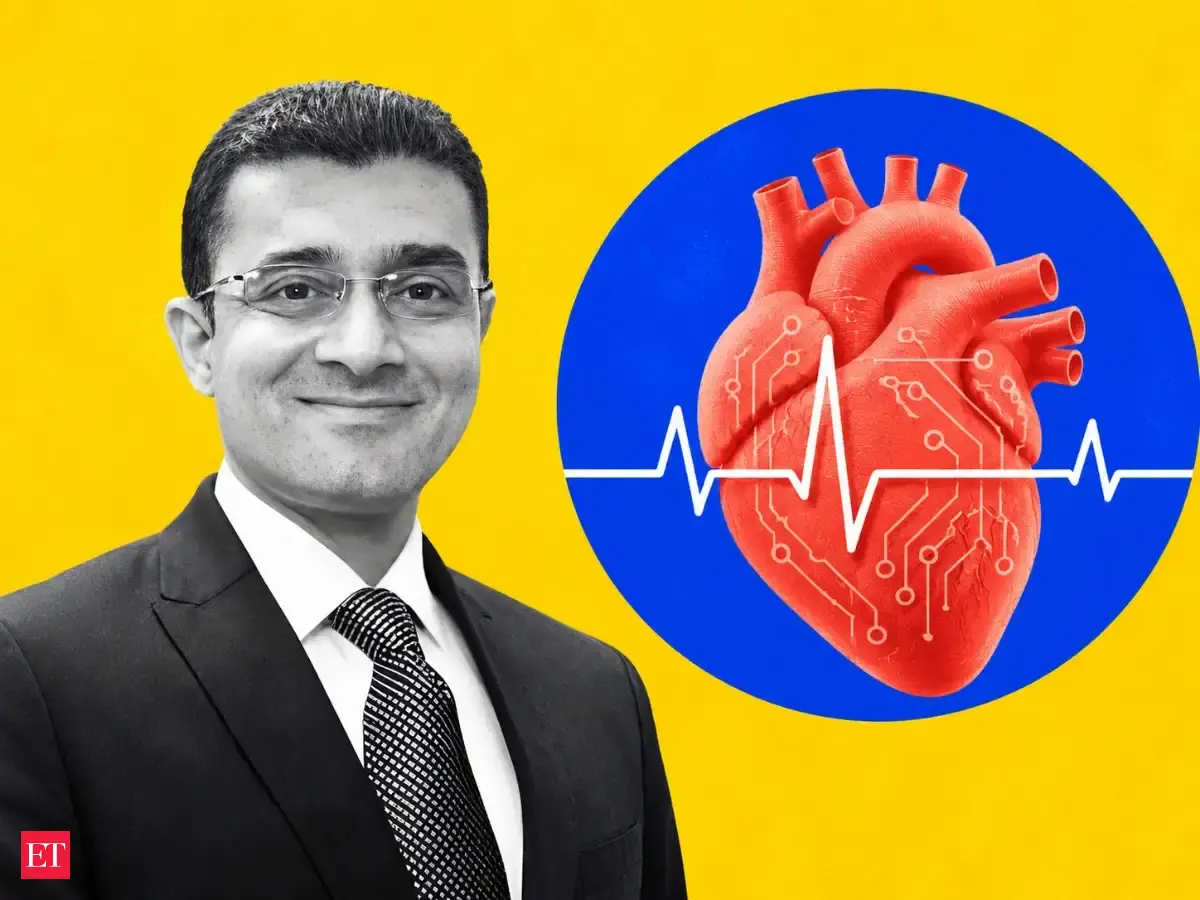
Surat-based Scanbo developed an AI-led medical device, D8, to help doctors detect heart abnormalities quickly. The palm-sized tool records ECG data and uses an AI engine to provide an interpretation in seconds. Ashissh Raichura said, "They can click a button and within 25 to 30 seconds it generates an initial interpretation."
Surat-based Scanbo has developed an AI-led medical device, D8, that can give a quick interpretation of abnormalities behind the functioning of a heart, critical in times of emergency situations.
When a patient arrives with chest pain at a general practitioner's clinic, the first responder is expected to conduct a 12-lead electrocardiogram (ECG) in the first 10 minutes to ascertain the cause of distress, as per international benchmarks.
In India, though, most clinics, particularly in smaller towns, lack the equipment to answer the one question that matters most in an emergency - what is causing the distress. And such a delay can prove to be fatal.
"There are only a few doctors who have a 12-lead ECG machine, with probably around 2% to 5% having one," said Ashissh Raichura, founder and chief executive of Scanbo Technologies.
A 12-lead ECG is a medical test that records the electrical activity of the heart from 12 different angles or viewpoints using 10 physical electrodes placed on the skin.
Surat-based Scanbo is a point-of-care intelligence platform that aims to fill this gap and has come up with a screenless device called D8. The device fits into a doctor's palm, connects to a phone and sends an ECG recording to an artificial intelligence (AI) engine.
"They [doctors] can click a button and within 25 to 30 seconds it generates an initial interpretation," Raichura told ET AI.
The need for a quicker first check is significant in a country where
cardiovascular diseases remain the leading cause of death and account for nearly 31% of all deaths, according to data from the Sample Registration System under the Registrar General of India.
Further, India has less than five cardiologists per million people, according to a study in the Journal of the Society for Cardiovascular Angiography & Interventions.
ECG in the doctor's palm
The hardware, Scanbo D8, which Raichura said the company manufactures in-house in Surat, is described as "smaller than a palm and weighs less than 90 grams".
It has no screen, so it records a single-lead ECG and sends the tracing to Scanbo's mobile app, which then forwards it to the company's cloud-based AI engine, HridayTaal. Raichura said the Central Drugs Standard Control Organisation (CDSCO) has approved the engine as software as a medical device (SaMD), a category that covers medical functions delivered through software.
"When you click on 'Call HridayTaal' on the app, the AI algorithm runs in the cloud and interprets the ECG to find abnormalities," he explained.
As per Raichura, the engine checks whether the heart is beating too fast or too slowly and if the tracing shows possible atrial fibrillation, an irregular heartbeat, or sinus arrhythmia (a harmless variation in heart rhythm where your heart rate speeds up when you inhale and slows down when you exhale).
HridayTaal also checks the quality of the signal and asks the healthcare worker to repeat the recording if the quality falls below 85%, he said. International benchmarks consider 85% to be a "good signal quality".
Scanbo's device does not give the diagnosis in isolation based only on its reading, he suggests. It captures the patient's age, gender, blood pressure, heart rate, blood oxygen level and glucose; HridayTaal then reads the ECG in consonance with those details.
"When we do the AI reading, we supply all the demographics to the AI and say, 'Now read it,'" he added.
Raichura described the software as an aid for a healthcare professional rather than a replacement. "AI reads the data in its raw format and converts it into an outcome the physician or healthcare professional can understand. I would not term it an AI cardiologist, but let's say it is an initial version of that."
However, unlike a conventional wired 12-lead ECG, the D8, which does not require wires or patches, captures only one view of the heart that limits its outcomes. "In simple terms, it is one dimension of the heart. I see the heart from the front and say, 'This is what I find, or what I don't find'," he said.
Trained on real hearts
Scanbo began training the model about four years ago using labelled, open-source ECG libraries from Massachusetts Institute of Technology (MIT) and Stanford, according to Raichura. Before the company applied to CDSCO in 2024, it screened almost 250,000 ECGs across geographies, age groups and ethnicities, of which 129,000 came from India.
"We have used zero synthetic data. These are all real ECGs," Raichura said.
The company also asked Dr Krishna Sudhir, a cardiologist on its medical advisory board, to label ECGs manually. Raichura said that process took more than 12 months and involved more than 7,000 tracings.
Scanbo compared about 50,000 readings manually with the algorithm's output during the early phase of development, claimed Raichura. The manual comparison was later stopped as the model improved.
"We no longer do that manually because our algorithm has improved a lot over the last one and a half years," he said.
Raichura said the engine has now read 1.2 million ECGs and achieves accuracy, sensitivity and specificity above 95% when compared with a healthcare professional reading the strip by eye. Scanbo also reports a 7% reduction in unnecessary referrals (second opinions) and a 5% fall in false alarms, he said.
The company claims that it has deployed more than 1,000 devices globally. Raichura said 70-80% of those devices are used daily and that 80-85% of active customers pay regularly.
The doctor still makes the call
Scanbo's limits on diagnosis shape its business model as it sells to healthcare providers and institutions, not directly to patients.
"Everything is B2B. We are not B2C at all. You can view your data as a patient, but you will not receive any interpretation or alarm," Raichura said.
He said the system flags possible abnormalities and leaves the diagnosis to a doctor. So, the responsibility to vet the diagnosis and act on it is on the doctor.
"We do not diagnose. We read your heart symptoms and say there are possible abnormalities. It is left to the doctor to decide whether those are really abnormalities," Raichura said, adding that "as a diagnostics and AI company, we do not take responsibility for the action."
CDSCO checked the D8's heart rate and rhythm readings against an approved 12-lead ECG in 79 subjects, according to Raichura, but it did not test the AI's interpretation of the ECG.
"They cannot verify the interpretation because even the US FDA does not have that capability," he said.
Scanbo has completed four of the five clinical trials needed to file for clearance from the US Food and Drug Administration under the 510(k) route, Raichura said. The company expects the next version of the device to add six-lead and 12-lead capability, but it is awaiting CDSCO approval, which is expected to arrive by the second quarter of 2027, he said.
For now, Scanbo's bet rests on giving a general practitioner a quick first reading without requiring a full 12-lead machine or a cardiologist in the room. Raichura said the company still sees the physician as the essential decision-maker.
"I strongly believe that until AI reaches the stage where it can do this automatically, it is better for a physician to do it," he added.