
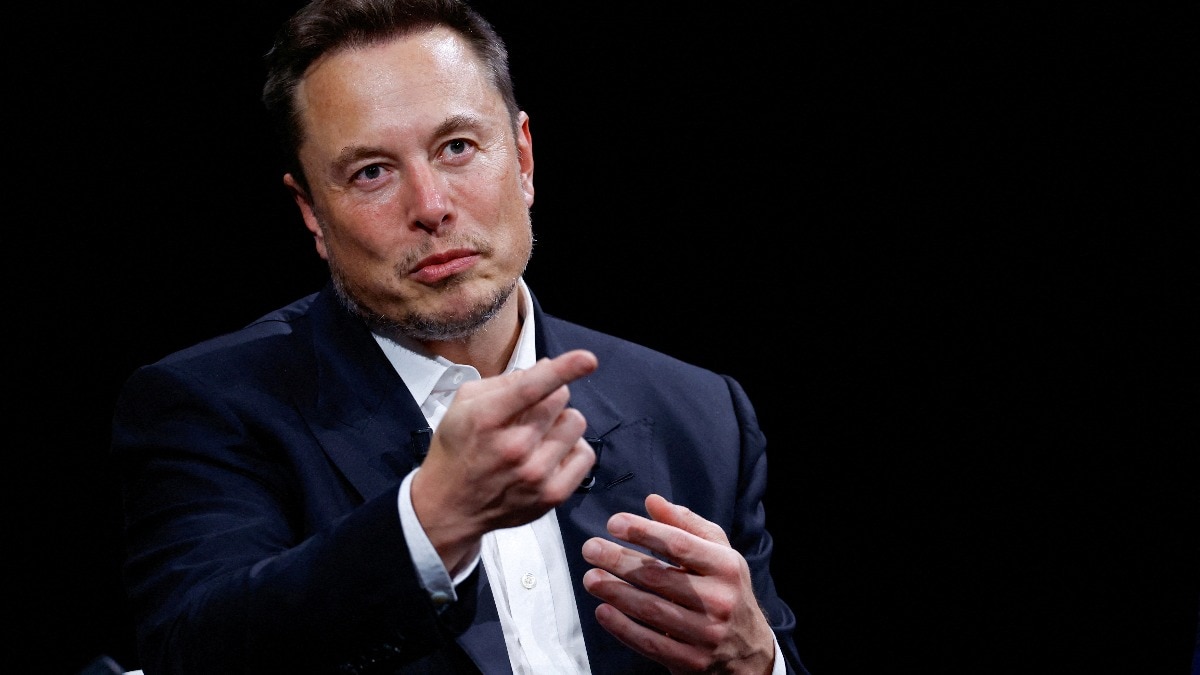
Elon Musk on Sunday branded those defending the existing Indian market as "Ambani's army of Internet shills." He argued that Starlink’s entry would benefit consumers through more choice. Musk said, "This is absurd hypocrisy and hyperbole," while claiming that competition would lower profits for Reliance without putting them out of business.
New day, new post. Elon Musk is not done taking shots at Mukesh Ambani. For the past few days, the SpaceX chief has kept up his online offensive over Starlink's proposed entry into India, taking digs at the Reliance chief and questioning the resistance to competition. On Sunday, he was back at it, branding those defending the existing market "Ambani's army of Internet shills" and accusing them of "absurd hypocrisy", while arguing that greater competition would benefit consumers.
In a fresh post on X, Musk described those defending the existing market as "Ambani's army of Internet shills", questioning their argument that Starlink could neither compete with the low prices offered by Reliance Jio nor pose a serious competitive threat.
"The ridiculous arguments by Ambani's army of Internet shills make no sense. On the one hand, they say Starlink couldn't possibly compete with the amazing low prices offered by Ambani's de facto monopoly in India and then, in the same breath, they essentially claim that Starlink would be too strong of a competitor! This is absurd hypocrisy and hyperbole," Musk wrote.
Arguing that competition would expand consumer choice, Musk said Starlink's entry could reduce the profits of existing players without threatening their businesses. He also maintained that SpaceX would have to make its services affordable if consumers found them too expensive.
"The reality is that competition would greatly benefit the average citizen in India by giving them more choices, as it always does. Ambani's profits will be lower, but he is not going out of business," he said.
"Obviously, if Starlink is too expensive in India, no one will buy it, so SpaceX will need to make pricing affordable," Musk added.
Musk was responding to a post by Aaron Burnett, CEO of Mach33 Financial Group, who questioned the narrative that India's internet services were widely available and inexpensive.
Burnett argued that the perception largely reflected mobile internet usage, while fixed broadband penetration remained low.
He cited monthly mobile data usage of around 30-40 GB in India, compared with home fibre consumption of nearly 300 GB, and argued that an affordable alternative could significantly increase fixed broadband adoption.
Musk's latest remarks come amid his repeated criticism of the delay in Starlink's commercial launch in India.
In an earlier post on X on Friday, he sarcastically addressed Ambani as "Prime Minister Ambani" and accused him of seeking to protect a monopoly.
"Dear Prime Minister Ambani, Please accept my humble apologies for not realizing that you are the real boss of India. Naturally, you would prefer to maintain your monopolistic exploitation of the great people of India, but would you nonetheless consider allowing Starlink to compete?" Musk wrote.
Musk said several areas in India, as in other countries, still lack internet access, limiting children's access to education and small businesses' ability to reach global markets. He argued that Starlink could improve their lives by bridging this connectivity gap.
Minutes after his late Friday post, Musk issued another statement highlighting Starlink's role in saving lives during natural disasters worldwide when other communication systems fail.
The SpaceX CEO added that the service could similarly help save lives in India, including those of "men, women and children". "So you would also be helping save men, women and children throughout India," he added.
Notably, the latest exchange follows Musk's posts on Saturday sharing reports alleging links between Reliance-funded entities and political campaigning and donations.
These included an Al Jazeera report from 2022 on a Reliance-funded firm's role in boosting BJP campaigns on Facebook and an archived Indian Express report from 2024 on Qwik Supply, which reported donations of Rs 385 crore to the BJP and Rs 25 crore to the Shiv Sena through electoral bonds.
Reliance has not publicly responded to Musk's allegations.
The posts came after Union Communications Minister Jyotiraditya Scindia on Friday said that India does not permit monopolies in any sector and that three companies, including Starlink, had secured satellite communications licences.
"Let me set the record straight. For us, the Department of Telecommunications, we are technology agnostic... Our job is to be able to provide the bouquet of services to every single customer. It is for the customer to choose in a free market which service he or she prefers, and within that service bouquet, which company's service he or she prefers," Scindia said at a briefing at the India Mobile Congress in Delhi.
The Union minister also informed that licences have been granted to three players: Elon Musk's Starlink, Reliance Jio's Jio Satcom and Bharti-backed Eutelsat OneWeb. Amazon's Project Kuiper has also expressed interest but will have to follow the established procedure.
"There is a lot of conversation about a particular party. But there are three parties that have got licenses. There is Reliance Jio, there is OneWeb, and there is Starlink. And there is another party that is also interested in procuring a license. Now that process has to be followed by that party, that's Amazon," Scindia added.
The Department of Telecommunications and the Telecom Regulatory Authority of India are nearing a final decision on satellite service pricing, Scindia said, adding that licensed operators must meet security requirements and other prescribed milestones before launching commercial services.
The Ministry of Communications rejected Musk's claim that business interests were blocking Starlink's entry, saying all three licensed operators were at a similar regulatory stage, with security assessments under way.