
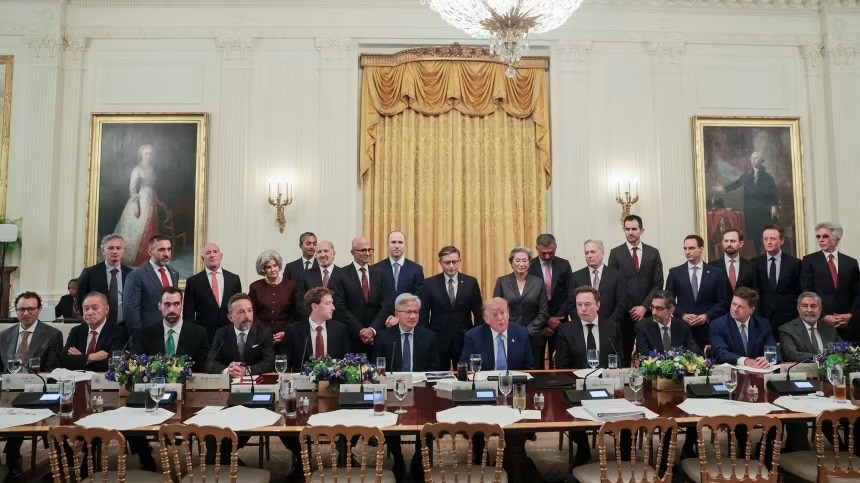
Harsh Goenka noted that Indians made up 25% of the AI leaders at a September 29 White House meeting. While Indian talent leads global tech firms, Goenka asked why India lacks the infrastructure to build such companies at home. The event focused on AI safety, data centers, and national power.
There was, the other day, a curious sight in Washington. At a table in the White House sat the men who command much of the world’s artificial intelligence: the heads of Nvidia, Google, Microsoft, Meta, OpenAI and other great houses of the new industry. Among them were several men born in India.
Harsh Goenka, writing on X, observed that Indians formed about a quarter of the gathering, against roughly 45 per cent Americans, with the remainder drawn from elsewhere. The arithmetic is less important than the question it raises: why does so much Indian talent appear at the table, while so little of the table itself stands in India?
ABOUT THE SEPTEMBER 29 MEETING
The White House meeting of September 29 was concerned with the government’s approach to this new technology. President Donald Trump signed an executive order directing federal agencies to use the expression “Super Intelligence” in place of “Artificial Intelligence”.
The companies, meanwhile, signed a voluntary Joint Commitment on Frontier Responsibilities. It proposed four layers of control: internal monitoring of advanced models, internal teams to examine those controls, independent external evaluation, and an independent board committee to review the findings.
The agreement also spoke of risks involving cyber, biological and chemical threats. It was voluntary, not a new federal law.
The wider discussion also concerned the construction of data centres and the infrastructure required to sustain the AI race.
Trump has repeatedly placed such development in the context of American economic strength and competition with China. Thus the meeting was not merely about machines; it was about capital, electricity, computing power, safety, and national power.
AND HERE LIES THE INDIAN PARADOX
India has never lacked men and women capable of mastering the machine. Its universities, engineering colleges and long experience in software have supplied talent to the great American technology companies.
But talent is only one part of invention. A scientist requires laboratories; an entrepreneur requires capital; a company requires customers; and a new industry requires institutions willing to bear failure.
Silicon Valley has long possessed this whole chain. India has possessed many of the links, but not always the chain.
The result has been a familiar migration. An Indian engineer goes abroad for study, joins a laboratory, finds capital, builds a company and becomes, in time, part of the very establishment that now gathers at the White House.
The Indian education system supplied the person; the American system supplied the conditions in which that person could become an institution.
It would, however, be unfair to say that nothing is being attempted in India.
The IndiaAI Mission, approved in 2024, has sought to widen access to computing, datasets, research, foundation models and start-up finance. By 2026, more than 38,000 GPUs had been made available through its common compute programme, while Indian teams were being supported in developing indigenous models.
The harder task is therefore not merely to produce more engineers. It is to build a country in which an engineer may remain, experiment, fail, begin again, find capital, sell to government and industry, and finally build at a scale that matters.
That, whilst, is the real meaning of the White House photograph. It is not simply a celebration of Indian talent. It is a reminder of where that talent has found the machinery to become power.