
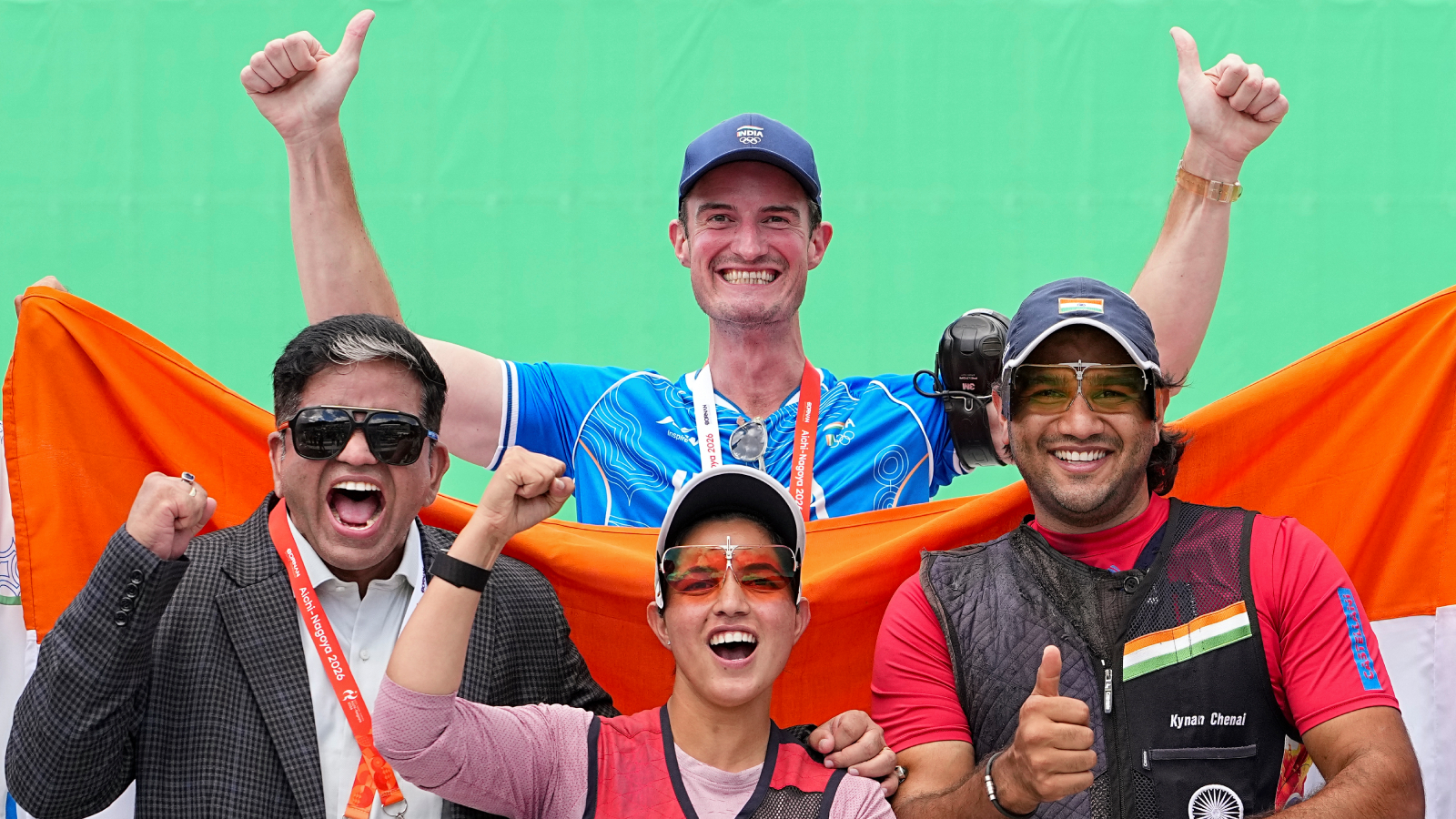
Trap coach Peter Wilson praised Neeru and Kynan for winning two gold medals. Neeru showed great talent after leaving the hospital, while Kynan stepped up in the mixed team final. Wilson said, "I am just delighted for them but I would not want anyone to get too ahead of themselves."
Excerpts :
Two gold medals in trap. How do you see that?
The campaign was great. It was a huge ask for Neeru to come out of hospital, go to Japan and shoot a handful of rounds in training followed by shooting for three days. She wins the singles title and then the mixed team title. This speaks of her talent. It was a testament of Kynan’s talent that he missed the individual final but stepped up in the mixed team final.
Any gold medal prior to the Olympics is a boost. I am just delighted for them but I would not want anyone to get too ahead of themselves. We have to win the LA Olympics quota first. I am a firm believer in competitive training as a squad. It got the best of myself. So bring on the next few months.
The technical things you worked on with Neeru and Kynan…
I made a small change to Neeru’s gun after the Lonato World Cup. Apart from that, it is more about mental and how to break a round efficiently so that she can be the best version of herself and to allow her the ability to shine. With Kynan, there were a lot of changes that were necessary to get him back to his best. We changed his barrel and gun. He actually kept the same action and stock but there were quite a lot of changes that had to be made. The aim of our team and our sports psychologist Tejaswi Karanwal was to keep them in the present and wor on one target at a time.
Italians, Americans, Britishers and Australians have dominated the Olympics scene in shotgun. How does India compare?
It’s fair to say that most countries’ performances can sort of ebb and flow. Take Great Britain prior to 2000. We had not won an Olympic medal of any colour for 32 years since Bob Braithwate ‘s gold in 1968 Mexico Olympics. Richard Faulds’s double trap gold and Ian Peel trap silver in the Sydney Olympics were a sort of relatively sustained period of such success until Nathan Hales became the Paris Olympics trap champion. In part that was due to funding and proper systems in place.I would say NRAI does a commendable job.
But I would personally like to see more shooting ranges across India. In Italy, there are ranges every 50 miles or less. To a degree, that was the case in the UK. Now sadly, the UK is losing ranges because we are a heavily populated island and shooting ranges are noisy. In India, I would say it’s not that they are closing but they are not opening. If India is serious about hosting the Olympics in future, they need to pick sports where they feel they can excel. Shooting is without a doubt one of them. To capture more talent, they have to build more facilities.
India had shooters like Rajyavardhan Rathore, Manavjit Singh Sandhu and Ronjan Sodhi. How do you see the current crop?
I see a huge amount of talent in the wider Indian squad. Not long ago, I was competing with one of the world’s best and that was Sodhi in Double Trap and Rathore towards the back end of his career. They were phenomenal athletes and competitors and I see just those attributes in the current crop of Indian shooters. It’s just down to me and the wider support team to try and get the best out of them on a daily basis. It’s about tweaking what needs to be tweaked with regards to guns, ammunition and their bodies and minds.
How do you see the path ahead?
The goal is to win the Olympics and it’s no mean feat but that is what I set my stall out to do. I was fortunate enough to have done it myself under the tutelage of Ahmad Al Maktoum and then to coach Nathan Hales for Paris. We all, including the coaches, support staff, myself, have to work incredibly hard to achieve that goal. You have to train outside your comfort zone, and too often, people, not just in India, but all over the world, choose not to. I work on the same philosophy that Ahmad Al Maktoum worked on with me. Train hard, compete easy.
Technically, what more do Indian shooters need to do?
It’s a difficult question to answer because there are so many intricacies in shooting. You are looking at different bore sizes and things like over-boring the gun, extending, forcing cones, porting–which I am big fan of and was banned by ISSF past 20cm from the end of the muzzle. Then the rub set-up, different types of beads, right back to the stock and making sure that all those little adjustments can be made to get the very best out of everyone’s weapon. It’s something I pride myself on and an area that I worked on extensively with my coach and 2004 Olympic double trap champion Ahmad Al Maktoum. I am talking about the weapon and combining it with the right ammunition so that you give yourself the best chance of hitting the next clay.