
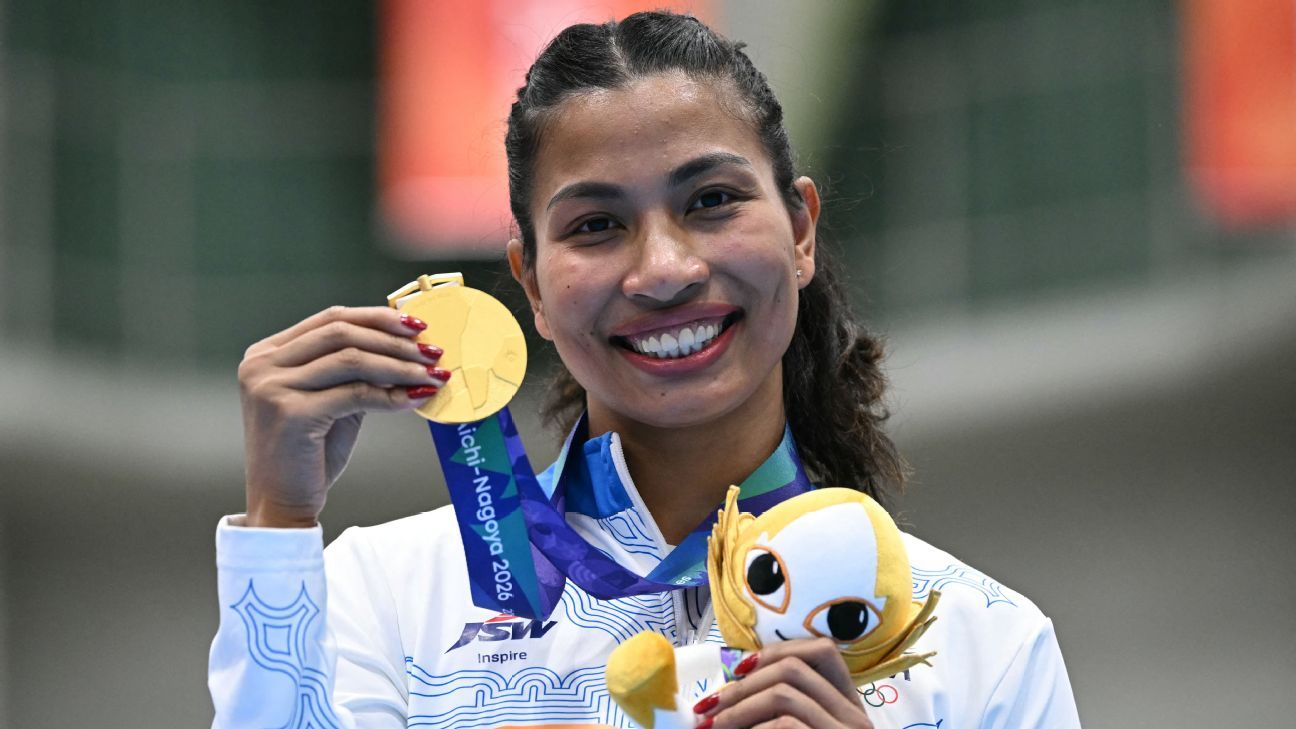
India won three boxing gold medals in six hours on October 2nd at the Asian Games in Aichi-Nagoya. Lovlina Borgohain, Parveen Hooda, and Ankush Panghal secured these historic wins. Lovlina said, "I don't know how to celebrate my gold. It has just ended. I need some time to accept that."
Going into the Asian Games in Aichi-Nagoya, India had won just nine boxing gold medals across 16 editions, all the way back to 1958 when an Indian boxer first took to the ring.
In the span of six hours on October 2nd, the birth anniversary of perhaps India's most famous proponent of non-violence, three Indians were a blur of controlled violence as they increased India's boxing gold medal tally by 33%.
Lovlina Borgohain. Parveen Hooda. Ankush Panghal. Names that perhaps signal a new dawn for Indian boxing.
ASIAN GAMES MEDAL TALLY | INDIA AT ASIAN GAMES 2026 | KEY DATES AT ASIAN GAMES 2026 | INDIA'S LIVE MEDAL TRACKER
Why? Because the Asian Games has always been a reality check. The multi-sports cycle has always seen Indian boxers obliterate the field at the Commonwealth Games, before crashing down to earth at the Asiad a few months later. India earned three gold, a silver and three bronze at the 2022 CWG - but only managed a silver and three bronze at the Hangzhou Asiad.
A similar drop was expected here - the addition of Uzbek and Kazakh boxers to the field meant that the seven gold and three silver medal haul at the 2026 CWG wasn't given its due.
And yet, the contingent was quietly confident. Santiago Nieva, back in charge of the women's boxing team after a while, claimed it was the best pool of boxers he had ever seen. Chief amongst his goals? Emulating MC Mary Kom.
The boxing legend remained the only Indian woman to win Asian Games gold - despite the rise (and fall) of multiple world champions such as Nikhat Zareen. Lovlina Borgohain ended that 12-year-wait today, and like London buses, another one came along soon after in the form of Parveen Hooda.
Even within the Indian boxing fraternity, the duo were not favourites to win gold. A medal, sure. Gold? No chance. So much so that Lovlina had no idea how to celebrate her gold after winning her final against China's Bao Ziyi, saying "I don't know how to celebrate my gold. It has just ended. I need some time to accept that I have won. I am feeling very good."
Now effectively a veteran of Indian boxing, Lovlina had wanted to lay down her gloves after the disappointment of the Paris Olympics. ""It was a tough year for me. (Earlier) I wanted to quit boxing. But I continued. I had to change the colour of my medal (at the Asian Games). It was very important. More important than that is that I continued (to play).
"There are a lot of things in an athlete's life: losses, injuries. You have to handle a lot of things. This gold medal was very important to me."
For all her perceived flaws, there is one thing no other Indian boxer can claim to be better at than Lovlina. Her tactical brilliance. It was clever to move up weight categories, to be part of a bracket where just a couple of victories (sometimes fewer) can win you a medal. That she reached the final was incredible, a narrow, split decision victory over reigning world champion Natalya Bogdanova was Lovlina at the tactical best - keeping her distance and counter-punching with her reach.
Bao Ziyi in the final may not have held the weight in Lovlina's mind that Li Qian did, but the flag on her jersey certainly did. However much as Nieva would deny it, Chinese boxers have the mental upper hand over Indians, but for once, Lovlina ignored reputations and used Nieva's advice about the Chinese boxers' lack of control.
Baiting Ziyi into the punch, Lovlina stood off and pounced when it mattered, as she romped to a 5-0 victory in the final - ending that 12-year-wait for a women's boxing gold. For all the criticism she's received, Lovlina can lay a very valid claim to be India's greatest boxer - a world champion, an Olympic bronze medallist, a CWG silver and now an Asian Games gold. Other Indian boxers may have had a higher peak, but Lovlina's consistency remains unbeatable (MC Mary Kom's misfortune with not being part of an Olympic category during her peak notwithstanding).
Not many would place Parveen Hooda in the same category as Lovlina and Mary Kom either, but it speaks volumes about her levels of resolve that she's an Asian Games gold medallist.
Back in 2022, Parveen was the next big thing, having won gold in the Asian Championships and bronze at the World Championships. A bronze at the Hangzhou Asian Games felt like the start of something big, but it all fell apart. She lost that medal after three whereabouts failures resulted in a 22-month doping suspension.
The hard work of overcoming cultural resistance, financial struggles and poor diets in her youth to get to the peak of boxing... it had all come to nothing. Parveen had to start from scratch again, and stumbled in her first major event back - the only female boxer to return without a medal from the 2026 CWG in Glasgow.
Facing up to a tougher field, Parveen didn't even get the benefit of an easy draw. 2025 Worlds silver medallist and 2022 Asian champion, Navbakhor Khamidova awaited her in the quarterfinal, but Parveen breezed past her 5-0 with a brilliant display. Li Shu, who had just beaten reigning world champion Aida Abikeyeva to cement her status as a rising star of Chinese boxing was brushed aside 5-0 as well.
In her final, Parveen faced up to a survivor as well, perhaps bigger than her. A world champion in 2018, Chen Nien-Chen of Chinese Taipei had recovered from cancer in 2019, to win the Asian championship in 2022, the bronze in the Hangzhou Asian, Paris Olympics and the 2025 Worlds. The final was perhaps the most evenly fought in Aichi-Nagoya, but Parveen retained her counter-punching prowess to take a split-decision victory - the gold completing her redemption.
Nieva's chief goal was complete. India's female boxers had finally lived up to their billing and won gold, made all the more special by coming from unexpected quarters.
That wasn't the case for Ankush Panghal, as he sealed his burgeoning reputation with a dominant gold at the 2026 Commonwealth Games. Tipped as a future Olympic medallist, Ankush was perhaps the most complete male boxer to emerge from India's talent pool. After just one bronze from India's male boxing contingent in Hangzhou, Ankush needed to deliver.
Deliver he did - Nekruz Salimov and Hamsa Vogel were no contest as Ankush made his way to the semifinal. This however, was surely where his journey would end - up against world champion Fazliddin Erkinboev of Uzbekistan. Ankush's speed in the ring meant he rarely got touched by the opposition across both games, but Erkinboev was a different class of opponent. The Uzbek connected hard, early - usually when Indian boxers come apart in the ring, but not Ankush.
Relying on his speed and counter-punching, Ankush played it to perfection, as Erkinboev fell to a 1-4 defeat. The world champion vanquished, Kim Minseong's status as a World's bronze medallist held no fear for Ankush as he breezed to a 4-0 win in the final, making it three gold medals from three finals for India.
The first man since Amit Panghal in 2018 to win gold, and you wouldn't bet against Ankush going far at the Worlds or Olympics either.
Given the barriers broken at this Asiad, one wouldn't put it past his fellow boxers either to build on from India's best-ever showing in boxing at the Asian Games. Six hours, three gold, and countless new Olympic dreams spawned - this could be where it all began.