
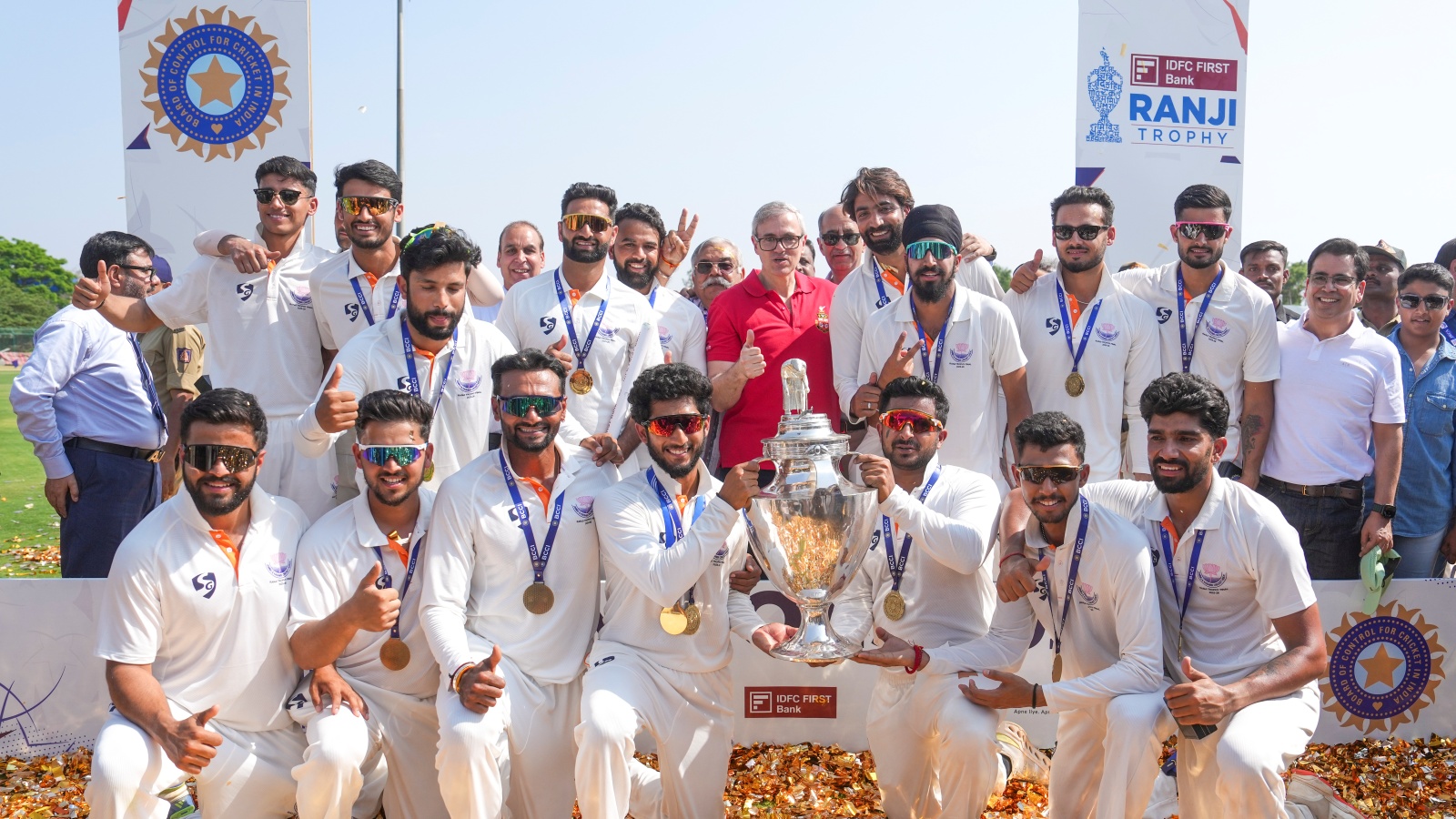
The Ranji Trophy season starting on Sunday aims to find the next generation of international players. Selectors are searching for a technically robust number three batsman to replace legends like Rahul Dravid. They are watching young talents like Shikhar Mohan and Ayush Doseja to build a strong future core group.
There are seasons when the Ranji Trophy plays out like a background score, an ambient hum to a busy season, quietly developing the next generation of international players. There are seasons when its tunes become louder and sharper, when the selectors scramble across the quiet locales, eyes probing for sparks, hands hastily jotting down the names that could shape the future and fix the present.
The season that unfolds on Sunday serves the twin purpose more urgently than in recent times -- of solving the immediate puzzles and assembling the long-term nucleus in a tedious transition phase, streamlining the needs and priorities, filling the cracks and laying the foundations. Half the eye would be on the tour to New Zealand and the Border Gavaskar Trophy; the other half would be on rebuilding a core group that could challenge for the next WTC cycle and beyond.
The void of the mini fab three (Virat Kohli, Cheteshwar Pujara, and Ajinkya Rahane) and Ravi Ashwin still suffocates.
To a considerable degree, Shubman Gill has raised his level and covered up for Kohli, although sterner tests, harsher decks and more deceitful bowlers await him. But India have not yet sketched in the successors of Pujara and Rahane. Devdutt Padikkal displayed the dynamic stroke-play of a postmodern No.3 in Sri Lanka; Sai Sudharsan exhibited the old-fashioned stonewaller's gutsiness in England, but with technical cracks in his game.
The selectors would ideally want a less flamboyant No.3 than Padikkal but a more technically robust one-down batsman than Sudharsan. Someone in the Rahul Dravid or Cheteshwar Pujara mould, who could wear down bowling firms for the more attacking-inclined batsmen to flourish around them. It's a traditional concept, but the values are still valued fondly in red-ball cricket. Sadly, there are not many of the tribe around, but selectors would look for habits and traits rather than the spot they turn up for the domestic side.
Like Vidarbha Danish Malewar, who largely batted in the middle order last season, but occupied the top-order in their previous, title-winning season. Jharkhand's Shikhar Mohan keeps filing remainders of his sturdiness, albeit the selectors would assess him for one more season before jetting him to the India A side or subsequently the national side. As it would be for Delhi's Ayush Doseja, a fluent stroke-maker with the grit to blunt an attack, but only a season into domestic cricket.
More ripened batsmen exist in Yash Rathod, Ravichandran Smaran, Sudip Kumar Gharami and Sanat Sangwan, those malleable enough to bat anywhere in the order, specially as a specialist No.5. Somewhere in the scheme, if Dhruv Jurel and Sarfaraz Khan, or both, fail to fulfil their promise, some of the names could fulfil their Test dreams.
It's a good time to be a batsman in the domestic grind; the runs are less likely to go wasted or unnoticed, as the national team is in flux, with only a handful of certainties in the top six. An injury, a prolonged dry streak, and the gaze will waver to the domestic field.
Pace talent
It's even better to be a seamer. The stock of those that can clock 140kph or upwards has diminished so rapidly that anyone that could complete the pace-criterion zooms immediately into the selector's consciousness. The paths of Gurnoor Brar, Harshit Rana and Anshul Kambhoj testify the team management's distress to bolster seam-bowling depth, although most of them are portraits in progress, still relatively raw to first-class cricket and callow.
A glimpse of last edition's wicket-taking pile will furnish the answers for selectors' expediting bowlers on promise rather than performance. Auqib Nabi helms the list; he cannily swings the ball both ways, but qualifies to be a medium pacer even at his quickest. The next seamer -- past four spinners, of which three are left-arm tweakers -- on the chart is Mohammed Shami, thrust into a cruel wilderness. The onslaught of left-arm spinners continues before the browser stops on Vidarbha's Nachiket Bhute, a military medium pacer placed 15th. It's only expected that spinners would feature prominently in the list, but not as disproportionately.
Contrast the drought to a not-too-distant time when Delhi quick Navdeep Saini couldn't barge into the national side; Mohammed Siraj ploughed through seven first-class season before winning the Test stripes; Umesh Yadav appearance depended on injuries or breathers for the frontline trifecta of Jasprit Bumrah, Mohammed Shami and Ishant Sharma; Shardul Thakur stocks skyrocketed only after improved batting utility. Discernible eyes would hover on the likes of Tamil Nadu pace-pair D Deepesh and Gurjanpreet Singh, Vidarbha's Yash Thakur and Delhi's Mayank Yadav. All are in varying developmental stages of their career, but are on high priority given the paucity of Test-ready options. Closely monitored too would be the red-ball prowess of Vaibhav Sooryavanshi.
Spinner watch
The aforementioned bowlers' table also depicts the inequitable supply versus demand equation of spinners. Left-arm spinners are abundant, but not so much the other genres. Six left-arm spinners comprise the top 10. Temporarily, India have Saransh Jain and Washington Sunday trying to populate Ravichandran Ashwin's super-sized vacuum. Manav Suthar has exerted himself as Ravi Jadeja's worthy inheritor. But the pool is shallow, compared to yesteryears where Jayant Yadav barely found a chance despite a Test hundred. Or when Kuldeep Yadav's appearances were as intermittent as a spell of thunderstorm in Sahara. Or when Jalaj Saxena barely inhabited the selectors' consciousness. The depth would be put into test immediately in the Australia series. Two teenagers would be keenly watched -- Tamil Nadu's J Hemchudeshan and Punjab's Anmoljeet Singh.
Some surprises are inevitable, like a left-field entry, or a long-discarded veteran finding himself back in favour (Mohammed Shami perhaps), the blossoming of an irresistible wunderkind, but the pervading theme would be striking a balance between the present and future, an eye on BGT, and the other on the next WTC cycle. And it promises to be a domestic season of loud music.