
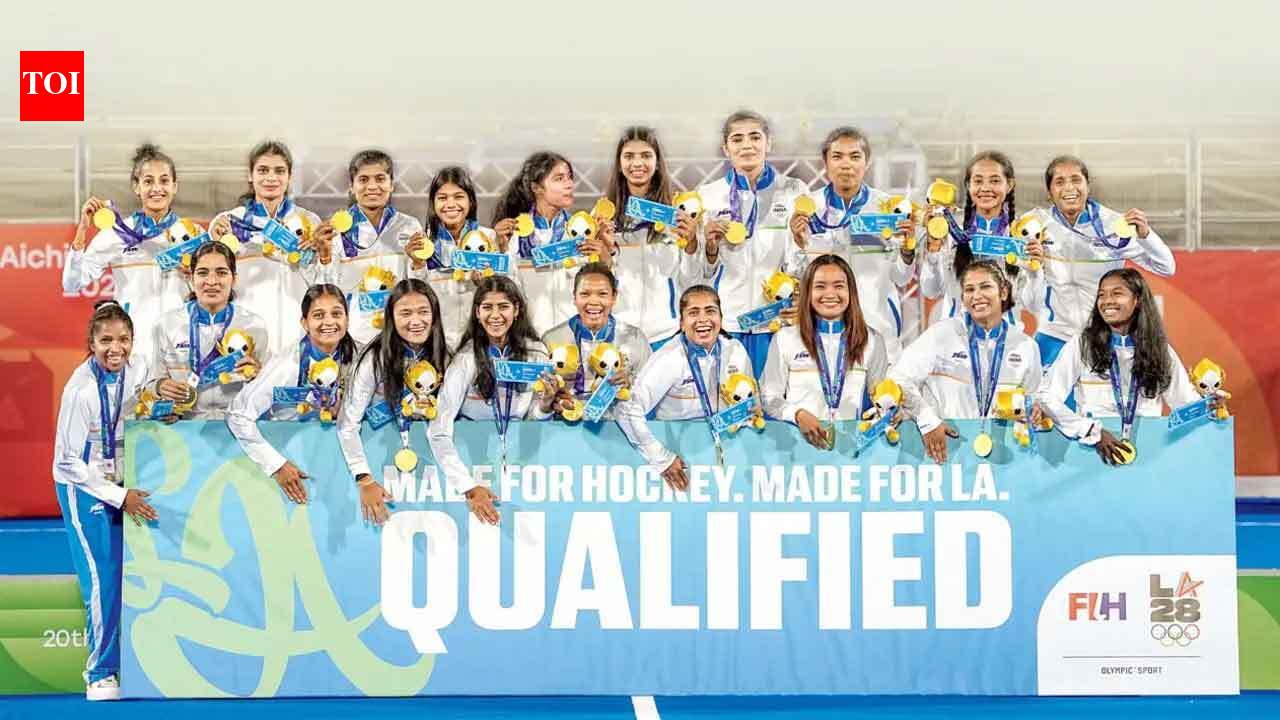
The Indian women’s hockey team’s Asian Games gold medal after a 44-year wait has rekindled belief at the grassroots. Former captain Pritam Siwach said, “This victory has given women’s hockey a new lease of life. It is like giving water to a thirsty person.” This success inspires many young girls.
Image credit: Hockey India
KOLKATA: The Indian women’s hockey team’s Asian Games gold medal after a 44-year wait has done more than secure direct qualification for the Olympics. According to coaches who have nurtured generations of players across the country, the triumph has rekindled belief at the grassroots, and is destined to inspire a new generation of girls to take up the sport while validating decades of hard work in academies and training centres, far from the spotlight. Former India captain Pritam Siwach, who has been working as a coach for more than 25 years in Sonipat, Haryana, believes the impact of the victory extends well beyond the podium. “This victory has given women’s hockey a new lease of life. It is like giving water to a thirsty person. Winning gold after 44 years has ended a long drought and brought renewed energy to the sport,” she said, adding that the success has given women’s hockey the recognition it deserves after years of operating in the shadow of the men’s game. For coaches working at the grassroots level, the medal has become a powerful tool. Dasrath Mahato, the 69-year-old from Khunti in Jharkhand who discovered and mentored Nikki Pradhan, said every major success creates a ripple effect among young athletes. “When children see players returning home with medals, they start to believe they can do the same. It inspires them to work harder and pursue hockey seriously,” Mahato said. The success has also been celebrated by coaches who have worked in some of the country’s leading hockey centres. Madhya Pradesh Hockey Academy coach Vandana says achievements at the elite level invariably strengthen the grassroots ecosystem. “When a sport performs well at the top level, it benefits the grassroots. We are already seeing more academies and leagues being established for women, and success like this will only accelerate that growth,” said Vandana, who trained the likes of Sushila Chanu and Bichu Devi Kharibam. Former India goalkeeper and coach Edgar Mascarenhas, who worked extensively in Odisha, described the achievement as one of the biggest milestones in the history of Indian women’s hockey. “I watched every match and what impressed me most was their fighting spirit. Even in difficult situations, they never gave up,” said Mascarenhas. The direct Olympic qualification has also been highlighted as one of the competition’s biggest outcomes. Coaches unanimously agreed that avoiding the pressure of an additional qualification campaign allows the team to focus entirely on preparation for the Games. “This may actually be even more important than the gold medal itself,” said Siwach. “Now the players know they are going to the Olympics and can devote all their energy towards preparing for that challenge.” The impact has been felt in regions that have emerged as strong contributors to Indian women’s hockey. In Mizoram, where coach Miss Btei helped nurture internationals Lalremsiami and Lalthantluangi, interest in the sport continues to grow among young children. “The success of players from our state will encourage more youngsters to take up hockey. Children see what Lalremsiami has achieved and begin to believe they can follow the same path,” she said.
Join conversation
Share your thoughts in the comments
Be respectful · TOI community guidelines
According to Btei, players as young as nine or ten years old, are now entering the development pathway with the latest generation already benefiting from the visibility created by the national team’s success. For former India international and coach Ajit Lakra, the gold medal represents proof that India’s grassroots structures are delivering results. “These players came through the grassroots system and delivered a gold-medal performance that resonated across Asia. It shows young athletes that there is a pathway from the grassroots level to the international stage,” said Lakra, who coached Rutuja Dadaso Pisal. While they welcomed the growing number of opportunities for women, the coaches stressed the importance of greater investment in infrastructure, academies and player development programmes to sustain the momentum. Yet the overriding sentiment remains one of optimism. Whether in hockey strongholds like Jharkhand and Odisha, established academies in Madhya Pradesh or emerging centres like Mizoram, coaches see the medal as a catalyst for growth.