
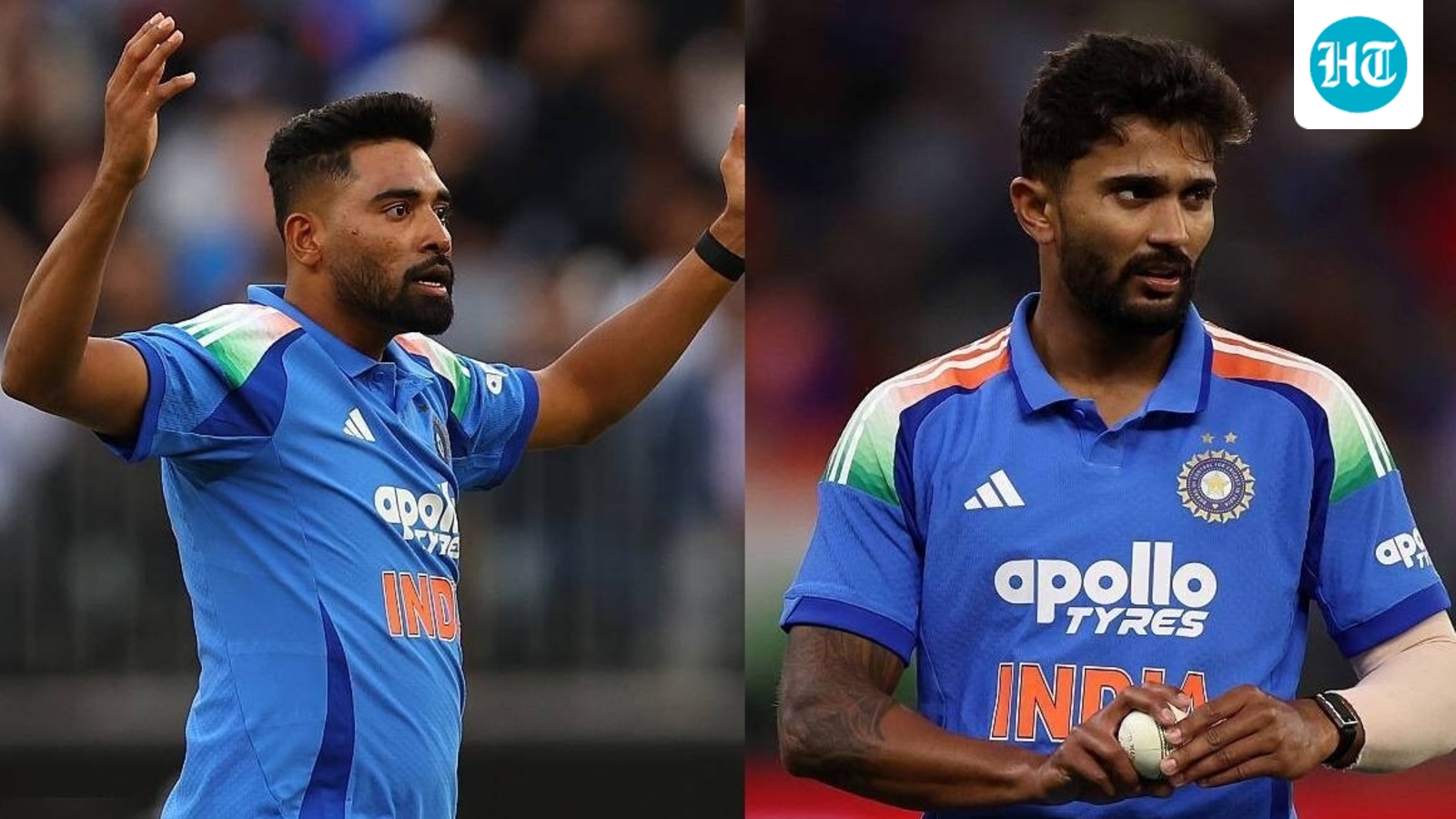
India’s cricket team faces a pace bowling muddle ahead of next year’s ODI World Cup. With preparations starting in New Zealand on November 4, leaders Shubman Gill and Gautam Gambhir must find a stable combination. India used ten fast bowlers in 11 ODIs this year, but lack of clarity remains.
Cricket’s biggest quadrennial extravaganza, the 50-over men’s World Cup, is a little more than a year away, with India desperate to end a wait since 2011 to add a third trophy to their burgeoning cabinet. The final leg of preparations will kick off in New Zealand from November 4, in the first of five One-Day Internationals, with so much work ahead of the leadership group of Shubman Gill and Gautam Gambhir when it comes to sifting through the pace options and arriving at a settled, stable combination.
India have played 11 ODIs this calendar year, winning seven and losing four, where they have used as many as ten fast bowlers/medium-pacers, and have been denied the certain use of an 11th because Hardik Pandya has remained steadfastly unavailable for selection. The old adage of strength in numbers doesn’t quite hold good in this instance. While the think-tank might harp on trying out options and arriving at the optimal group to lead India’s charge in the Africas, it is undeniable that there is some cause for concern as the home stretch of the preparatory phase beckons.
Too many options, too little clarity
In these 11 games, India have handed out debuts to Gurnoor Brar, Prince Yadav and Auqib Nabi, with mixed results. Alright, so Nabi is only one match young and ran into a tartar in a marauding West Indian batting group on a shirtfront in Guwahati on Wednesday, going for 84 in 8.5 wicketless overs in his maiden appearance. But there is a feeling that India are embarking on too much experimentation without allowing players to settle into their roles.
One of the reasons for this large number of faster bowlers figuring in the XIs over the last nine months is the constant threat of injury that hasn’t merely laid Pandya low, but restricted Harshit Rana’s appearances to just three – in January – and kept spearhead Jasprit Bumrah and all-rounder Nitish Kumar Reddy out for long periods. Gill and Gambhir, and Ajit Agarkar, the chairman of selectors during this tumultuous phase, might place the reason for casting the net far and wide at the very altar of being prepared for every eventuality. But what purpose the lack of role clarity and the opportunity to grow into one’s responsibility serves is open to question.
Siraj's curious case exposed the problem
Take Mohammed Siraj, for example. He is in the squad for the West Indies series but is yet to get a game. Does it mean Siraj is a shoo-in because he is experienced enough to slot right back in whenever he is required to do so, or is he surplus to requirement and merely present as an unavoidable back-up if one of the other fast bowlers is injured? Siraj’s lack of preparedness was one of the talking points during India’s Test series in Sri Lanka in August, and he didn’t have a great Duleep Trophy final either. How will he get better by merely bowling in the nets and ferrying drinks? Is he going to go the Mohammed Shami way, right now out of favour but soon to be out of sight?
All other things being equal, India’s preferred pace options in the World Cup squad – we are talking just specialists – ought to be Bumrah, Prasidh Krishna, Arshdeep Singh and possibly Brar or Harshit Rana. The challenge for both the team management and the support staff attached to the Indian team is to ensure that this quintet is fit and firing on all cylinders by October next year. Along with that onerous task, they must make sure that Pandya and Nitish, who both provide great balance and depth in batting, are also in the fray because when both, and especially the former, is available, it makes a world of difference to India’s fortunes.
Time to identify the core and let them play
The squad for New Zealand is yet to be announced and it remains to be seen who the chosen ones are, because one should assume that these are the faster bowlers who are in with a genuine shot at making the cut. It appears as if Pandya will miss the bus again after picking up a new, unrelated injury in the last few days while the jury will contemplate on managing Bumrah’s workload and in any case, the champion quick is hardly the biggest cause for concern so long as he is fit. India’s experiment with Prince Yadav seems to have come to a shuddering halt and one isn’t sure how much of a rope Nabi will get.
Around all this, Arshdeep Singh and Shivam Dube – not quite in the Pandya/Dube mould but an all-rounder in T20Is, without a doubt – are at the Asian Games trying to defend India’s gold medal. The overlapping of the Asian Games cricket competition with the West Indies ODIs is an inevitable fallout of the packed calendar that confronts the Indian side. But once the New Zealand series starts, all the focus must be trained on getting the fast-bowling unit to play together for as many games as possible so that they are all in sync and operating as a group by the time the World Cup comes around.
Prasidh (9 matches) and Brar (8) have been the near-constants in 2026. As India gear up for the mega event, it is imperative that the preferred choices stack up more competitive overs under the belt simultaneously, which means the core fast-bowling group must be identified and persisted with, without delay.