
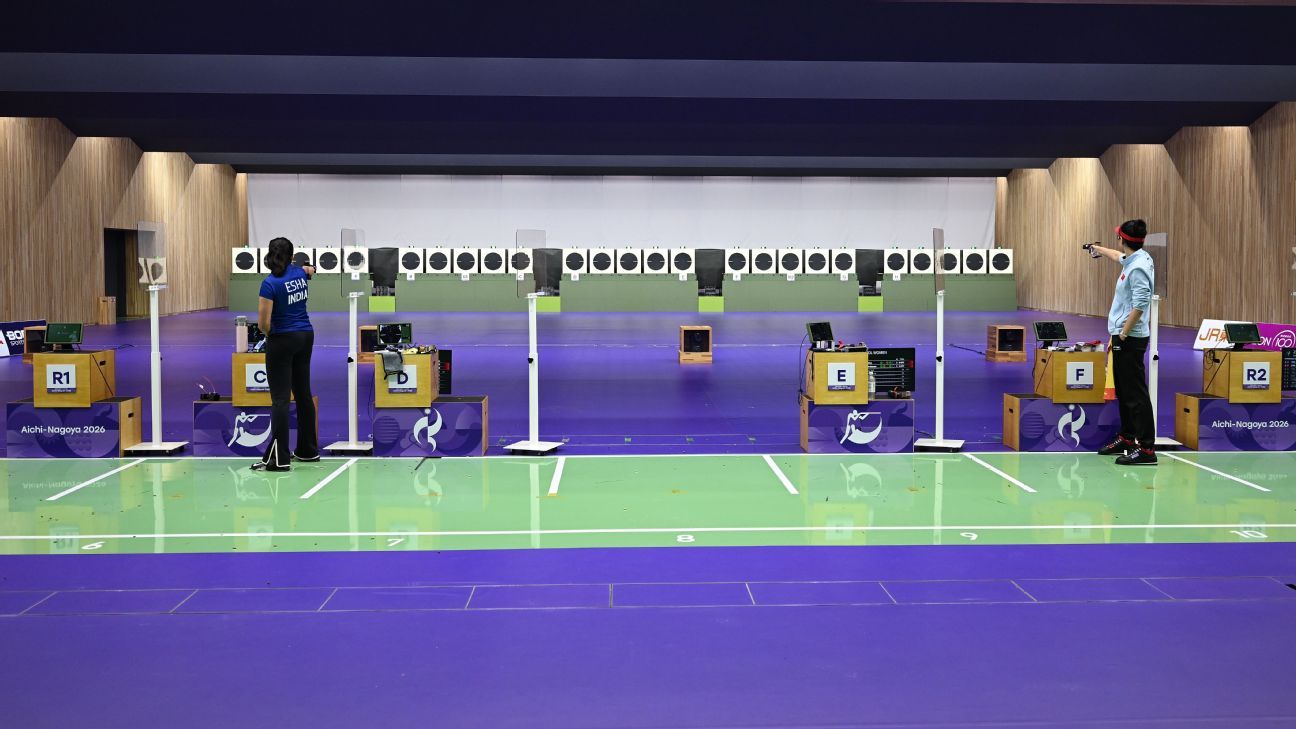
India finished the 2026 Asian Games shooting campaign with 15 medals, including three gold, eight silver, and four bronze. This result showed a 57% drop in gold medals compared to the 2023 Hangzhou edition. Many shooters failed to fire in the finals, leading to a shadow of India's usual standard.
India's shooting campaign at the 2026 Asian Games came to an end with what can only be described as an underperformance.
It started with a bang and ended with... not quite a whimper, but definitely a shadow of the standard that India had let set up last time and squad's potential. India finished second on the shooting medal tally once again, behind -- you guessed it -- China.
India won a total of 15 medals, of which only three were gold, eight silver and four bronze. Of these, seven were team medals, five individual and three in mixed team events.
The golds medals came in one individual and two mixed team: Neeru Dhanda in women's trap, Neeru and Kynan Chenai in mixed trap and Suruchi Phogat and Kamaljeet in mixed 10m air pistol. That's two in shotgun, one is pistol and none in rifle.
ASIAN GAMES MEDAL TALLY | INDIA AT ASIAN GAMES 2026 | KEY DATES AT ASIAN GAMES 2026 | INDIA'S LIVE MEDAL TRACKER
A return of only three gold medals from a sport as successful as shooting is average at best. Shooting is typically India's best-performing sports at the Asian Games, accounting for a bulk of medals because of it's many disciplines and India's pedigree. In the last edition, it was India's most successful sport per gold medals, and likely will be this time as well. So, how do we read into this performance and how does this measure against past precedents? Here's what the numbers say:
In 2026, India won a total of 15 medals: three gold, eight silver, four bronze. Now this can't be compared to China's haul of 27, even though India were second only to them. But it can be compared to India's haul from last edition in Hangzhou in 2023 where Indian won a total of 22 medals: seven gold, nine silver, six bronze. In 2018 and 2014, there were no team medals so the numbers look fewer, but there were nine medals in both editions, with two and one gold.
Prima facie, India's 2026 shooting campaign had a 31% dip in total medal tally and 57% drop in gold haul. But this number is not as straightforward as shooters failed to fire in the finals. A closer look suggests that the drop is not just in number of medals, but more crucially a collective dip from India's shooters.
One of the starkest figures to highlight for India is the difference between the number of team and individual gold medals across the last two editions.
A team medal in shooting is not won in competition, but in qualification which everyone takes part in. The qualification scores of a country's three shooters are added together for the medals. Hence, team medals are indicative of the collective strength of a contingent.
In 2022, India won a total of five team gold medals, which formed the bulk of the gold haul. This aligns with Indian shooting's biggest strength -- consistent numbers, both in scores and shooters who achieve them. For instance, an average of 580 is expected in pistol and rifle qualification because that's the average in India's national trials.
In 2026, India did not win a single team gold; there were five silver medals and two bronzes. The seven team medals were the same as the last time but the lack of team golds directly correlate to poorer performance in qualification from Indian shooters. From having all three shooters in contention last time, there were instances this time where they barely made it to the final eight.
Now Indian shooters reached the finals of all but one event - the men's 10m air pistol - even if there weren't medals in all. There were also four fourth place finishes in finals, which is as narrow a miss as it can be this year.
But the lack of team golds -- as maligned as the way they are "won" is -- indicates that the collective dipped in 2026. (Note: There were no team medals awarded in 2018 and 2014)
However, there's an optical illusion of sorts at work here as the other side of this number shows a slightly different picture. Last Asiad, there were only two individual gold medallists -- Palak Gulia in women's 10m air pistol and Sift Kaur Samra in women's 50m rifle 3 positions. This time, there are three if you count the mixed team champions.
That is a definite improvement when it comes down to hard tacks. Three Asian champions, two of them -- Neeru and Suruchi-Kamaljeet dominating their finals.
The highlight of India's shooting campaign will be Neeru, who obliterated all hitherto ideas about Indian and women in shotgun. She became the first Indian woman to win any individual shotgun medal at the Asian Games and made it a gold with a sensational performance leading throughout the three days of trap shooting. On the fourth day, she came and won the mixed team gold with veteran Kynan Chenai, adding to her women's team silver to make it three medals in two events. Coach Peter Wilson seems to have made an instant impact on trap. Skeet also had a mixed team bronze medal to highlight Indian shotgun's big run at Aichi-Nagoya.
Neeru, also the first Indian woman to win a trap gold at the Asian Championship and ISSF World Cup, broke the idea that Indians didn't do as well in shotgun disciplines as rifle/pistol and, she hopes, barriers for other women shotgun shooters in India.
Also breaking barriers, if a different kind, was Elavenil Valarivan, who finally had her big-stage redemption with a silver in women's 10m air rifle after years of misses and doubts in major events. On the other hand, Himanshu Dhillon men's 10m air rifle silver on debut was a reminder of Indian shooting's depth and that the NRAI's stringent selection policy has often enabled youngsters to cause upsets. In the only double podium for India at this Games, Rudrankksh Patil won bronze to have his own redemption arc after missing on the Paris Olympics.
The most brutal and brilliant individual medal was Esha Singh, delivering a silver in 25m pistol and missing gold by one point, a nerve-wracking thriller of a final where she channelled the disappointment of missing on the 10m pistol and team medal as well as pressure of not letting down her superb run of form into shoot-off studded silver.
The pistol mixed team gold had cinematic storyline as well. Suruchi, the teen prodigy who fluffed her individual event but regrouped and returned to lead from pole to flag, along with Kamaljeet, a last-minute choice from a 50m pistol background who stepped up in the final to salvage the 10m air pistol campaign.
The biggest disappointment though will be the blank in 10m air pistol -- the discipline that won two Olympics medals just two years back. Double-Olympic medallists Manu Bhaker had a dismal run while questions were asked of the rookie men's team selection that missed out on the final.
There are no easy answers here, but fact remains that it's not as simplistic as blaming the selection policy. The same emphasis on recent numbers over proven names created former Asian champions like Saurabh Chuadhary, Palak and Sift and world champions like Rudrankksh and Samrat Rana. The hit or miss form at these major multi-sport events is as much on the shooter, as on the policy. However, there is some introspection to be done on the magnitude and intensity of the rigorous selection trials, which while empowering shooting prodigies on the international tour, doesn't always sustain them. With two years to the next Olympics, the answers have to be found.
Overall, India's shooting campaign at the Aichi-Nagoya Asian Games had its moments, but there were more misses than hits this time around.