
Brazil is in India for a football match at Salt Lake Stadium. The All India Football Federation spent about Rs 40 Crores to bring the team here. While ticket sales are slow, officials hope fans will fill the stands soon. Many influencers and politicians will attend the big event.
India vs Brazil. Football. The Salt Lake Stadium. That's a combination of words that should evoke something deep within an Indian football fan, stir up the soul. It's Brazil, and they're in India. Just... 'wow'
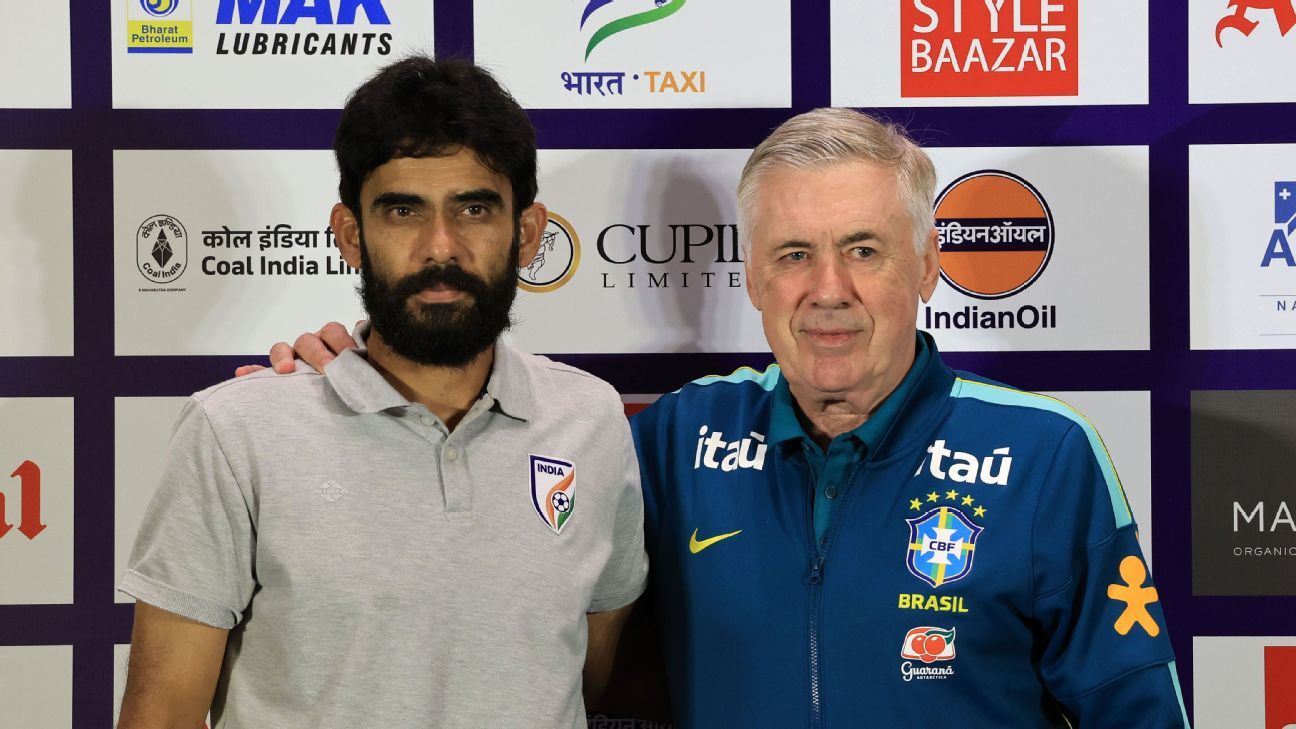
Everything official around it adds to the 'wow' factor. There's the press conference with Carlo Ancelotti and Marquinhos, names that need no introduction to even the most casual fans of the sport. There's the training session where Brazil's A-listers rondo-it around and the sidelines are packed to the rafters (like the PC was) with journalists and influencers and officials. Brazil's security adds to an already teeming security force at the stadium. There's more of that at the JW Marriott where Brazil are staying because the West Bengal Chief Minister is hosting a state dinner there (It's there because Brazil don't want to move out of the hotel, and Brazil are Brazil on and off the pitch, and they get what they want). India vs Brazil. It's happening. It's big.
Of course it's big. That's got nothing to do with the All India Football Federation, who have spent ~Rs 40 Crores on just getting Brazil here and about double that in arranging the matches between them, Uruguay and Panama. They'll recoup about half of that in sponsorships and ticket sales but we're not here to talk about the finances, not directly... after all Brazil are in town! Even if ticket sales are flagging now (the Federation has had to put up offers of buy one get one to encourage a full house after initially pricing the tickets quite high), there's always the possibility it will pick up. Sure, all of Kolkata and West Bengal is saving up for Durga Puja, but there will be people willing to shell out fortunes for their one chance to watch their favourite team and players play without having to take a visa, or even a flight.
Sure, as this writer walked to the stadium to watch that Brazil training session, the only 'fan' visible was a young man on a scooter, in a Neymar shirt, zooming past the stadium with a curious look on his face -- at the stadium and at the hotel, either by (security) design or otherwise, there are few, if any, fans to be found -- but when the match dawns, the officials and the politicians and the influencers will get their photoshoots and their reels and their 'wow' moments and maybe even a full stadium. Crowd pleasers rarely come more obvious than Brazil. From 7.30 to 9.30 on Saturday, India -- a team that failed to qualify for the coming Asian Cup -- may even give Brazil the "entertaining game" Ancelotti hoped it would be.
Then what?
Once the final whistle blows and Brazil go through their high-speed dedicated corridor of stadium-hotel-airport and take off, and Uruguay (hardly a ripple in this Brazil-sized wave) are seen off, what happens to Indian football?
You could scream at the screen you're reading this on and say, 'hey, don't underestimate how much seeing Brazil play live will inspire the next generation,' but I'd merely retort: inspire them to do what? Take up the game and...? As this is being written, none of the four tiers of men's football in this country have started up, nor have the two tiers of the women's game (yes, start dates have been announced, but we're already in October here and a ball hasn't been kicked yet). Every season, we seem to go through the drama of 'when will *insert league of your choice* start?' 'Will it start?' 'Where can we watch it?'
Now, the reported 90 crore outlay for this fortnight seats neatly alongside the audited expenditure of AIFF in 2024/25 (latest published reports) where they'd spent ~75 crores through the whole financial year. If you're wondering how well 2024/25 went in Indian football, fret not, we've got you covered (spoiler, the headline reads: "2024/25 season leaves big questions about the future of Indian Football")
The conduct of the IWL was particularly egregious and has remained it - just last season, the league saw four matches a day, with two simultaneous weekday kickoffs at 9 am and 3 pm each in the heat of Kolkata, before moving to 3 pm and 7.30 pm kickoffs. That same season, the Indian Super League, India's top tier of men's football, was delayed by almost half a year and kicked off in February 2026. The second division, rebranded to the Indian football league, kicked off a fortnight later, the third division a month and a half after the ISL started. From the top of the pyramid to the grassroots around its foundation, chaos reigns supreme.
Oh, and if the mere presence of a world-class team or player could have improved Indian football exponentially, why didn't it when a series of big teams visited Kolkata in the 70s and the 80s, when Oliver Kahn and Bayern Munich played here in 2008, when Lionel Messi himself played at the Salt Lake in 2011 as Argentina played Venezuela. Are we expecting Rayan to do what 2011-vintage Leo Messi couldn't?
So, the question remains. What now? If Indian football continues along on its current path -- where Hong Kong and Singapore and Bangladesh are unbeatable foes -- when will we see a Brazil or an Argentina or a France play the national team again? Maybe when another AIFF president wants the popular vote for reelection or another newly installed Chief Minister wants a photoshoot or two with superstars who are so popular within their voting base, eh?
Until then, let's sit back and enjoy the circus. The fun bits of it won't be in town for long.