
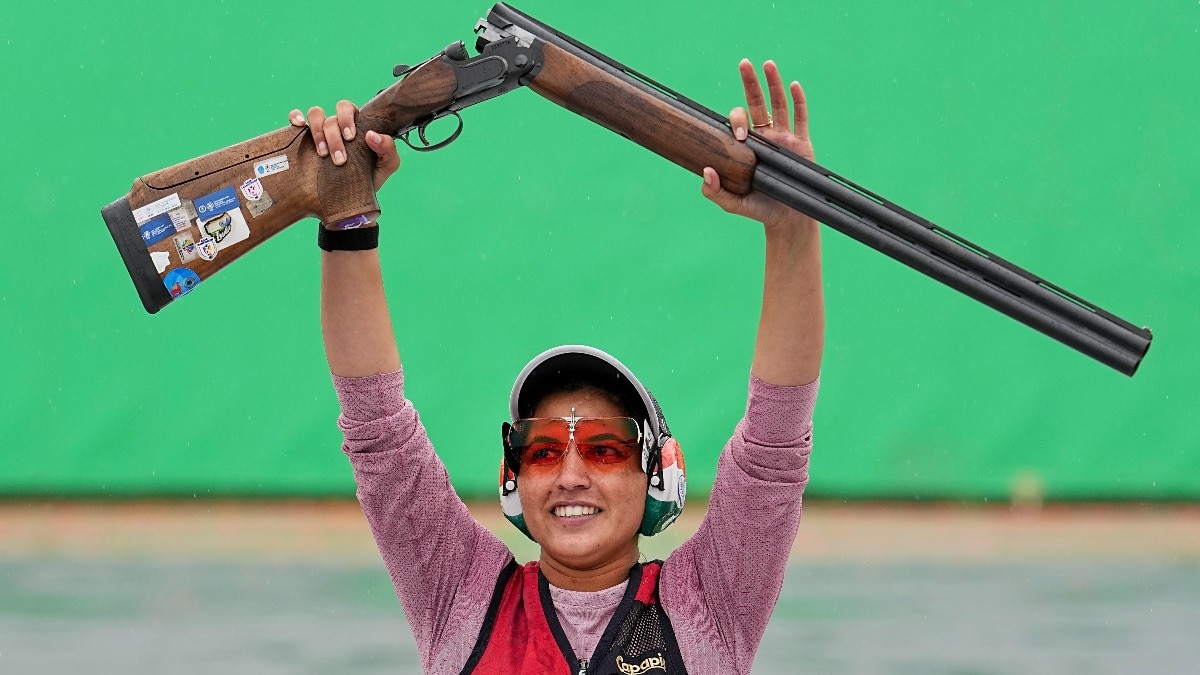
Neeru Dhanda won two gold medals at the Asian Games this week. The 26-year-old shooter from a BPL family started her journey using a borrowed double-barrel shotgun to hit tin cans. An official said, "Neeru Dhanda's journey from a humble background to the ranks of India's top shooters is a testament."
When Neeru Dhanda's mother learnt that her daughter had won her first gold medal at the Asian Games, she was not watching the competition on TV or keeping tabs on a smartphone. She doesn't have any of the two. Dhandha's mother was at a ration shop, collecting her family's quota of wheat, clutching her below-poverty-line (BPL) ration card.
Neeru Dhanda, 26, has created history by winning two gold medals at the Asian Games.
On Tuesday, she became the first Indian woman to win an individual Asian Games gold in trap shooting. Randhir Singh was India's only individual Asian Games gold medallist in trap shooting, achieving the feat in 1978. Randhir Singh died earlier this year.
On Wednesday, the Jind-born shooter added another gold, teaming up with Kynan Chenai to win the mixed trap event.
A National Rifle Association of India (NRAI) official told India Today that Neeru Dhanda's journey from a humble background to the ranks of India's top shooters is a testament to her exceptional talent.
It is also a remarkable story of the Indian Army's support for talent.
HOW NEERU DHANDA STARTED OFF WITH DOUBLE-BARREL SHOTGUN
The story of India's latest shooting sensation did not involve a state-of-the-art range, or a customised imported shotgun costing lakhs. She started out with a rudimentary, family-owned dunaali (a side-by-side double-barrel shotgun), shooting at tin cans. Her father is a farmer, and such guns are commonly kept by farmers to protect crops.
Neeru Dhanda grew up without the kind of resources that often make competitive shooting possible. Trap shooting needs expensive equipment, ammunition, regular access to ranges and sustained coaching. For many young shooters, talent alone is never enough.
But Dhanda found a way in.
Her cousin Lakshya Sheoran, an Asian Games medallist, began doing well in trap shooting. Seeing him, Dhanda started practising too.
In the beginning, Dhanda did not even have a gun of her own. Dhanda's father told ANI that it was a borrowed gun that she used in the beginning.
A dunaali, or a side-by-side shotgun, is vastly different from a sporting shotgun, which typically has over-and-under barrels and several other specifications designed specifically for competitive shooting that a civilian shotgun lacks.
Those casual shots at tin cans eventually took her to the ISSF (International Shooting Sport Federation) Shotgun World Cup in Lonato del Garda, Italy, where she became the first Indian woman to win a World Cup gold in the event. She has now added two Asian Games gold medals to that journey.
NAIB SUBEDAR NEERU DHANDA FOUGHT ILLNESS BEFORE ASIAN GAMES
Dhanda's journey is remarkable on several counts.
She is a Naib Subedar in the Indian Army and joined the Corps of Military Police after the Army opened recruitment to women in the rank-and-file category. The Army eventually became an important part of her development as a shooter. She has trained at the Army's Marksmanship Unit in Mhow, Madhya Pradesh, which brings together some of the Indian Army's finest shooters across various shooting disciplines and calibres.
Before the Asian Games, Dhanda had also been dealing with illness. She was down with an infection and had little time to practise during the national camp in New Delhi. Because of that, she reached Japan two days late for the Asian Games.
For an athlete competing at the highest level, a disrupted preparation and a late arrival can derail a campaign. But Dhanda instead went on to win two golds.
Her story is therefore not simply about an athlete who discovered shooting. It is about how a sport often associated with expensive equipment and privileged backgrounds produced one of its biggest Indian success stories through an Army pathway.
WHAT IS INDIAN ARMY'S MARKSMANSHIP UNIT, WHICH HAS HONED INTERNATIONAL SHOOTERS
The Indian Army has long played a significant role in developing India's shooting talent.
The Army Marksmanship Unit, based in Mhow, is one of the country's key centres for training shooters. It provides athletes with access to structured training, coaching and the facilities required to compete at the national and international levels.
For talented shooters who might not have the financial means to sustain the sport independently, institutions such as the Army can provide a crucial pathway.
Several of India's best-known shooters have come through the Army's shooting system. Olympic medallists such as Colonel Rajyavardhan Singh Rathore (Retd) and Honorary Captain Vijay Kumar (Retd), and Olympian Jitu Rai, are among the names associated with the Army's shooting programme.
The importance of such institutional support becomes clearer in a sport like trap shooting.
A competitive shooter needs a firearm, ammunition, range access, coaching and regular competition. Ammunition alone can become a significant expense over years of training. For a young athlete from a modest family, those costs can determine whether talent ever develops into a career. Each imported ammunition can cost up to Rs 200-300 apiece, depending on the brand.
For shooters without institutional sponsorship, a single day at the range can cost Rs 20,000-30,000, with 100 shells used in practice. Hence, the sport is often limited to those from affluent backgrounds, and was earlier associated with royals.
Neeru Dhanda's story shows what happens when that barrier is overcome.
From shooting tin cans with a rudimentary gun, the girl from a modest farming family has risen to the top, now with two smoking barrels, and two gold medals.