
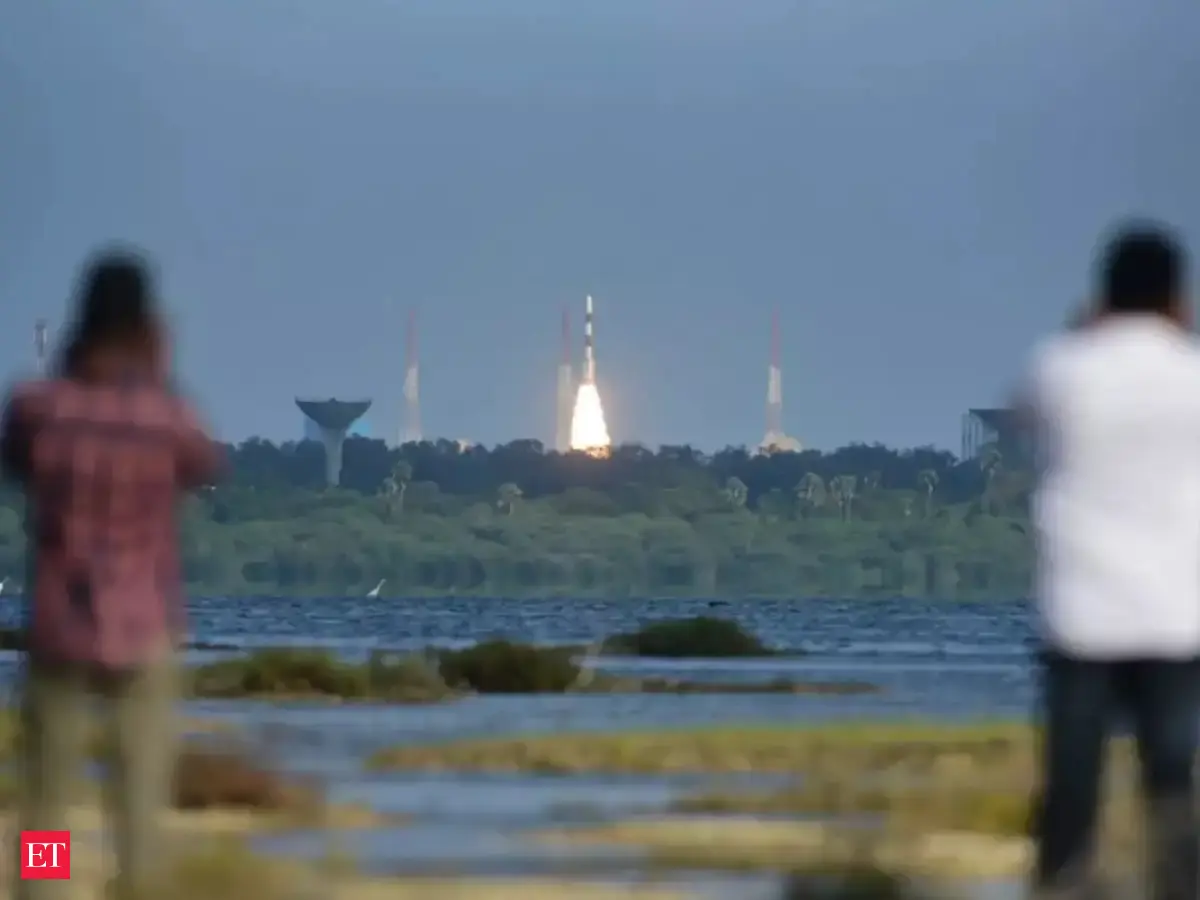
India’s space journey evolved from the Polar Satellite Launch Vehicle to the powerful Launch Vehicle Mark-3. The PSLV started its flights in 1993, acting as a workhorse for many missions. Later, LVM3 got built to carry heavier payloads, eventually helping India achieve a successful soft-landing near the Moon’s south pole.
India's space journey illustrates a significant evolution in rocket technology from Polar Satellite Launch Vehicle to Launch Vehicle Mark-3. PSLV played a crucial role in launching various satellites and missions including Chandrayaan-1. LVM3 facilitated the launch of Chandrayaan-2 and the successful soft-landing of Chandrayaan-3 near the Moon's south pole. This progression demonstrates India's growing capabilities in launching heavier payloads and future missions.
India's journey to the Moon has a long story of trial, learning and steadily bigger ambitions.
Long before a spacecraft could make a historic soft landing near the Moon's south pole, India had to learn how to build rockets powerful enough to carry increasingly heavy payloads beyond Earth.
That journey did not happen with one breakthrough rocket. It unfolded over years, as each launch vehicle expanded what India could put into space.
At the heart of that evolution are two rockets: Polar Satellite Launch Vehicle (PSLV), which grew into India's workhorse, and the Launch Vehicle Mark-3 (LVM3), the heavier rocket that eventually carried the country's lunar ambitions.
The rocket that did the heavy lifting for India's space programmePSLV made its first flight in 1993 and went on to become one of India's most important launch vehicles. It was built with four stages using solid and liquid propulsion and was capable of placing satellites into a range of Earth orbits.
Its role subsequently grew with India's space programme.
PSLV became closely associated with Earth-observation, navigation and commercial satellites and also carried some of the country's most ambitious missions beyond Earth, including Chandrayaan-1 and the Mars Orbiter Mission.
But there was a limit to how far a medium-lift rocket could take an expanding space programme.
This meant that India was no longer looking at only satellites in Earth orbit. Now the project meant larger communication satellites and deep-space missions which resulted in bigger payloads and eventually called for a more powerful launch vehicle.
Enter LVM3The answer was LVM3, initially called the Geosynchronous Satellite Launch Vehicle Mark III, or GSLV Mk III.
It was not simply a larger version of PSLV.
LVM3 was built around a different configuration, combining two large solid boosters with a liquid-fuel core stage and a cryogenic upper stage.
The rocket stands about 43.5 metres tall and has a mass of approximately 640 tonnes.
The Moon changed the equationLVM3's importance became particularly visible with India's lunar programme.
In 2019, the rocket launched Chandrayaan-2 towards the Moon. Four years later, Chandrayaan-3 lifted off aboard LVM3 from Sriharikota.
What followed made for one of the defining chapters of India's space programme. Chandrayaan-3 successfully soft-landed near the Moon's south pole, marking a historic achievement for India.
The mission was also a demonstration of how far the country's launch capability had come.
Bigger ambitions need bigger rocketsThe progression from PSLV to LVM3 captures something larger than a change in rocket size.
It reflects years of work in rocket technology, launch technology and mission design, with each generation giving India the ability to attempt something the previous one could not handle as easily.
And the evolution is not over.
India is now looking towards heavier satellites, human spaceflight and future lunar missions. Those ambitions will demand still greater launch capability.
In other words, the road to the Moon was never just about getting there, but about building something bigger for whatever comes next.