
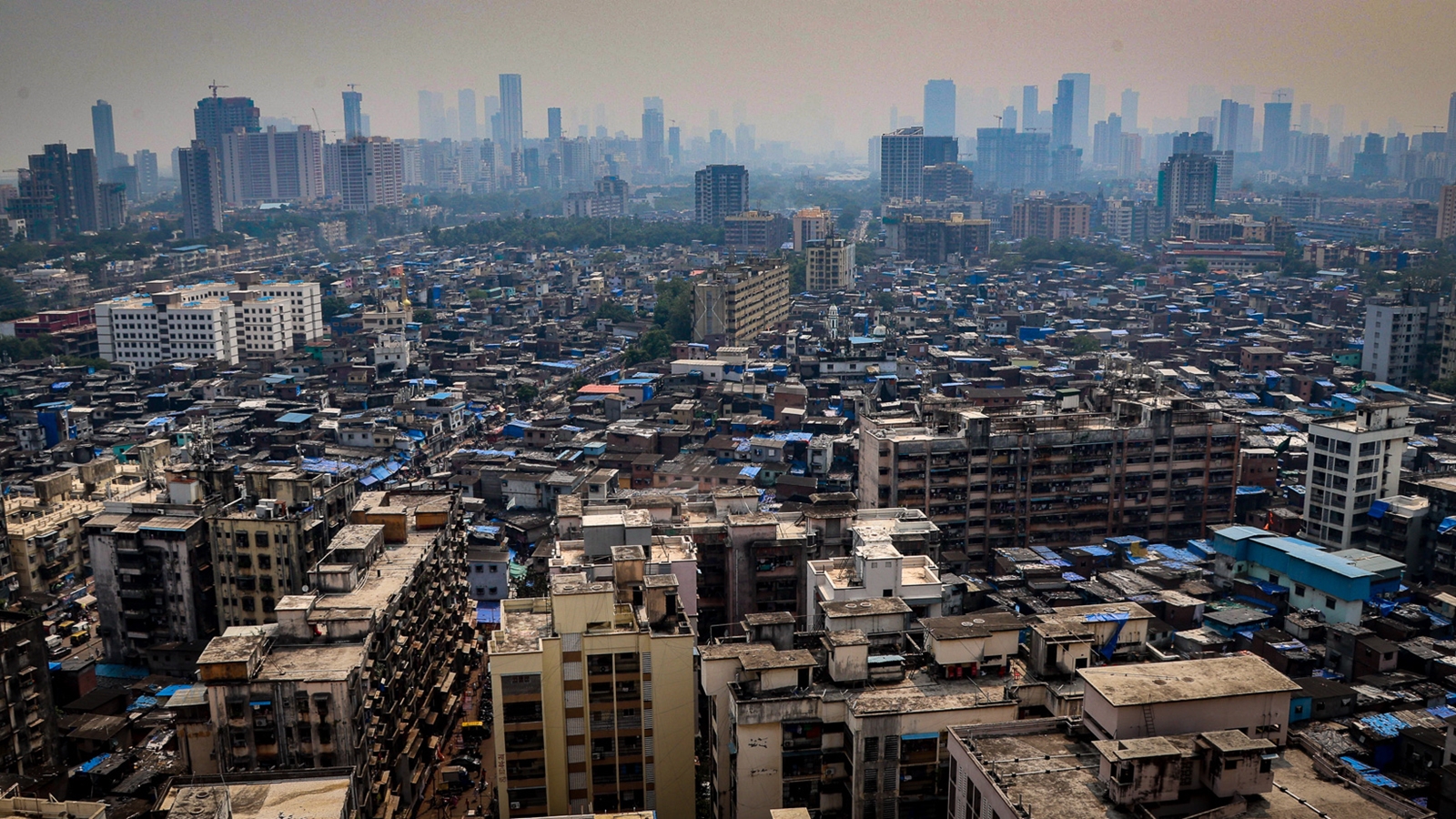
A study tracking 592 slum projects from 2007 to 2022 showed that only one-third reached completion. Many displaced residents remain in slums because private builders often wait for better profits before starting work. Philip said, “Ideally, such programs should have follow-up surveys that track residents over time regardless of where they live.”
The study
Titled ‘Slum Redevelopments and Evictions in a Developing Megacity’, the paper tracks slum redevelopment projects, the locations of their residents and daytime satellite data over 15 years, from 2007 to 2022.
Data from the SRA covered projects, approvals and timelines for a sample of 254 projects, out of 592 slum projects in the period. Philip digitised around 8,00,000 pages of electoral roll data and tracked residents through their names and other details, including father’s or spouse’s name, age and gender. Satellite data from Google Earth provided another layer of verification, allowing her to track a project’s progress from slum to construction site to building.
“I set out to do this paper because we have very little evidence on what happens to residents when slums are redeveloped, both in historical settings in the developed world and in developing countries today,” Philip told The Indian Express over email. “Ideally, such programs should have follow-up surveys that track residents over time regardless of where they live to study how redevelopment affects them, but this is rarely the case.”
Tracking people through voter rolls has a catch: the same person can show up twice. Philip found that about 2 per cent of entries looked like duplicates, even after matching names, fathers’ names and ages. Philip did her calculations again in three different ways to see if the duplicates were messing things up. In one, she removed the possible duplicates entirely. In another, where someone appeared twice, she kept them only once. In the third, she counted the possible duplicates but treated them as less important. The findings didn’t change. “Duplicate names are unlikely to be driving the findings,” she said.
Far from the finishing line
What Philip found is that the scheme fails more often than not. Only one-third of the approved SRA projects she tracked between 2007 to 2022 reached completion.
Twenty-nine per cent of approved projects never started. Residents were neither evicted nor rehoused. That’s because the SRA relies on private builders, who rehouse slum dwellers for free and in return get extra floor space to sell, on the same plot or, through Transferable Development Rights (TDR), elsewhere in the city. Whether a builder starts work, the paper notes, “depends on expected economic returns.” If the project doesn’t promise enough profit, it stays on paper.
“Builders can often choose to wait for bylaws and regulations to change that would make the project more profitable for them,” said Hussain Indorewala, assistant professor at the Kamla Raheja Vidyanidhi Institute of Architecture, who has studied the scheme over the years.
SRA schemes also need the consent of 51 per cent of slum dwellers, down from 70 per cent earlier. Conflicts between the builder and residents, or between residents and their managing committee, can sink a project before it starts.
Stuck midway
Even when a project begins, with evictions and demolitions, there is no guarantee of the promised home. Philip found that 37 per cent of approved SRA projects had started but were yet to be completed.
That leaves slum dwellers in limbo, uprooted from their communities, work and schools, with little savings to keep them afloat. They get either transit rent or transit accommodation to tide them over. But the rent often stops, while transit accommodation can become a permanent home.
“I have resigned myself to the fate that there will be no rent payments after two years,” said Shankar Patil, a resident of Lumbini Bagh Cooperative Society, a slum settlement in Govandi on the brink of an SRA project.
With others in his slum pocket ready for redevelopment and taking two years of transit rent, Patil’s opposition carried no weight. “The builder is giving Rs 14,000 per month as rent. While I have chosen to move into a building in Panvel, moving further away, most here prefer to move into slum homes in the vicinity, paying Rs 5,000 in rent and using the rest to run their homes.”
His suspicion comes from his own backyard. “Around 10 years ago, the settlement of Bhim Wadi, behind my home, went into redevelopment. But midway, all progress on it stopped. There were 190 families living there, who all went their own ways,” he said. The project is nearing completion only now.
The cost of delay
The longer the delay, the less likely it is that slum dwellers will make it out of slums at all. Philip found that slum redevelopment projects take an average of six years to build. In her sample, most residents who successfully moved from a slum home to formal housing on the same site had their projects completed within four years.
On paper, rebuilding slums on the same site should let residents stay close to their work, schools and neighbours, while giving them a proper home. In practice, the paper notes, the slum has to be cleared before construction begins. So “eviction is immediate, while the asset arrives only if and when construction is completed.” Residents lose their homes on day one and may wait years, or forever, for the new ones.
The paper also offers a possible fix. “Reducing this lag, through stricter enforcement of construction timelines, interim housing support, or phased demolition and construction, is therefore central to how effective in-situ redevelopment is.”
Slum to slum
Approval of a redevelopment project raises the probability of a resident moving into formal housing by only six percentage points, Philip found. On the other hand, the probability of living in other slums increases by 22 percentage points. Put another way, for every person who moves from a slum home into formal housing on the same site, 9.5 others who are eligible for a redeveloped home are displaced to other slums.
“The broader takeaway is that delays and non-completion matter for the extent to which slum redevelopment translates into transitions out of slum living even when residents are eligible for an apartment in the redeveloped slum. This raises questions about whether in-situ rehabilitation is the right model to follow at all for slum residents, given that it features a delay in compensation by design,” said Philip. She is now studying what causes construction delays and plans to send the paper to journals once that is complete.
What the SRA says
A senior SRA official acknowledged the problems. “The estimate the SRA began with, that around 5 lakh homes were needed to rehouse slum residents has jumped to 13-14 lakh. This is because slums have proliferated, and agencies have been unable to prevent encroachments,” he said.
“It is true that a lot of slum redevelopment projects don’t take off even after approvals,” the official said. He gave three reasons. The first is rising expectations. “As the government has increased entitlements of home sizes over the years, the expectation of slum dwellers has increased,” he said.
The second is opposition from residents who stand to get nothing. In slums, families often build upward, adding floors they live in or rent out. Those living on the upper floors are not eligible for a free flat under the scheme, except in Dharavi. “Top floor residents, who are ineligible, often object and get projects stalled,” the official said.
The third is the unexpected. “And occasionally, events like covid delay projects, making them run into 10 years.”
The Maharashtra government has now turned to cluster redevelopment for areas over 50 acres, banking on private muscle. When such projects are taken up by a government body like the SRA or MMRDA, they need only government approval, not the consent of slum dwellers. Action against inactive developers, who have submitted and gotten approvals for redevelopment proposals on paper but have not proceeded with any work on ground, has also been ramped up, with over 450 developers terminated in the past three years. “Perhaps in the next 5 years, the slums around us will no longer be around,” the official said.
The study does not cover residents who do move into in-situ formal housing but do not stay there for long, another established problem with slum redevelopment.
“It is well established that once slum residents are rehabilitated into their in situ rehabilitation buildings, not all of them continue to stay there,” said Indorewala. “They may lose their livelihood, and the costs of living in a high-rise building, like maintenance, are more – which may lead to them renting out the units. If the family is faced with distress, they may sell and go somewhere else.”