
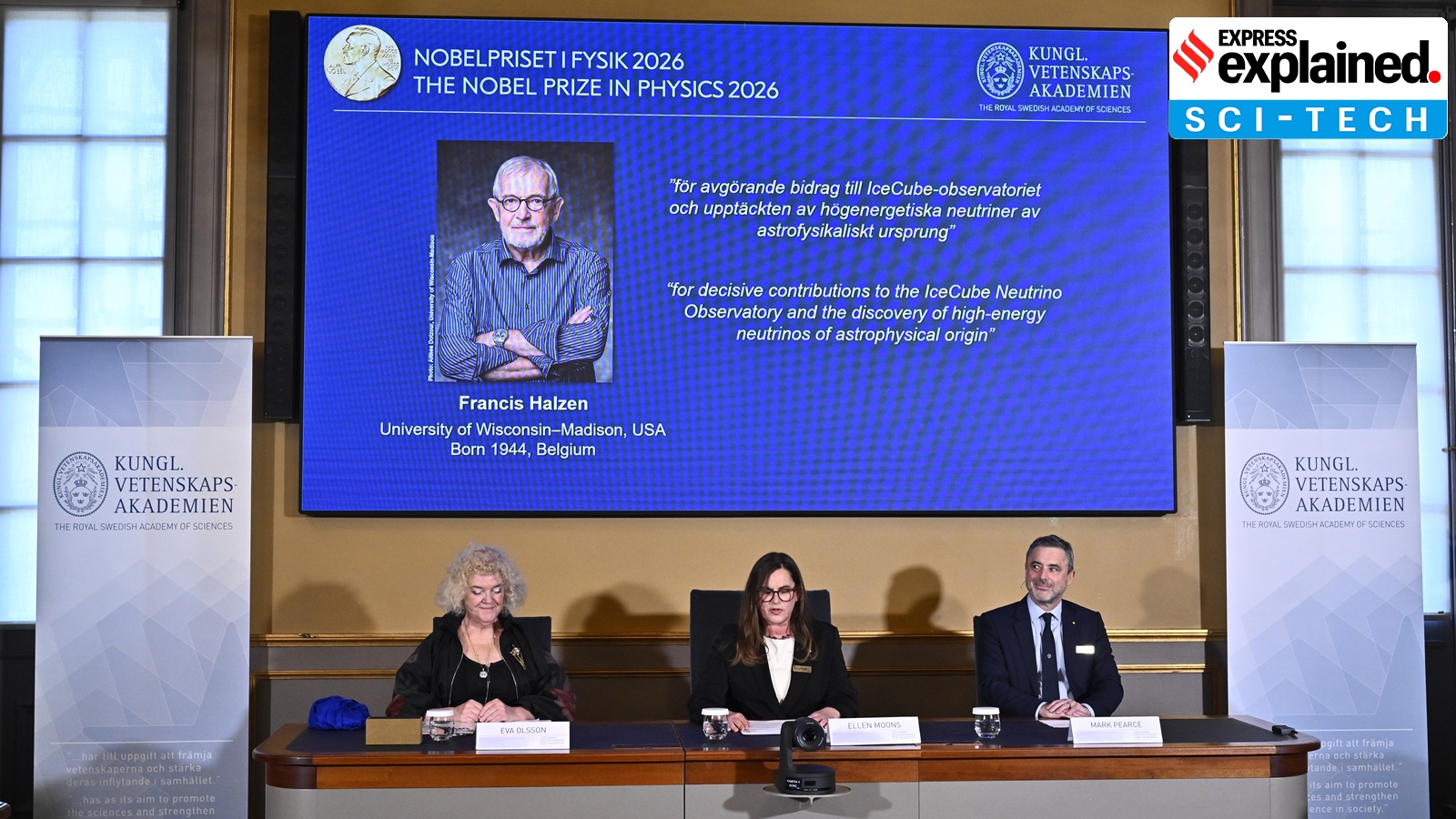
Francis Halzen won the 2026 Nobel Prize in Physics on October 6 for his work on the IceCube Neutrino Observatory. He used Antarctic ice to detect elusive neutrinos from space. "Neutrinos also come from other regions of space, carrying clues to some of the mysteries of the cosmos," the release said.
After the Medicine Nobel went to scientists who discovered a way to 'control the brain using light', the Physics Nobel, announced on Tuesday (October 6), also involves light.
Francis Halzen has been awarded the Nobel Prize in Physics 2026 "for decisive contributions to the IceCube Neutrino Observatory and the discovery of high-energy neutrinos of astrophysical origin".
What exactly are neutrinos, why do we need ice to observe them, and why observe them at all? We explain.
What is a neutrino?
A neutrino is a subatomic particle with no electric charge and almost no mass. The Nobel Prize official release calls it "the shyest particle in the universe", because it passes through matter almost without a trace. Every second, 65 billion neutrinos from the Sun pass through our bodies, and we do not notice.
Neutrinos are produced in enormous numbers by the Sun, exploding stars, nuclear reactions and radioactive decay. The same processes also produce protons, but because protons carry electric charge, their paths change by the time scientists can study them. Neutrinos interact so little with the world around them that studying the particles can give scientists a window into the processes that created them.
"Neutrinos also come from other regions of space, carrying clues to some of the mysteries of the cosmos. Researchers that succeed in capturing these rarer cosmic neutrinos can then extract information about the extreme environments in the universe where they originated," as the Nobel release says. However, the same reason that makes neutrinos important to study also makes them difficult to detect -- they pass through matter leaving almost no trace. Enter Francis Halzen.
Francis Halzen's idea: use the Antarctic ice
In the 1980s, Francis Halzen realised that glacial ice at the South Pole could serve as a giant detector of neutrinos.
On the rare occasion that a neutrino collides with an atomic nucleus, it can produce a charged particle that emits a faint blue light as it travels through the ice. If the material is transparent, sensors can detect that light and work out which way the neutrino was travelling. What matters most is having a large enough volume of the interceptor material, to catch many collisions.
Ice has several advantages: at depth, the darkness is constant, so it is easy to see flashes of light; unlike the ocean, there is no interference from living creatures. In the Antarctic, radioactivity is low, the ice is stable, and the area has no earthquakes. Also, when Halzen first floated the idea, a research station with regular transport already existed there.
The drawback was that practical work was only possible in the brief Antarctic summer, between November and February.
Halzen first presented the concept with John G Learned in 1988. Interest in the idea kept growing, and researchers from various institutions gathered around Halzen to build such an observatory.
Building the IceCube observatory
Glaciologists showed the team that hot water, delivered through a sophisticated shower head, can melt kilometre-deep holes. Strings of light sensors, which Halzen describes as "a lightbulb in reverse", were then lowered into them. The sensors capture light and turn it into an electrical signal.
The first attempts were disappointing, because bubbles in the upper ice scattered the light. Below 1,400 metres, however, the ice proved extremely pure and transparent, and light could travel 300 metres before being absorbed. The first observatory, AMANDA, worked as intended but was not big enough.
Its successor, IceCube, is a cubic kilometre of ice with 5,160 light sensors on 86 cables, completed in 2011. Halzen carried both projects from idea to results as principal investigator.
What has IceCube since done?
IceCube must pick out cosmic neutrinos from an enormous background. Over a hundred million particles from the atmosphere above Antarctica register every day, and a few hundred atmospheric neutrinos a day reach IceCube after travelling through the Earth.
The team looks at selected events and checks whether, taken together, their properties match cosmic neutrinos rather than atmospheric ones. In 2013 they reported the first evidence, and a couple of years later they were certain.
"The neutrino has thus helped physicists confirm their models of the processes inside the Sun and what happens inside a supernova. The idea behind IceCube is to take neutrino astronomy to a new level, the hope being that neutrinos will provide information about phenomena that are hidden behind dust clouds, or objects that are so distant that other forms of radiation have disappeared along the way. The aim is to gain knowledge that cannot be obtained in any other way," the Nobel release says.
What comes next
Scientists hope to establish sources of neutrinos that come towards the Earth.
"A few potential sources have been found by IceCube, of which one is the active galaxy NGC 1068 (also called M77). Of the neutrinos registered in IceCube, 79 appear to come from the direction of this galaxy. However, this evidence is not robust enough to definitively identify NGC 1068 as a neutrino source; the more neutrinos that are captured by the sensors, the greater the chance of being able to find their origin," the release says.