
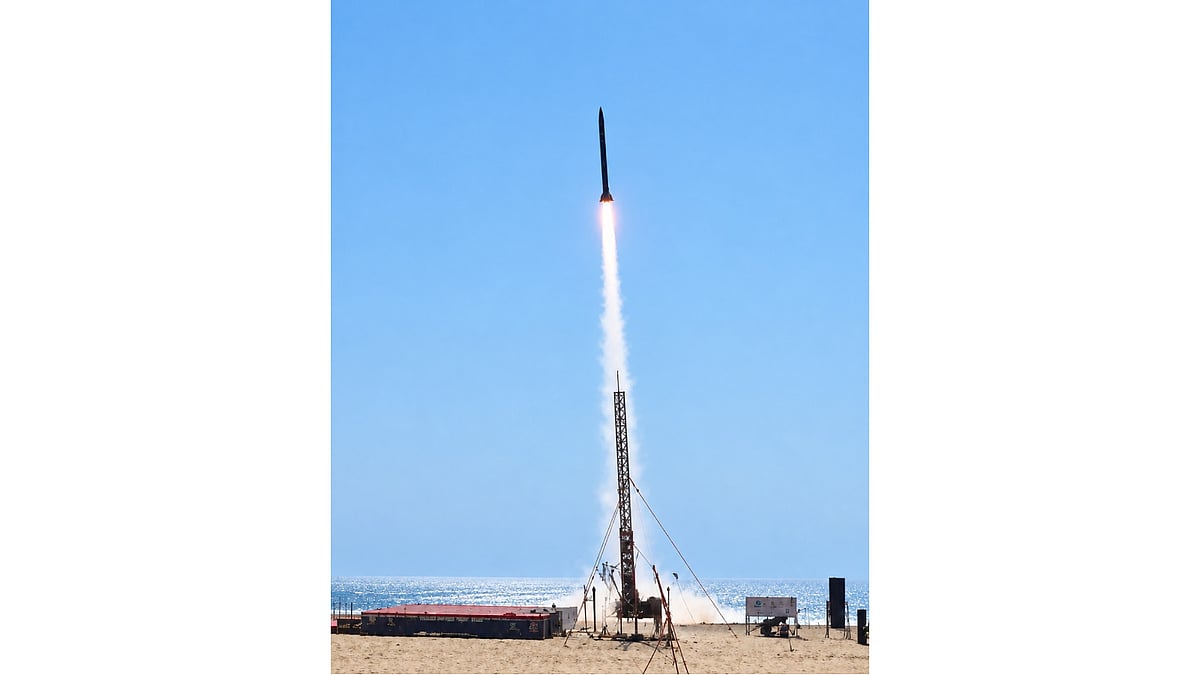
Two hybrid rockets launched at Tiruvidanthai on October 10 to test restart technology. Space Zone India and the Martin Group organised this mission to promote space science among students. Governor Rajendra Vishwanath Arlekar initiated the launch. The rockets carried student-made instruments to collect data and support future space sector research.
CHENNAI: Two indigenously developed hybrid rockets were launched simultaneously at Tiruvidanthai along the East Coast Road on Saturday, as part of Mission RHUMI Twin 2026 to test restart and reignition technology and promote space science education among students.
.
The launch was organised by Space Zone India, Martin Group and the US-based Global Help International Foundation at 7 am on October 10.
The two rockets, named RHUMI 1 and RHUMI 2, were developed using hybrid propulsion technology with an indigenous restart mechanism. Each rocket measures 3.1 metres in length and 164 mm in diameter and weighs 35 kg. Data gathered during the experiment is expected to support future research and technological development in the space sector.
.
The mission also aims to encourage school and college students to participate in practical space research. Students were trained in satellite technology, rocket science, payload systems, avionics, sensors, telemetry, communication and atmospheric studies. Scientific instruments developed by students were integrated into the rockets to collect atmospheric data.
Governor Rajendra Vishwanath Arlekar attended the event as the chief guest and initiated the launch. Former ISRO director and Padma Shri awardee Mylswamy Annadurai and former DRDO chairman G Satheesh Reddy were among the scientists who attended the event.
.
Space Zone India, led by Anand Megalingam, said it had trained more than 5,000 students in space technology. Its earlier initiatives included launching 100 femto satellites in 2021, 150 pico satellites in 2023 and a hybrid rocket in 2024.
The Martin Group has reportedly spent more than Rs 1.5 crore from its corporate social responsibility (CSR) funds on the mission, which seeks to expand student participation in India's growing space sector.