
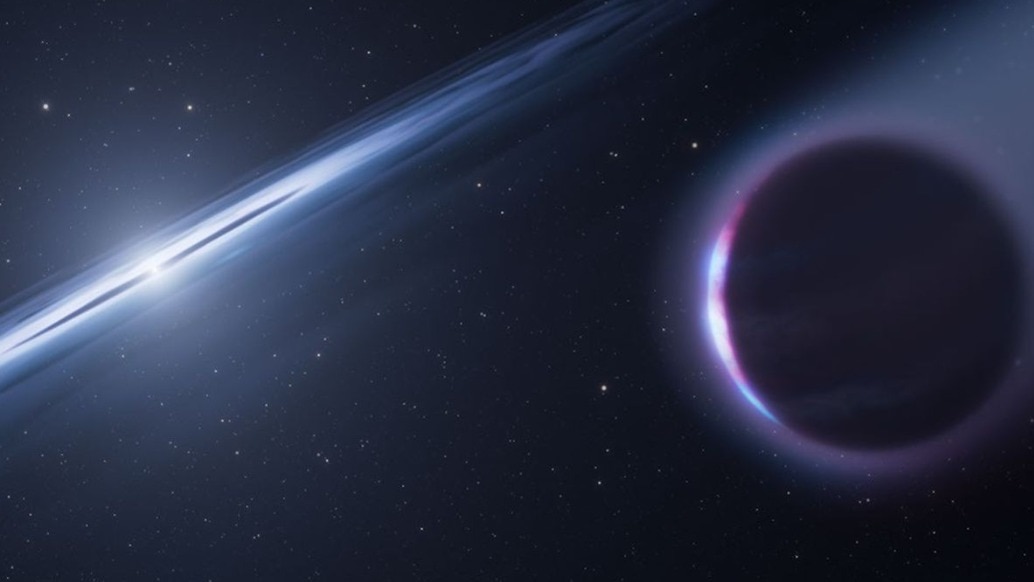
Astronomers at the University of Warwick identified a planet orbiting the white dwarf HS 0209+0832. Professor Boris Gansicke said, "It looks like it was built from the very material its own star cast off as it died." This discovery shows how dead stars might create new worlds from remains.
A planet orbiting a dead star may have been born from the very material that the star shed as it died, demonstrating a cosmic rebirth that could offer astronomers a new way to understand how planets form.
Astronomers led by the University of Warwick have identified what they say is the first candidate for a "second-generation" planet around a white dwarf, the leftover core of a star that has exhausted its fuel and lost its outer layers.
The finding, published in Nature Astronomy and backed by observations from Nasa's Hubble Space Telescope and TESS mission, suggests that planets may be able to form even after a star's original planetary system has reached its end.
A PLANET OR A PHOENIX?
Normally, planets form from the disc of gas and dust left around a young star, much like how Earth and the other planets in our solar system formed billions of years ago.
But the planet candidate around the white dwarf HS 0209+0832 appears to tell a very different story.
Hubble observations revealed unusually high amounts of heavy elements in the star's atmosphere, including zinc, copper and niobium. Niobium was peculiar, with levels more than 1,000 times those found in the Sun.
"What's remarkable about the planet around HS 0209+0832 is that this isn't a planet from somewhere else, or a survivor from the system's birth, it looks like it was built from the very material its own star cast off as it died," said Professor Boris Gansicke, Department of Physics, University of Warwick. "In a sense, this system has given birth to a new world using the foundations of the old one.
These elements can be produced through nuclear reactions during the later stages of a star's life, and their unusual combination suggests that the white dwarf may be feeding on material coming from a planet that formed from matter expelled by the dying star.
In other words, the star may have helped create a new planet from its own remains.
CAN A DEAD STAR GIVE BIRTH?
When a star, like the Sun, eventually runs out of fuel, it expands into a red giant before shedding its outer layers, leaving behind only its core, called a white dwarf.
For a new planet to form, however, that expelled material must gather into a disc rather than simply escaping into space.
Researchers think a companion star may have helped pull some of the material back into orbit around HS 0209+0832, creating the conditions needed for a new planet to form.
Nasa's TESS detected a regular brightness signal repeating every 4.4 days, consistent with a gas giant roughly the size of Jupiter orbiting extremely close to the white dwarf, about 6 million km away.
When a Star Becomes a Crystal When a Sun-like star reaches the end of its normal nuclear-burning life, it can shed its outer layers and leave behind an incredibly dense white dwarf -- roughly Earth-sized, but containing a large fraction of the original star's mass. But the story doesn't end there. A white dwarf has no ongoing nuclear fusion, so it slowly releases its stored heat over billions of years. As it cools, material deep inside can crystallize into a solid state. ESA's Gaia mission provided observational evidence for this crystallization process. Far in the future, a white dwarf could theoretically cool until it becomes a dark remnant often called a black dwarf. However, the Universe is currently far too young for such objects to have formed. -- cosmic pulse (@cosmicpulsee) October 1, 2026
The planet, however, is likely losing its atmosphere under the white dwarf's intense radiation.
Some of this escaping material may be falling back onto the star, carrying the unusual elements detected by Hubble.
"Finding this one example raises the question of how many more might be out there and might our own Solar System host a second-generation planet formed from the ashes of our Sun," said Gansicke.