
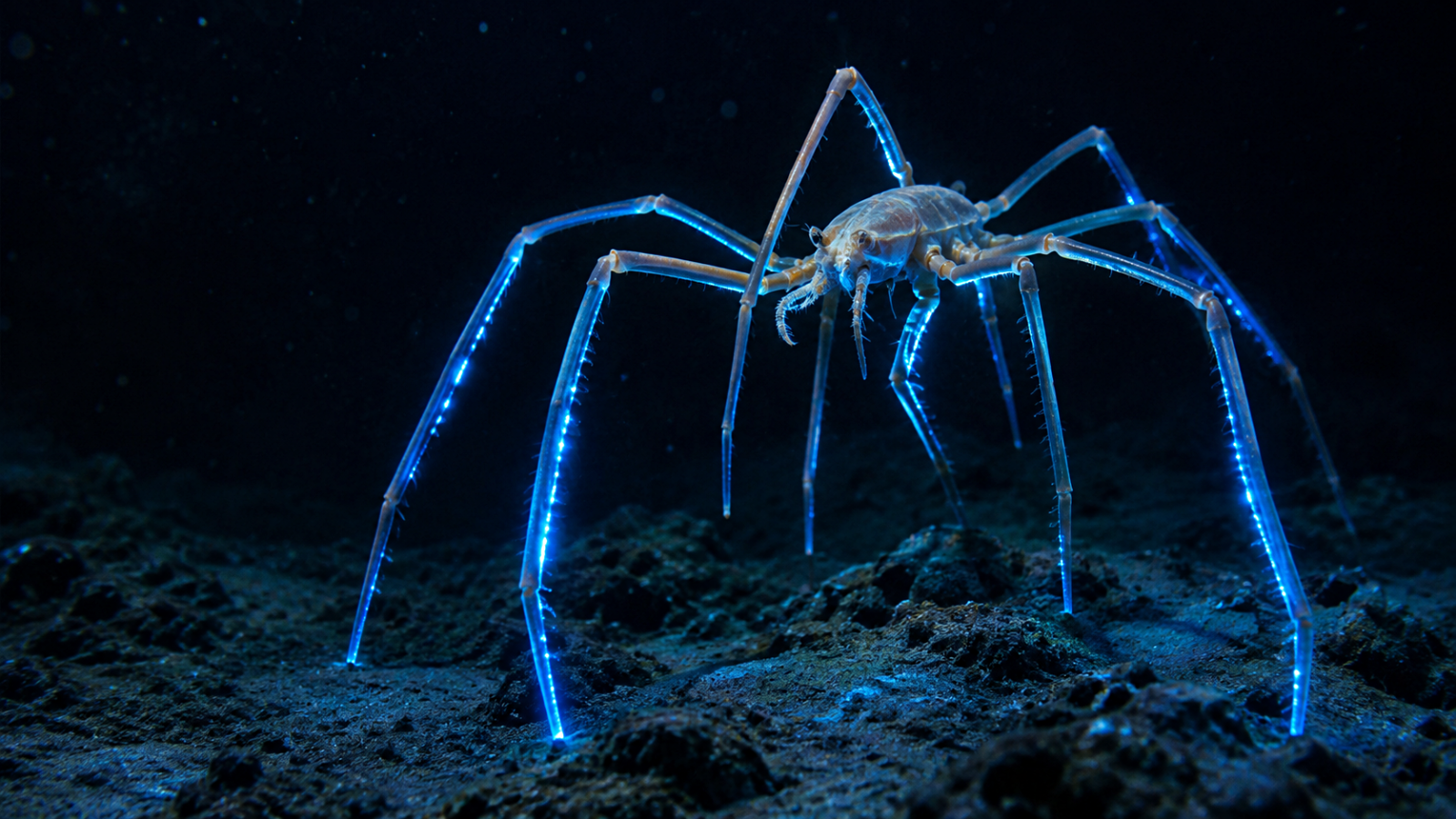
Researchers observed giant sea spiders glowing blue during a 2017 expedition off southeastern Australia. These creatures, found 5,000 metres deep, use bioluminescence in their legs. Scientists said, "much more needs to be learned about how these animals behave." They suspect the light might help the spiders attract mates or find prey.
Imagine pulling a creature from nearly 5,000 metres below the ocean surface and watching its long legs suddenly glow blue in the dark.
That is what researchers observed in giant sea spiders living in the deep waters off southeastern Australia. The eerie creatures, whose legs can stretch up to 25 centimetres, produce their own light, making them look almost like something from another world.
The phenomenon is known as bioluminescence, when a living organism produces light through a chemical reaction.
Researchers first noticed the glow during a 2017 expedition to the Australian Abyss. Marine biologist Jérôme Mallefet and his colleagues examined thousands of deep-sea specimens for signs of bioluminescence, working in a darkroom aboard the research vessel RV Investigator.
Among them were specimens of the giant sea spider Colossendeis tasmanica. When researchers stimulated the animals, their legs glowed faintly. Adding potassium chloride, which can activate bioluminescent cells, caused the spiders to glow for up to 10 minutes.
Another species, Colossendeis minor, also showed signs of bioluminescence.
Why are only the legs glowing?
View this post on Instagram
A post shared by 🪼Ocean Life🪼 (@_.marine_biology_lovers)
The most intriguing clue is where the light appears.
Most of the glow is concentrated on the underside of the sea spiders' legs, where their digestive tract is located. Researchers suspect this could be linked to what the animals eat.
One possibility is that the sea spiders acquire their bioluminescent properties from prey such as sea anemones, although this idea still needs to be tested.
Scientists also are not yet certain what purpose the glow serves.
One possibility is that the light could help the animals attract mates. Another is that it could help them locate prey on the seafloor.
Sea spiders feed in a particularly unusual way. They use a needle-like structure called a proboscis to liquefy and suck up tissue from their prey.
But researchers say much more needs to be learned about how these animals behave in their natural environment. Deep-sea video observations could help reveal whether the glow actually plays a role in hunting, mating or another behaviour.
These aren't quite the spiders you know
Despite their name and spidery appearance, sea spiders differ greatly from the spiders commonly found on land. They are marine arthropods with extremely long legs, and some species can have organs such as the digestive tract extending into their legs.
The giant sea spiders found in the Australian Abyss are among the largest of their kind. Their bodies may be only around the size of a person's finger, while their legs can stretch much farther.
Bioluminescence is far from unusual in the deep sea. Because sunlight barely reaches these depths, many marine animals have evolved the ability to produce their own light. Researchers estimate that around 76% of deep-sea creatures produce bioluminescence.
For these giant sea spiders, however, the discovery adds another strange feature to an already unusual group of animals: they don't just haunt one of the darkest places on Earth; they can light up parts of their own bodies too.
Explore more captivating stories about pets and animals here, and make us your daily stop for the latest from the animal kingdom.