
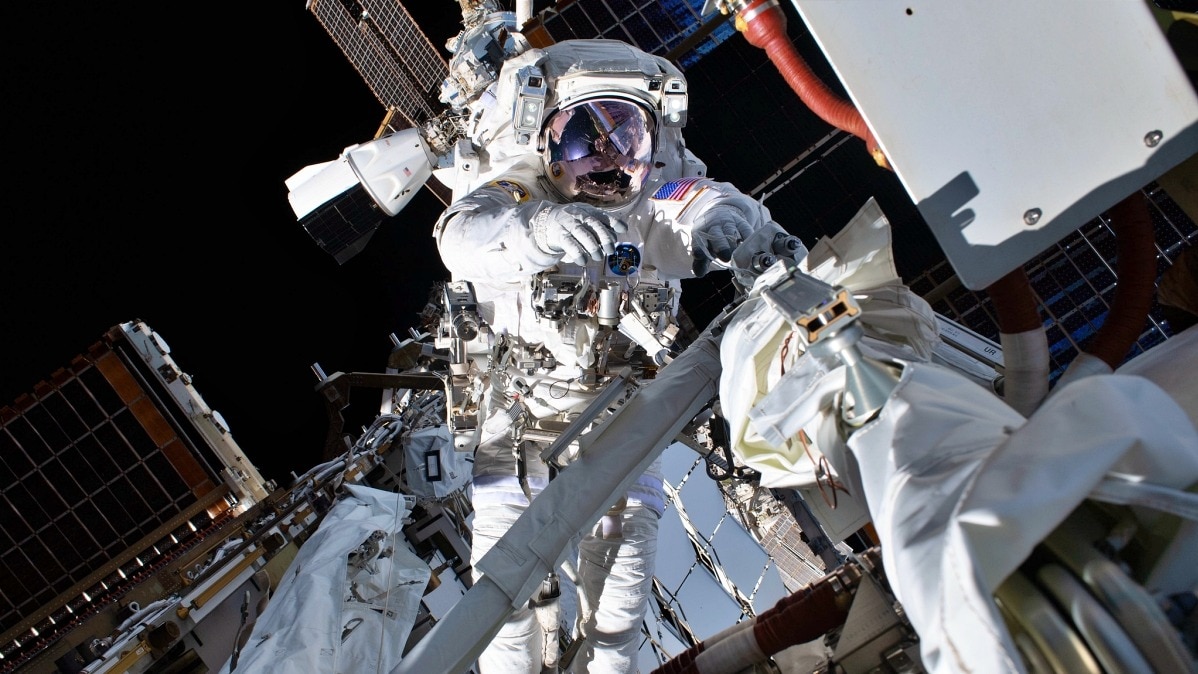
Fourteen astronauts are currently living in space across two stations after Nasa’s SpaceX Crew-13 docked with the International Space Station on October 2. Eleven people now occupy the ISS, while three crew members remain on China’s Tiangong station. These experts will spend months conducting research on plant growth and health.
Fourteen humans are currently living and working in space, all of them aboard the two permanently occupied space stations in low Earth orbit; the International Space Station (ISS) and China's Tiangong Space Station.
The number reached 14 after Nasa's SpaceX Crew-13 docked with the ISS in the early monring hours of October 2 (in IST), temporarily taking the station's population to 11.
Meanwhile, Tiangong has three astronauts aboard as part of China's Shenzhou-23 mission.
ISS HOSTS 11 ASTRONAUTS
The ISS is currently in the middle of a crew handover under Expedition 75.
The seven astronauts and cosmonauts who were already aboard have been joined by Crew-13's four members.
The new arrivals are Nasa astronauts Jessica Watkins and Luke Delaney, Canadian Space Agency astronaut Joshua Kutryk and Roscosmos cosmonaut Sergey Teteryatnikov.
Watkins is the Crew-13 commander, Delaney is the pilot, while Kutryk and Teteryatnikov are mission specialists.
For Delaney, Kutryk and Teteryatnikov, this was their first spaceflight. Watkins is making her second trip to the station.
The existing Expedition 75 crew comprises Nasa astronauts Jessica Meir, Jack Hathaway and Anil Menon; European Space Agency astronaut Sophie Adenot of France; and Roscosmos cosmonauts Pyotr Dubrov, Anna Kikina and Andrey Fedyaev.
That gives the ISS five Americans, four Russians, one Canadian and one French astronaut.
Crew-13 will spend several months aboard the station, conducting research and technology demonstrations.
Its planned work includes experiments involving human tissues, plant growth and astronaut health.
THREE ABOARD CHINA'S TIANGONG
The other three people in orbit are China's Shenzhou-23 crew, including commander Zhu Yangzhu, Zhang Zhiyuan and Li Jiaying, also known as Lai Ka-ying in Cantonese.
They launched on May 24 and reached Tiangong the same day.
Zhu had previously flown on Shenzhou-16, while Zhang and Li were making their first spaceflights. Li is the first astronaut from China's Hong Kong Special Administrative Region to travel to space.
IS 14 HUMANS IN SPACE A NEW RECORD?
The answer, unfortunately, is no, it's not.
The record for the largest number of people simultaneously in Earth orbit is 19, set on September 11, 2024.
At the time, people were spread across the ISS, China's Tiangong, the private Polaris Dawn mission and a Soyuz spacecraft.
There have been 20 people in space simultaneously under a broader definition that included six people on suborbital flights.
But for people actually in Earth orbit, the record remains 19.
So today's 14-person total is a sizeable concentration of humanity in orbit, but it is not an all-time high.
The ISS population will also fall again after the current Crew-12 members complete their handover and return to Earth.