
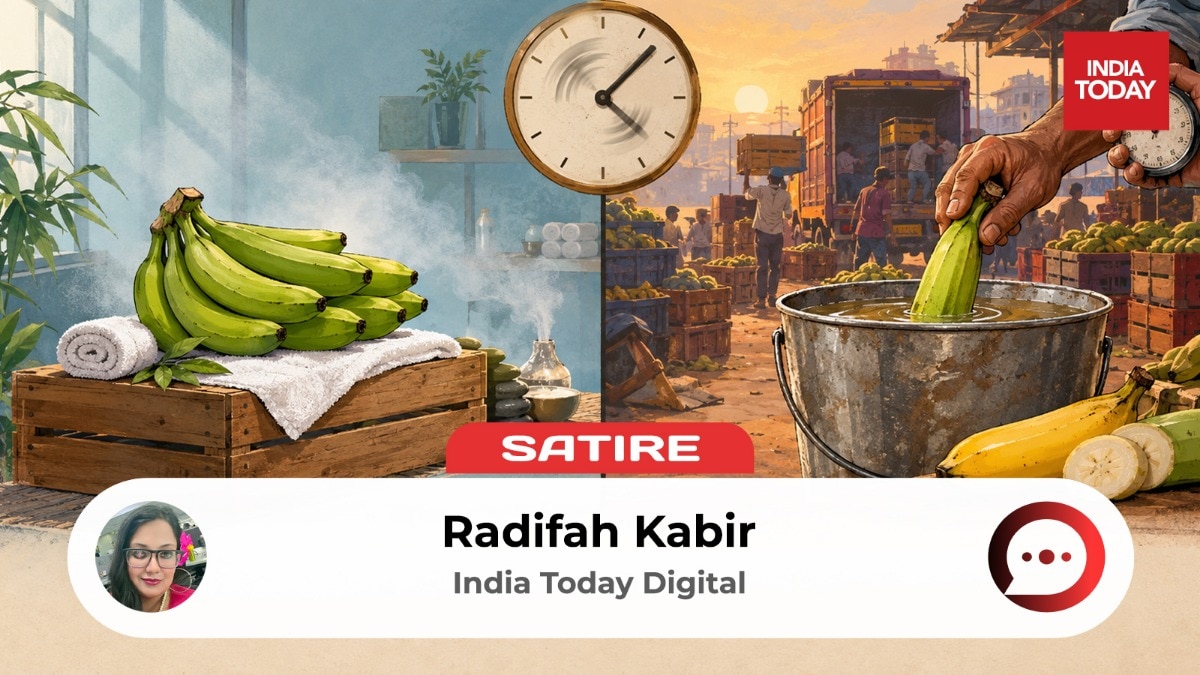
In Turbhe, Maharashtra, the Food and Drug Administration found 1,394 kg of bananas treated with unregistered ethephon. Officials seized the fruit after finding the chemical lacked proper licensing. While bananas naturally ripen using their own ethylene gas, traders often use chemicals to speed up the process for quick market sales.
At four in the morning, a wholesale fruit market is all exhaust and argument. Trucks reverse into the dark, crates land like dropped furniture, and great green hands of bananas lie stacked to the ceiling, waiting for the one thing nobody in the building can spare. Time.
Recently, in Turbhe, Maharashtra's Food and Drug Administration found 1,394 kg of bananas that had, it is alleged, been spared the wait. They had been dipped in ethephon, a ripening chemical, drawn from a container that carried no registration number from the Central Insecticides Board and Registration Committee, the body that licenses such substances in India. The officials did precisely what officials should. The bananas said nothing. Bananas rarely do. They have always let their colour speak for them, and their colour, lately, has been lying.
A FRUIT THAT KNOWS ITS OWN MIND
Here is the delicious part. The banana does not need help to ripen. It ripens itself, with a gas of its own making called ethylene, a plant hormone, meaning a chemical messenger that tells the fruit what to do next.
The banana belongs to a family scientists call climacteric fruits. Like the second half of a Hindi film, its life has one great turning point, after which everything happens at once. The fruit takes a deep breath, releases a burst of ethylene, and sets its own transformation in motion.
Enzymes break its starch into sugar, which is why a green banana tastes of chalk and a yellow one of dessert. Other enzymes loosen the walls of its cells, and the flesh softens. The green pigment chlorophyll fades, revealing yellow pigments called carotenoids that had been there all along, hidden under the green like gold under tarnish.
Ethylene, in other words, is not an additive. It is the banana's own breath.
A SPA WITH A STOPWATCH
Long ago, traders noticed that a banana in company ripens faster than a banana alone, because each fruit's ethylene hurries its neighbours along. Your grandmother noticed it too, which is why she shut unripe fruit in a paper bag. The modern ripening chamber is that paper bag, grown up and given a licence.
The Food Safety and Standards Authority of India permits ethylene gas at up to 100 parts per million, meaning 100 parts of gas in every million parts of air, inside a closed chamber. For bananas, its guidance recommends 24 to 48 hours at 15 to 18 degrees Celsius, in air kept 90 to 95 per cent humid. Even ethephon is allowed, but only as a source that releases ethylene inside the chamber. It may not touch the fruit. The gas may visit. The liquid may not enter.
It is, essentially, a spa. Cool air, careful humidity, a whisper of hormone in the atmosphere and two unhurried days. The banana walks out looking rested and tasting of itself.
THE DUNK
The trouble with a spa is that it takes two days, and a market measures time in hours. So, it is alleged, someone skipped the room and went straight for the bucket.
Dipping fruit in ethephon, or spraying it on, is not permitted. FSSAI's guidance does not pause to explain why, and it hardly needs to. A rule that allows the gas to visit and forbids the liquid to touch is not really about a molecule. It is about distance, dose and the difference between a method that can be measured and one that can only be hoped for.
A chamber gives the banana a weekend. A bucket gives it a dunk and an alibi.
Below the bucket lies the basement, where calcium carbide lives. FSSAI bans it outright. When carbide meets moisture, it releases acetylene, a gas that imitates ethylene rather clumsily and, the regulator warns, carries harmful traces of arsenic and phosphorus. Its list of possible effects reads like a bad night out: dizziness, vomiting, difficulty in swallowing, skin ulcers. Carbide does not ripen a banana so much as frighten it into costume, a peel that turns yellow on cue while the flesh inside often keeps its own counsel.
THE GREAT CHEMICAL PANIC
Then there is us.
Every season of seizures produces a new citizen scientist, usually a man at a fruit stall pressing his thumb into bananas as though taking a pulse, demanding to know whether they are chemical. Every banana is chemical. So is the man. So is the thumb.
The word has become a curse, which is a pity, because the real culprit slips away in the confusion. The panic says ethylene is poison. Ethylene is the banana's own voice. The panic says naturally ripened is safe and artificially ripened is dangerous. The law says something far more precise: ripening with a permitted gas in a controlled chamber is acceptable, and shortcuts are not.
Between the outrage and the WhatsApp forward, a whole industry of reassurance has bloomed. Naturally ripened, the signboards promise, as though the other kind ripened under duress. Chemical-free, the labels sing, about a fruit that is nothing but chemistry wrapped in a peel.
We have become a country that wants its bananas ripe by breakfast and natural by lunch, and is shocked, by dinner, to learn that someone in between found a bucket.
THE HURRY IS THE HAZARD
So let the raids continue, and let them be loud. Maharashtra's officials did exactly what a food safety system exists to do. They found a shortcut and stopped it.
But the lesson of Turbhe is not that chemistry has poisoned our bananas. Chemistry is how bananas ripen. The lesson is that a system designed to give fruit two days was beaten by someone who could not spare two days. At some point in the chain, a margin mattered more than a method, and a deadline more than a dose.
The banana has never been in a hurry. It knows how to ripen in its own time, on its own breath, in the company of its own kind. All it ever asked of us was a room and a little patience.
The scandal was never the chemical. It was the clock.