
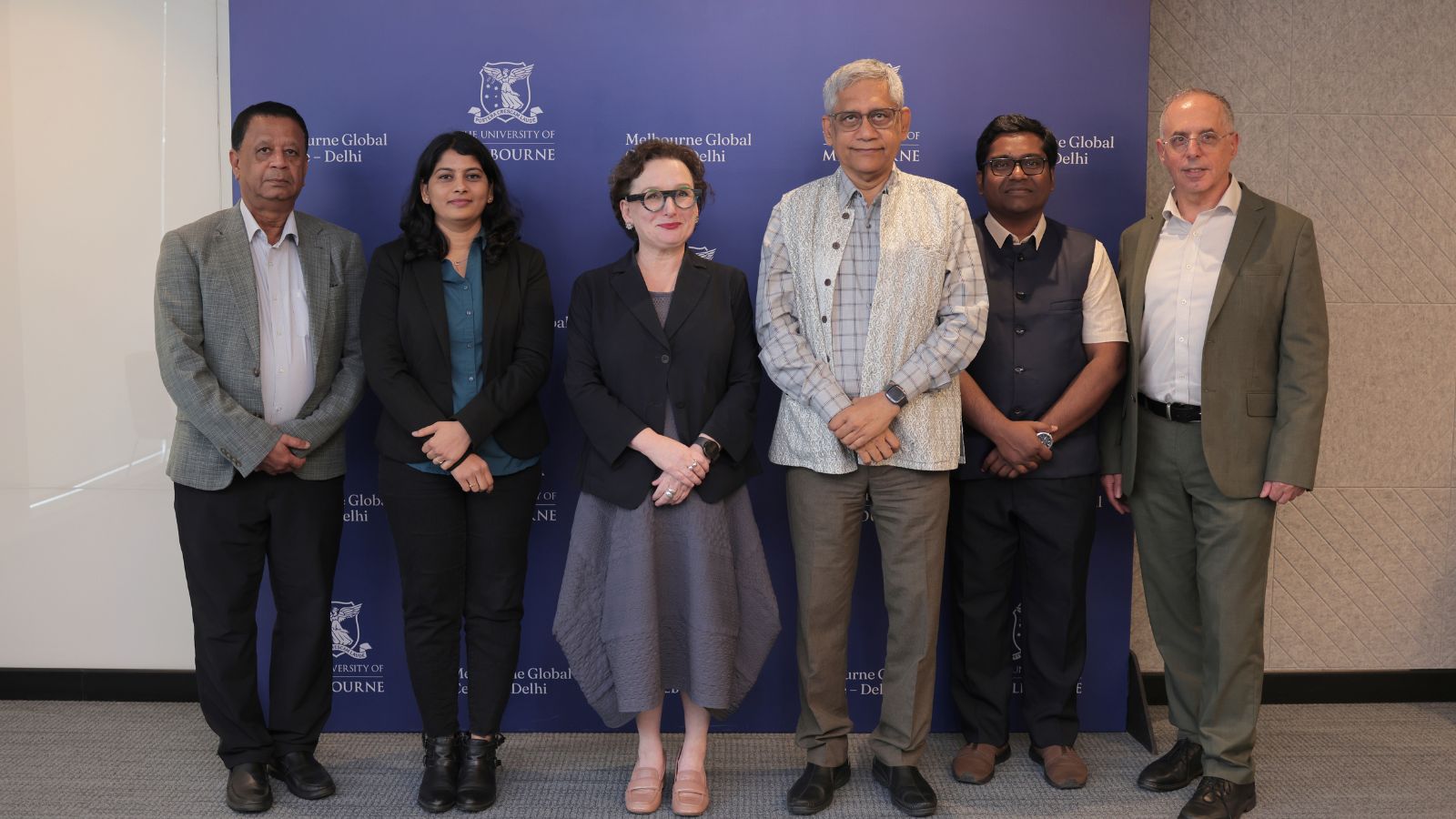
The University of Melbourne and IISER Tirupati launched a 2+2 dual degree today in New Delhi. Students spend two years in India and two in Australia to earn two honours degrees. Director Santanu Bhattacharya said, "The high cost of education going all the way to Australia will be significantly reduced."
The University of Melbourne and the Indian Institute of Science Education and Research (IISER) Tirupati have today launched a Bachelor of Science Integrated (Honours) 2+2 dual degree at the Melbourne Global Centre in New Delhi.
Indian students will spend their first two years at IISER Tirupati and their final two in Melbourne, graduating with two Bachelor honours degrees from two globally renowned institutions. Majors include biotechnology, chemistry, ecosystem science, environmental science, food science, genetics, physics and plant science.
Graduates can move on to a master's degree, with advanced standing that may shorten the time it takes. All students automatically join the Science Global Scholars Program, which supports research collaboration and talent mobility.
Same syllabus, lower cost
IISER Tirupati Director Professor Santanu Bhattacharya said the degree should cost less than studying abroad for all four years, with no compromise on quality.
"They will spend two years in India and two years in Melbourne, so the high cost of education going all the way to Australia for four years will be significantly reduced. We will have instructors from both institutions. The syllabus we have mapped. Exactly what you get in Melbourne, we are going to offer. So there is no dilution," he said.
Starting at home also helps students settle in. "You spend two years here, you get acclimatised, you know the system, and then you go there," he said.
What is the intake process?
Students will not enter through the IISER Aptitude Test (IAT) route. "We will create a qualifying test. It will be completely different, because IISER's IAT has various other elements. We have to follow social justice and various other parameters. This will be open-ended, and this would be a paid program," Professor Bhattacharya said.
The first intake could be up to 50 students, depending on applications. "Quality is very important. How many people apply, and all those factors, will determine the cohort size in the first year. Then we will fine-tune it the following year," he said.
Melbourne's Dean of Science, Professor Moira O'Bryan, said she expects the programme to grow. "I would hope that we would start small but not too small, and then we could get bigger. These are transnational education programmes, so they are exempt from the international caps," she said.
Professor Bhattacharya described it as an advanced honours programme for very high-quality students. Career paths depend on the major, he said, and industry is part of the picture. "We now try to do many things linked with startups, private industry participation and internships," he said.
Partnership over branch campus
Professor O'Bryan said Melbourne chose to partner with Indian institutions rather than open its own campus. "We feel we can have more impact in that model. We think this is the best model for the University of Melbourne. I can't speak for others, and I'm sure branch campuses work for other universities, but this is the model we chose," she said.
For IISER Tirupati, the Melbourne tie-up is one part of a wider international push. "We would like to go with an excellent institute, and so we have chosen Melbourne," Professor Bhattacharya said.
University of Melbourne Pro Vice-Chancellor (Global) Professor Frank Vetere said the programme would give emerging scientists international experience and the skills to tackle complex global challenges. "Together, the University of Melbourne and IISER Tirupati are fostering a new generation of globally connected scientists equipped to contribute solutions to challenges that transcend national boundaries," he said.
Professor O'Bryan called the degree "an important investment" in science education and in ties between Australia and India. "Students will gain the benefits of an international education grounded in academic excellence and research-led learning," she said.
Next month, the two institutions will jointly host Frontiers of Science for Global Advances, a series of public events across India. Keynotes and expert panels will cover biotechnology, climate science, quantum technologies, ecosystems, agriculture and sustainability, bringing leading researchers together with students, educators and the public.