
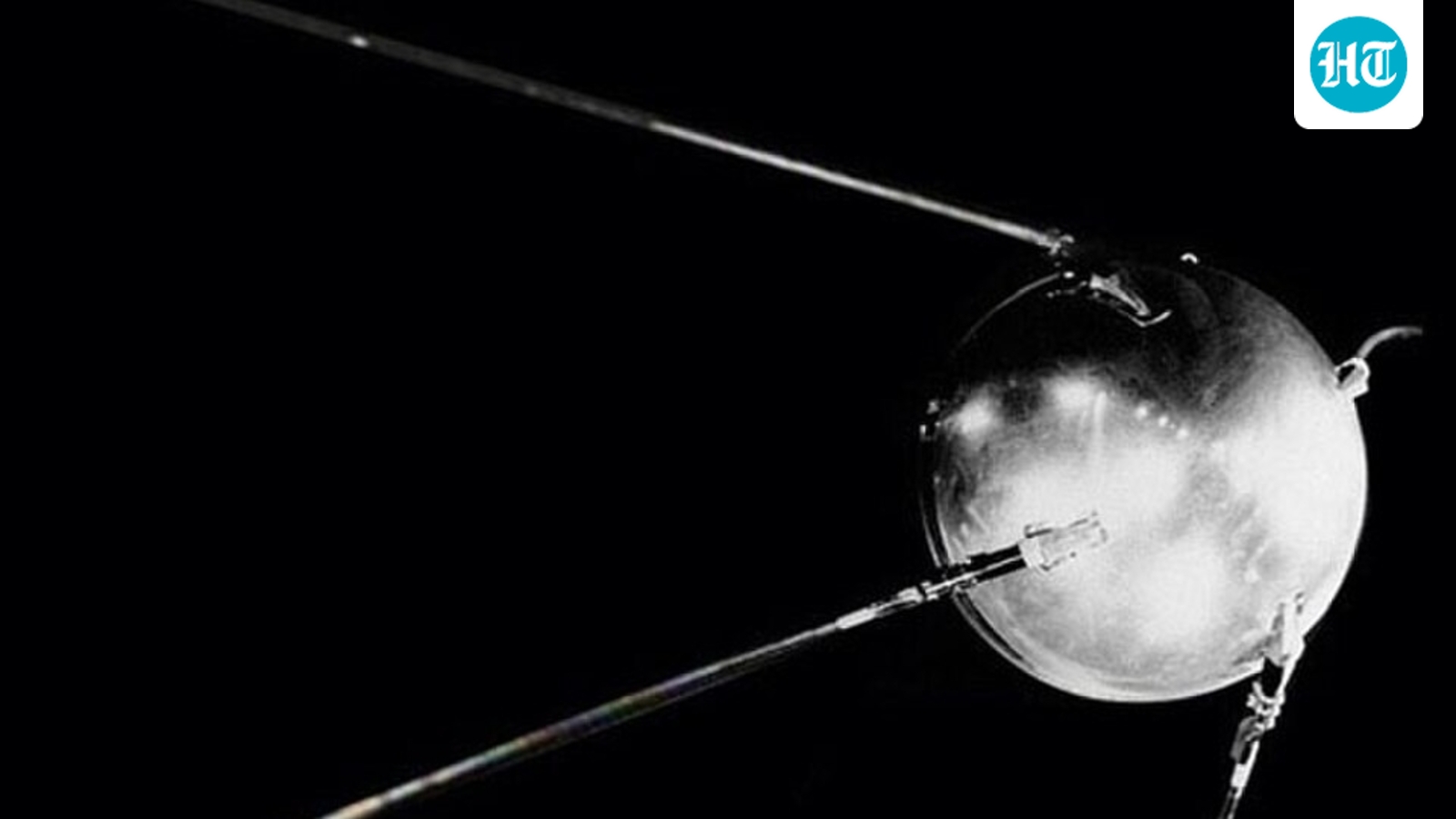
On October 4, 1957, the Soviet Union launched Sputnik 1, the world’s first artificial satellite. This 83.6kg metal sphere circled Earth every 96 minutes, sparking a massive space race. The event worried Washington, as the rocket used was a modified missile. Soon, the US started its own space agency, NASA.
On October 4, 1957, a secret Soviet missile test range in present-day Kazakhstan bristled with unusual energy.
A rocket and a satellite had been rolled out to the launch pad the previous morning and were due to lift off on October 6. But just days ahead of that deadline, a rumour set off ripples through the loosely cobbled Soviet teams that had built the hulking rocket and slick satellite – the Americans were due to present a paper on satellites at an international conference on October 5, and chief designer Sergei Korolev feared it meant a US launch was imminent. So, the Soviets decided to slice through the atmosphere earlier.
Exactly 69 years ago, the Soviet Union put an 83.6kg metal sphere into orbit, catching the US off guard and sparking a breathless contest that eventually landed 12 Americans on the Moon and ended only 18 years later.
Sputnik 1, the world’s first artificial satellite, measured about 58cm across, circled Earth every 96 minutes and transmitted for 22 days before its batteries ran out.
Korolev built it as the Soviet contribution to the International Geophysical Year, a global scientific programme meant to bring researchers together across the Cold War divide. The rocket that carried it, though, was a modified R-7, the world’s first intercontinental ballistic missile, which the Soviets had first flown successfully six weeks earlier, on August 21. This especially triggered American consternation. A missile that could carry a satellite into space could also carry a nuclear warhead into America, Washington believed.
The first US attempt, on December 6, 1957, ended on the pad. The Navy’s Vanguard rocket, carrying America’s first satellite, rose about four feet off the ground in Florida and exploded. Newspapers called it “Flopnik” and “Kaputnik”.
The Army’s Explorer 1 reached orbit on January 31, 1958. Washington set up the Advanced Research Projects Agency that February and the National Aeronautics and Space Administration (Nasa) in October. President Dwight Eisenhower also signed a law that put about $1 billion into schools and science and mathematics teaching.
Moscow’s firsts
For the next eight years, the Soviet Union set the pace.
Luna 2 crashed into the Moon in September 1959, the first object from Earth to reach it. A month later, Luna 3 sent back the first photographs of the lunar far side.
On April 12, 1961, Yuri Gagarin, a 27-year-old air force pilot, became the first human in space, orbiting Earth once in a 108-minute flight. Alan Shepard, the first American in space, followed on May 5 on a 15-minute flight that never reached orbit.
On May 25, US president John F Kennedy asked Congress to commit the country, before the decade was out, to “landing a man on the moon and returning him safely to the earth”.
Valentina Tereshkova became the first woman in space in June 1963. Alexei Leonov carried out the first spacewalk on March 18, 1965. Luna 9 made the first soft landing on the Moon in February 1966.
When the eagle landed
Moscow did not formally commit to landing a cosmonaut on the Moon until August 3, 1964, more than three years after Kennedy. Rival design bureaus fought over money and rockets. Korolev and engine designer Valentin Glushko feuded so bitterly that they refused to be in the same room, and the military, which wanted missiles, resented the cost.
Nasa’s budget, meanwhile, peaked at 4.41% of all federal spending in 1966.
Korolev died in January 1966.
On January 27, 1967, a fire swept through the Apollo 1 capsule during a launch pad test and killed astronauts Gus Grissom, Edward White and Roger Chaffee, a major setback to American ambitions that fuelled fresh hopes among the Soviets that the space race was theirs to win.
On December 24, 1968, Apollo 8 put three astronauts into orbit around the Moon, the first humans to get there.
Moscow’s Moon rocket, the N1, needed 30 engines firing together in its first stage, and to save money the Soviets never tested that stage on the ground. Its first launch, on February 21, 1969, failed. The second, on July 3, exploded on the pad and destroyed it.
Apollo 11 lifted off 13 days later.
How it ended
With the Moon won, Congress and the Nixon administration cut Nasa’s budget. The agency cancelled Apollo 20 on January 4, 1970, and two more missions later that year.
Apollo 17 commander Eugene Cernan, the last of the 12 men on the Moon, left on December 14, 1972. By 1976, Nasa’s budget had fallen to just under 1% of federal spending.
The N1 failed twice more, in 1971 and 1972, and Moscow cancelled it in May 1974. The Soviet crewed lunar programme stayed secret until 1989.
Relations between the two had thawed by then. At a summit in Moscow on May 24, 1972, US president Richard Nixon and Soviet premier Alexei Kosygin signed an agreement to build spacecraft that could dock with each other. On July 17, 1975, an Apollo capsule linked up with a Soviet Soyuz, and Nasa astronaut Thomas Stafford shook hands with Leonov in the docking ring.
No one has walked on the Moon since 1972.
The new race
For more than half a century, no country sent people back. With the Soviet Union beaten, the money behind Apollo dried up. But China has revived the contest. Its Chang’e-6 probe brought back the first rock and soil samples from the Moon’s far side in 2024, and it is preparing a crewed landing. Nasa administrator Jared Isaacman has warned that the US may get back first by “months, not years”. Both countries are aiming for the lunar south pole, where permanently shadowed craters are thought to hold water ice that could sustain a base and cut the cost of shipping supplies from Earth.
Three American astronauts and a Canadian flew around the Moon on Nasa’s Artemis II in April 2026. Nasa plans to land astronauts near the lunar south pole in 2028, and in March announced a $20 billion plan to build a base there over seven years.
“This time the goal is not flags and footprints. This time the goal is to stay,” Isaacman said.
In early September, US president Donald Trump posted on Truth Social an image of the lunar surface and a US flag, with the words “THE MOON IS OURS”.
Unlike Apollo, the new effort leans on private companies. Nasa is paying SpaceX about $4 billion to land its astronauts using the company’s Starship, and Blue Origin, founded by Jeff Bezos, is building a second lander. SpaceX founder Elon Musk said in February that the company had “already shifted focus to building a self-growing city on the Moon”, which he said could be done in less than 10 years, against more than 20 for Mars.
China aims to land its own astronauts by 2030 and, with Russia, to have a basic south pole research station by 2035.
Weapons in space
The 1967 Outer Space Treaty bans nuclear weapons in orbit and bars any country from claiming the Moon. It does not ban conventional weapons.
China blew up one of its own satellites with a missile in 2007, and Russia did the same in 2021. US officials have accused Russia of developing a nuclear weapon to destroy satellites, which Moscow denies. The US Space Force is developing interceptors that would orbit Earth and shoot down missiles, part of Trump’s Golden Dome missile shield. Flight tests are due to begin in 2027.