
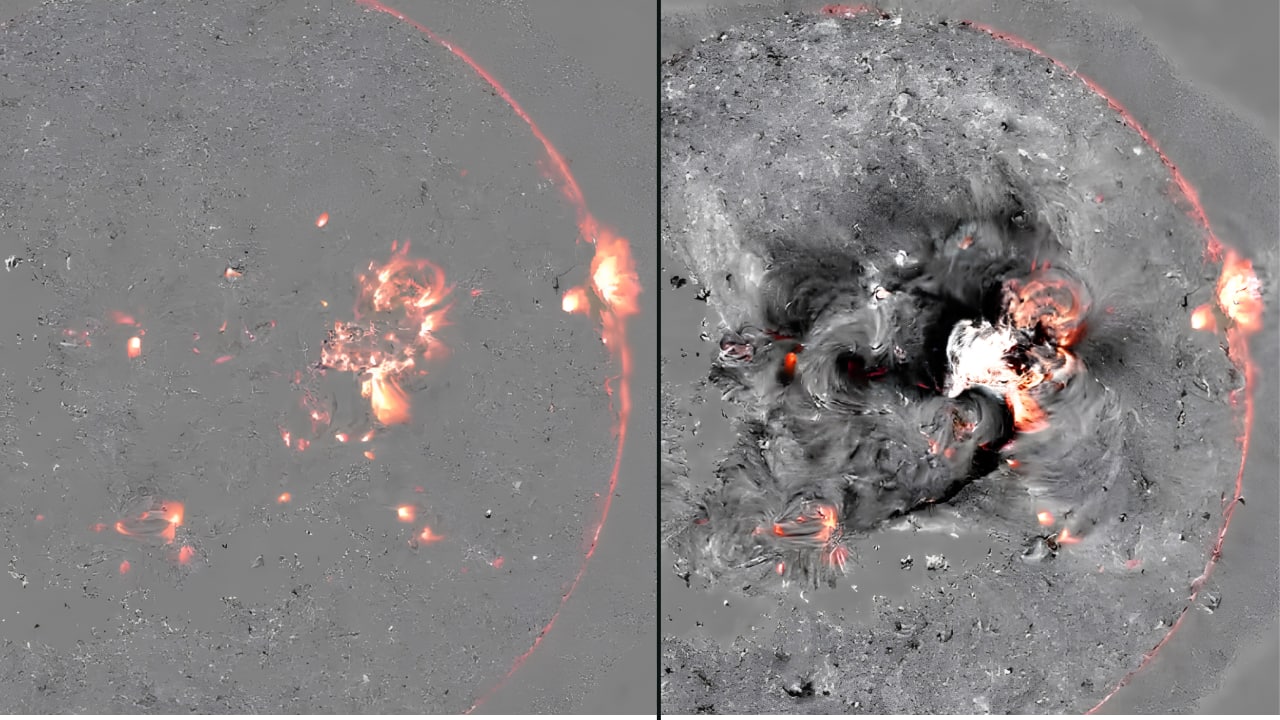
The US National Oceanic and Atmospheric Administration issued a geomagnetic storm watch for October 11, 2026. Two solar eruptions left the Sun on October 7 and 8, merging as they moved toward Earth. These storms reached G3 levels on October 10, potentially affecting satellites, radio communications, and various navigation signals today.
Two powerful clouds of solar material are at the centre of a space weather alert, with scientists warning that a faster eruption could catch up with an earlier one on its journey towards Earth. The US National Oceanic and Atmospheric Administration (NOAA) issued a geomagnetic storm watch for October 11, 2026, after two coronal mass ejections (CMEs) left the Sun on October 7 and 8. However, the first major impact has already begun, with geomagnetic storm conditions recorded on October 10. What is happening between the 2 solar eruptions? According to NOAA, the October 8 CME was travelling faster than the one launched on October 7. Forecasters expected the second cloud to catch up with the first and merge with it while travelling towards Earth. Such interactions can change the structure and magnetic properties of solar material reaching our planet. However, the resulting impact depends on the strength and orientation of the magnetic field carried by the combined cloud. Region where auroras will be seen on October 11. (Image: NWSSWPC) Has the solar storm reached Earth? Yes. NOAA reported that a CME arrived at Earth on October 10, with its signature detected in the solar wind at 14:34 UTC. Geomagnetic activity subsequently reached G3, or strong storm levels, on October 10. NOAA had also issued a G2, or moderate, storm watch for October 11 as further geomagnetic disturbances were expected. GPS and satellites to be affected by this solar storm! Geomagnetic storms can interfere with satellite operations, radio communications and navigation signals. They can also increase atmospheric drag on satellites orbiting at lower altitudes. Strong disturbances can affect power-grid operations, particularly in regions vulnerable to geomagnetically induced currents. However, the actual impact varies with storm intensity and local conditions. A storm warning does not automatically mean widespread technological disruption. Could India see the Northern Lights tonight? Geomagnetic storms can produce auroras when charged particles interact with gases in Earth's upper atmosphere. During stronger events, these colourful displays can become visible farther from the polar regions. Visibility from India is not guaranteed. It depends on the storm's strength, location and local viewing conditions. What happens on October 11? NOAA's October 11 forecast expected G1 to G2 geomagnetic storm conditions, with further disturbances possible as additional solar material arrived. Scientists monitor these changes to assess risks to satellites, navigation and communication systems. The key question is not simply whether the two eruptions merge, but how their combined magnetic field interacts with Earth's magnetic shield.