
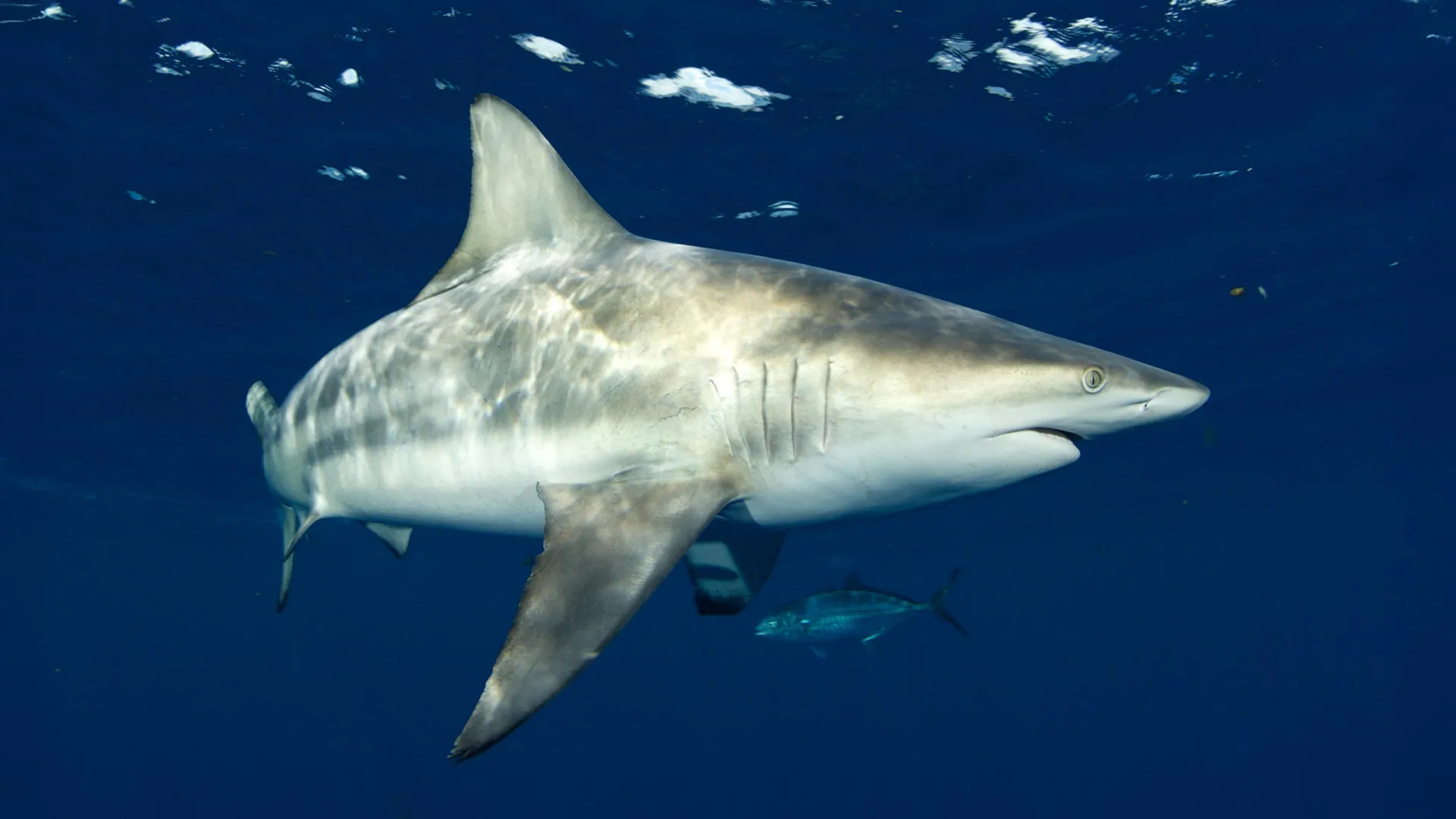
A new study from Florida Atlantic University showed that blacktip sharks can hear sounds from nearly 250 feet away. Researchers used underwater speakers and drones to track the animals off the coast of Palm Beach County. The sharks got startled by low-frequency sounds and quickly turned away from the source.
A new study from Florida Atlantic University is beginning to answer those questions. Researchers studying blacktip sharks (Carcharhinus limbatus) used an underwater speaker, a drone, and wild sharks swimming naturally in coastal waters. They found that the animals could detect sounds from substantial distances and abruptly turn away from the source, even when it was nearly 250 feet away.
The findings, published in Integrative Organismal Biology, provide the first quantified evidence that free swimming sharks can detect and orient away from sounds in the acoustic far field. The results offer a rare look at a basic shark sense that remains surprisingly poorly understood.
Testing Shark Hearing in the Wild
Blacktip sharks were especially well suited for the experiment because they gather predictably off Southeast Florida. Large numbers congregate along the Palm Beach County coast each winter, while smaller groups can be found there throughout the year. Clear, shallow water also allowed researchers to monitor individual sharks from above while minimizing interference with their natural behavior.
"Their abundance and accessibility made it possible for us to observe them from above without disturbing their natural behavior, while also presenting controlled underwater sounds," said Stephen Kajiura, Ph.D., senior author and a professor of biological sciences in FAU's Charles E. Schmidt College of Science.
Researchers carried out the tests in shallow coastal waters across Palm Beach County. After anchoring a boat, they placed an underwater speaker in the water and allowed it to drift with the current as far as 19 meters from the vessel. This setup helped reduce the possibility that the boat itself would influence the sharks.
The team played three groups of low-frequency sounds, covering 100 to 200 Hertz, 200 to 400 Hertz, and 400 to 800 Hertz. They also used a 10 kiloHertz control sound, which lies beyond the known hearing range of sharks. Rather than attempting to lure the animals toward the speaker, the researchers played the sounds loudly enough to provoke a startle response.
Sharks Responded From 243 Feet Away
Calibrated hydrophones allowed the researchers to measure sound levels at different locations, making it possible to determine what each shark was hearing at the moment it reacted. Meanwhile, a drone flying 40 to 50 meters above the water recorded the movements of free swimming sharks during both the experimental and control sounds.
The researchers then analyzed the footage frame by frame to determine how far each shark was from the speaker and how sharply its swimming direction changed.
The sharks reacted to all three low frequency sound ranges but showed no response to the 10 kiloHertz control. They detected low frequency sounds from distances of up to 74 meters (243 feet), substantially farther than had previously been demonstrated in freely swimming sharks.
Just as importantly, the animals often made rapid turns away from the speaker. That behavior indicates that they were not simply detecting the presence of a sound. They could also determine the direction from which it was coming.
More than 70% of the recorded responses occurred in the acoustic far field. The sharks were also most sensitive to lower frequency sounds, which they detected from greater distances and at lower sound levels.
"What makes this finding particularly interesting is that the sharks were responding to sounds beyond the acoustic near field, where the sound behaves differently than it does close to the source," Kajiura said. "This suggests that they are detecting the particle motion associated with sound even at considerable distances from the source -- something we have not previously been able to demonstrate in free-swimming sharks."
How Sharks Hear Without a Swim Bladder
The result is especially notable because sharks lack the gas filled swim bladder found in many bony fish. In those fish, the organ can contribute to the detection of sound pressure.
Sharks are instead believed to depend largely on their inner ears. These include a specialized sensory structure known as the macula neglecta, which may help them detect motion and vibrations generated as sound travels through water.
The research also demonstrates why studying shark hearing in the ocean can reveal information that is difficult to obtain in laboratory tanks. Inside a tank, sound can reflect repeatedly from the walls, producing complicated acoustic patterns that may make an animal's response harder to interpret.
"Trying to do hearing experiments in a tank results in the sound bouncing off the walls which causes complex and confusing signals -- it is like being in a house of mirrors. This is why it is so important to do these types of experiments in the ocean with wild sharks to get a natural response," said Caroline Sullivan, lead author who conducted this work as part of her master's degree in biological sciences.
Study co-author is Edmund Gerstein, Ph.D., a research director, Charles E. Schmidt College of Science.
A Hidden Sensory World in the Ocean
The findings suggest that sound may provide sharks with useful information about events occurring hundreds of feet away, long before those animals or objects enter view. Researchers now want to understand more precisely how the shark sensory system detects and processes these distant acoustic signals.
"The ocean is an acoustic environment, and sharks are clearly tuned into it in ways we are only beginning to understand," Kajiura said. "Being able to detect and respond to sounds from hundreds of feet away gives these predators an important source of information about their surroundings. The next question is how their sensory system allows them to pick up and interpret these distant sounds."
The work was supported by the Colgan Foundation, awarded to Kajiura, and the National Save the Sea Turtle Foundation, awarded to Sullivan.