
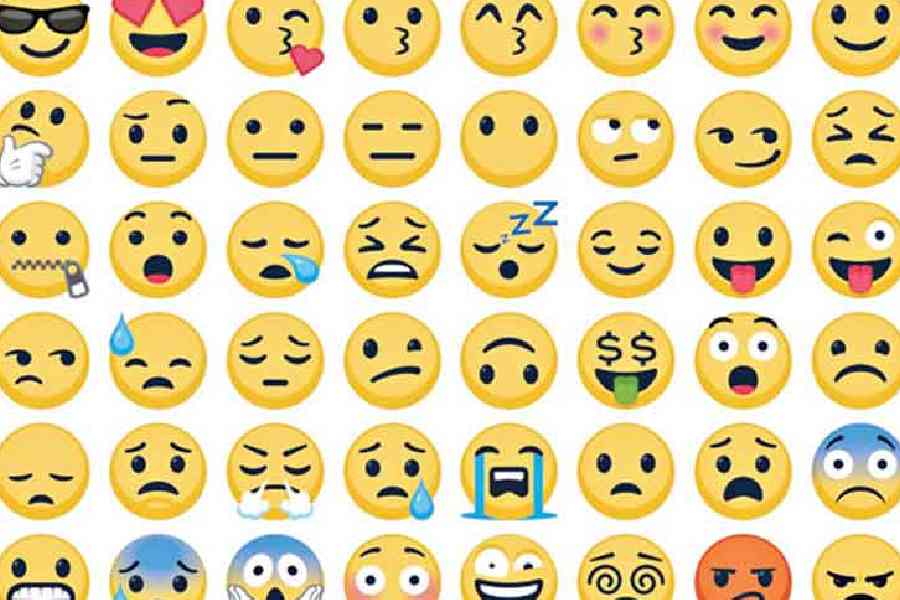
Emojis are becoming a language of their own as people use them to express complex feelings. Much like words, their meanings change based on culture and social groups. Gen Z users often use emojis sarcastically, showing that these symbols follow the same rules that govern our everyday spoken language.
The convergences between word and image need not be frowned upon. It goes to show the confounding -- and hence magnetic -- nature of human communication
Linguistics distinguishes between semantics -- the conventional meaning of an expression -- and pragmatics -- the meaning it acquires with quotidian usage. Gen Z's deceptive use of emojis highlights this distinction perfectly. A 'slightly smiling face' may appear to depict happiness but it means something completely different in day-to-day use: members of this cohort are likely to interpret it as passive aggression or sarcasm. Thus, the official label for an emoji, just like the dictionary definition of a word, cannot always determine the meanings people extract from it. The word, 'great', conventionally expresses approval. But it can equally be used in a sarcastic way to convey irritation. Similarly, a smiling emoji can communicate displeasure despite its cheerful appearance. This raises a tantalising possibility. Even as image -- emojis -- replaces text -- words -- in everyday exchanges, their meanings continue to adhere to the same processes that govern language. Does that put language on a higher pedestal than a visual medium?
Often, an emoji will also change meaning by taking on the characteristics of existing language and phrases. For instance, when younger users employ a 'skull' emoji to signify laughter, they are actually adapting the familiar expression, dying of laughter, into pictorial form. Again, much like words, the meanings of emojis also vary across cultures and social groups. 'Folded hands' can indicate prayer to some, gratitude to others, and pleading to someone else. Similarly, the word, sick, can mean illness to an older person but something really cool to a youngster. Emojis also acquire specific registers, making some uses appropriate among friends and awkward in professional correspondence. A manager's 'thumbs-up' may signal the acknowledgement of completed work; but the same response to a declaration of affection by a friend will be seen as a snub. In this, too, emojis are much like linguistic registers: calling a friend an idiot can express affection; addressing a colleague in the same way is likely to cause offence.
Such similarities should inform debates on the ties that bind words, images and correspondence. The emojis' defendants -- passionate, opinionated youngsters -- will argue that the modern version of hieroglyphics can at times capture sentiments that have no convenient, precise textual equivalent: embarrassment accompanied by resignation, for instance, or, say, amusement mixed with an awareness of personal foolishness. A 'melting face' or 'clown' emoji can convey such combined sentiments economically. The older, contrarian generation would respond by saying that even such nimbleness does not make the use of every emoji precise any more than the existence of dictionaries makes every sentence clear. Just as with language, poor communication and misunderstandings involving emojis require clarification.
The convergences between word and image need not be frowned upon. It goes to show the confounding -- and hence magnetic -- nature of human communication. Moreover, shared registers can create familiarity between people whose experiences otherwise differ. They also democratise communication. Words and images should help people understand one another better, with each adding possibilities the other leaves unexplored.