
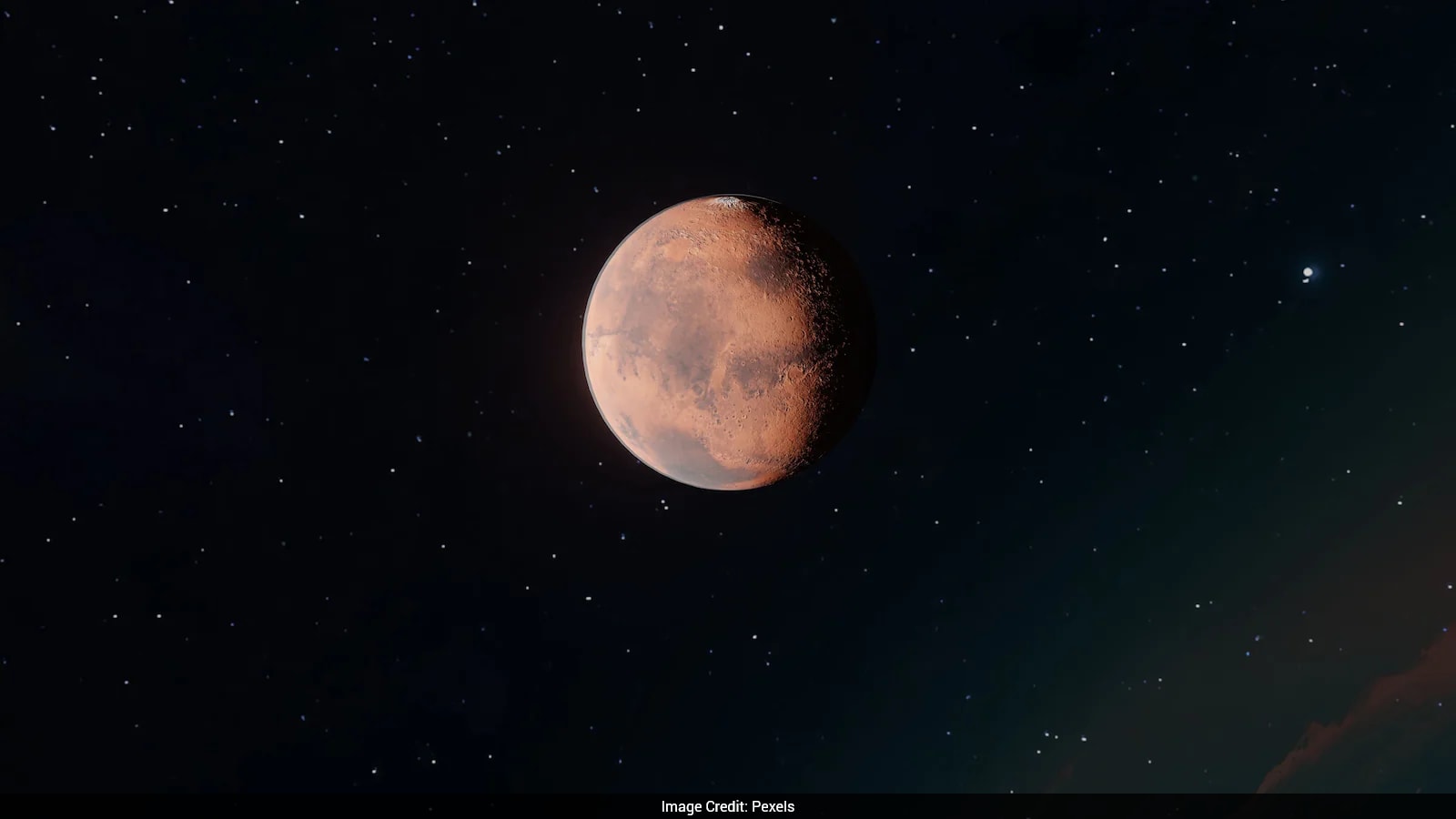
Scientists found that the Arsia Mons Elongated Cloud on Mars forms through an unusual process where water vapour turns directly into ice. This cloud appears every spring and summer in the southern hemisphere. Researcher Jorge Hernandez-Bernal said, "the researchers had to include unusual physical processes in their model to recreate."
The cloud appears every spring and summer in Mars's southern hemisphere.
Scientists have found that Mars's strangest cloud may form through an unusual process involving water vapour turning directly into ice. Researchers used the European Space Agency's Mars Express spacecraft and a weather model to study the cloud. Their findings suggest that some unusual physical processes may be responsible for its formation, reported NYPost.
The Arsia Mons Elongated Cloud (AMEC) is one of the most visually striking clouds on Mars. It can grow up to 1,800 kilometres long, nearly twice the length of the United Kingdom. The cloud appears every spring and summer in Mars's southern hemisphere, during the planet's dusty season.
A study published in Nature Geoscience suggests that the cloud forms through a process called homogeneous ice nucleation. This means water vapour turns directly into ice particles without first gathering on dust or other material.
Winds passing over Arsia Mons, a volcano on Mars, push moist air several kilometres upwards within minutes. This rapidly cools the air, causing water vapour to freeze directly into ice particles.
Jorge Hernandez-Bernal of LMD/CNRS/Sorbonne Universite in Paris, France, who led the study, said that the researchers had to include unusual physical processes in their model to recreate the cloud.
He explained that these processes are discussed in textbooks as theoretical and are generally not expected to occur naturally. However, once they were included in the simulations, the cloud appeared as expected.
Hernandez-Bernal added that although some parts of the model did not exactly match observations, reproducing the cloud to such a degree was a major success, especially because scientists have less information about Mars's atmosphere than Earth's.
European Space Agency Mars Express Project Scientist Colin Wilson said that clouds on Earth and Mars appear to follow similar rules, but understanding this unusual Martian cloud required unusual physics. He added that similar processes may also be important elsewhere in the universe.
The findings show that scientists should consider even unlikely physical processes when studying planets, including planets outside our solar system.
Got a follow‑up question on this article? Go on
How may i help you today
Show full article
Track Latest News Live on NDTV.com and get news updates from India and around the world