
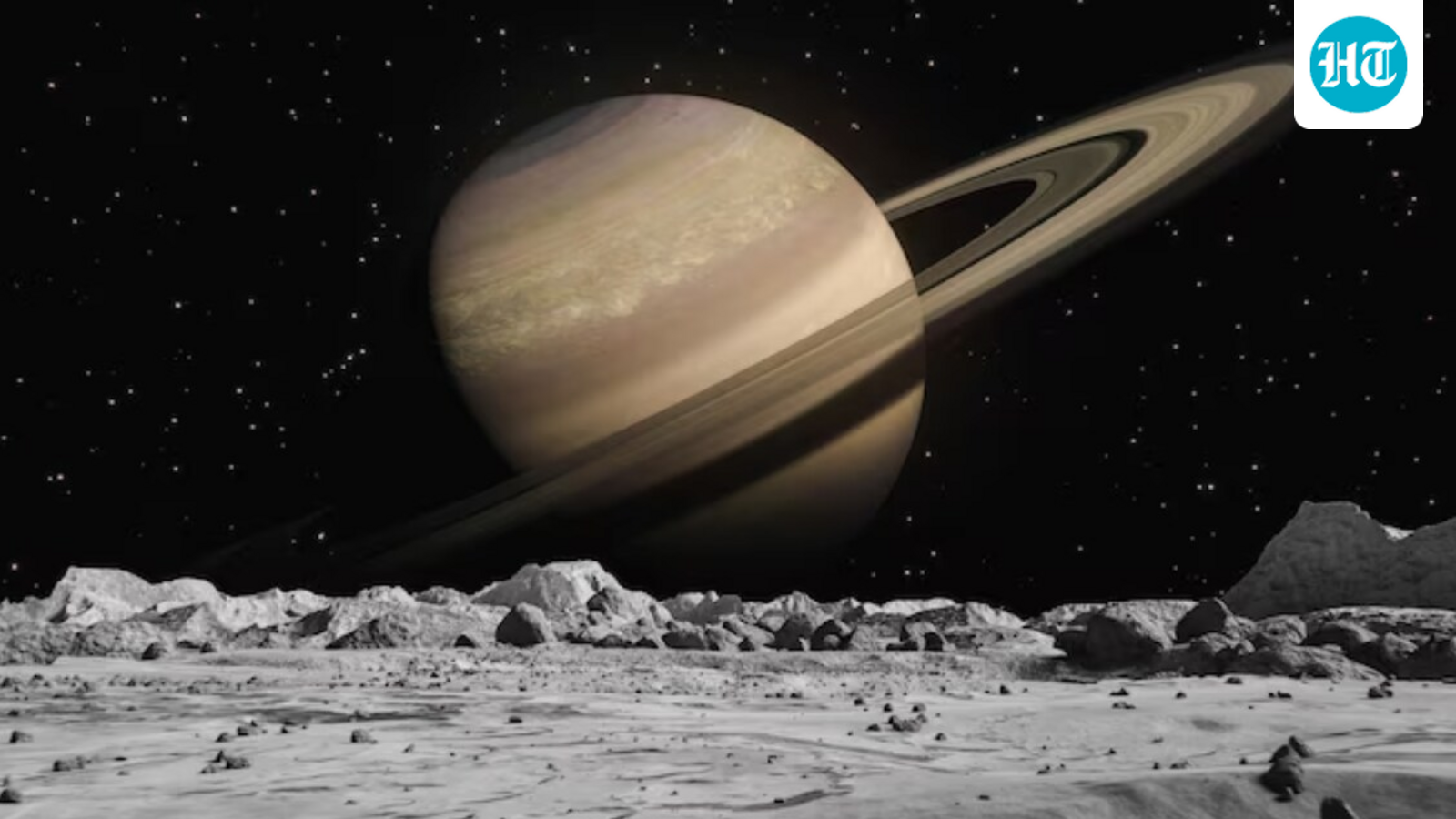
Saturn reaches opposition on October 4, making the planet visible for most of the night in India. As Earth passes between the Sun and Saturn, the Seeliger effect makes the rings appear brighter. NASA said, "coherent backscatters are an important contributor to the opposition surge." You can see it clearly.
Saturn reaches opposition on October 4, putting the ringed planet among the highlights of the October night sky. The event brings Saturn closer to Earth for the year and makes it visible for much of the night, but there is another phenomenon that makes the occasion particularly interesting for observers: the Seeliger effect, or opposition surge.
Opposition occurs when Earth passes between the Sun and an outer planet. From Earth, the planet then appears opposite the Sun in the sky. As a result, Saturn rises around sunset and remains visible for most of the night. NASA has listed October 4 as one of October's major skywatching events, noting that the geometry makes Saturn especially well placed for observation.
According to EarthSky, Saturn reaches opposition at 12:00 UTC on October 4, or around 5:30pm IST. At opposition, Saturn will be about 1.26 billion kilometres from Earth and will shine at around magnitude 0.3, making it readily visible to the unaided eye when above the horizon. Its apparent disk will measure about 19.7 arcseconds across through a telescope.
For skywatchers in India, Saturn rises at around 6:11pm on October 4 and reaches its highest point in the sky at approximately 12:17am, before setting around 6:23am on October 5. It will be visible for almost the entire night.
The Seeliger effect refers to the increase in brightness of Saturn's rings around opposition. The phenomenon is named after German astronomer Hugo von Seeliger, who studied the effect in the late 19th century.
The effect occurs because of the unusual geometry of sunlight, Saturn's rings and Earth around opposition. Saturn's rings consist of countless particles, primarily made of water ice. Under normal viewing conditions, these particles cast tiny shadows on one another. Near opposition, however, the Sun is almost directly behind the observer from the perspective of the rings.
That means many of the shadows cast by the ring particles fall directly behind those particles and become hidden from Earth. More of the visible ring surface is therefore directly illuminated, producing an increase in apparent brightness.
According to NASA, 'coherent backscatters' are an important contributor to the opposition surge. In this phenomenon, light scattered by particles in the rings can undergo constructive interference when viewed close to the direction from which the sunlight arrived.
Sky & Telescope notes that the Seeliger effect is expected to be most noticeable around October 3-5, with the rings appearing brighter relative to Saturn's globe for roughly a day or two around opposition. The publication says the effect is not dramatic but can be noticeable through a telescope, particularly for observers familiar with Saturn's usual appearance.
Saturn can be spotted without optical equipment as a bright, steady point of light. From India, skywatchers can look towards the eastern sky after sunset and follow the planet as it climbs higher through the evening.
A telescope, however, offers a very different view. Even a small amateur telescope can reveal Saturn's rings, while larger instruments can show features such as the Cassini Division (the dark gap between Saturn's rings) and some of the planet's brighter moons under favourable conditions.
The rings are currently opening up again after Earth passed through Saturn's ring plane in March 2025. EarthSky puts their apparent tilt at about 7.5 degrees in October 2026, meaning they remain relatively narrow compared with years when they are more widely tilted towards Earth.
The Seeliger effect will not make Saturn suddenly appear to flash or brighten dramatically to the naked eye. Instead, it is a subtle change in the way sunlight is scattered by the ring particles. For telescope observers, however, opposition provides a useful opportunity to see how the appearance of Saturn's rings changes with the geometry of the Solar System.