
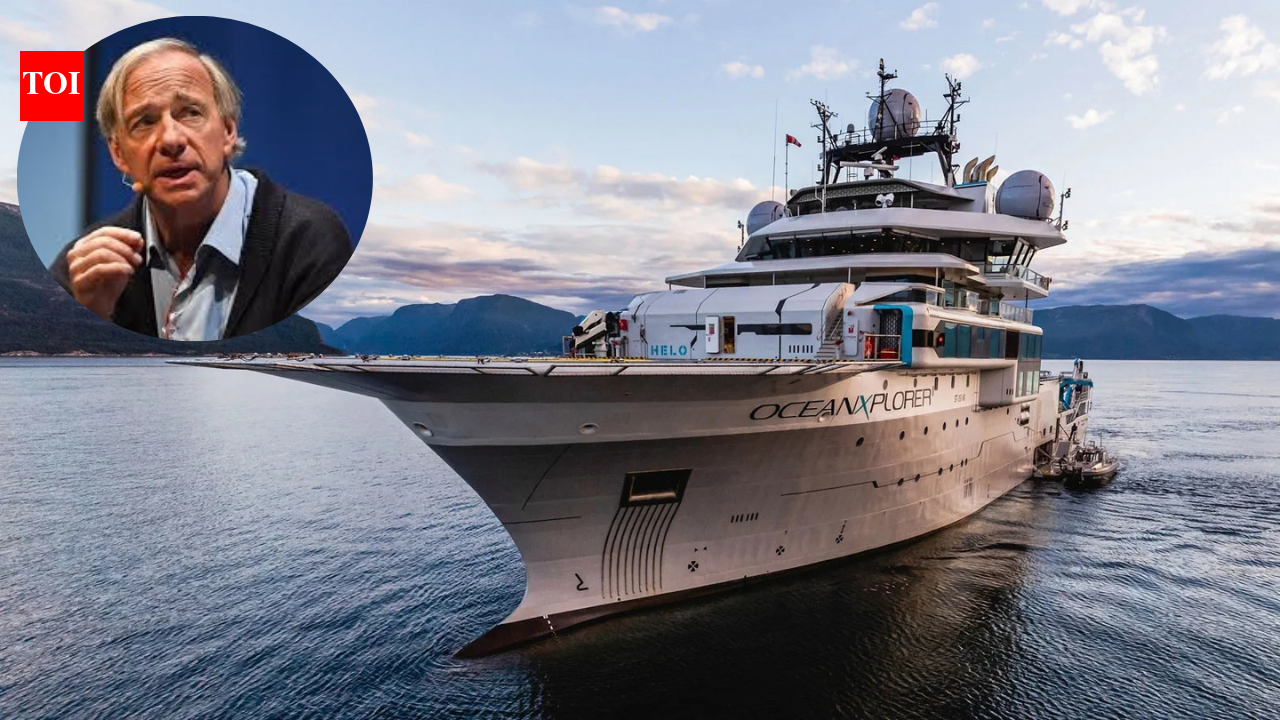
Billionaire Ray Dalio transformed a former oil-survey ship into the 87.1-metre OceanXplorer. The vessel got a major rebuild at Damen Shiprepair Rotterdam to support deep-sea research. It now carries two manned Triton submersibles that reach 1,000 metres. OceanX uses this ship to study the ocean and share discoveries with many.
Billionaire investor Ray Dalio's OceanX transformed a former oil-survey ship into the 87.1-metre OceanXplorer, a specialised vessel built to combine deep-sea research with advanced filmmaking and real-time broadcasting. The ship was originally known as Volstad Surveyor and later as Alucia2 before undergoing an extensive rebuild at Damen Shiprepair Rotterdam in the Netherlands. The conversion involved rebuilding the vessel from the main deck upwards and adding laboratories, research facilities, a submarine hangar, a helicopter hangar and specialised systems for ocean exploration. Today, OceanXplorer carries two manned Triton submersibles capable of reaching 1,000 metres, as well as remotely operated vehicles that can descend to 6,000 metres, allowing scientists to study parts of the ocean that are difficult to reach directly.
From oil surveying to ocean exploration
The vessel began its working life as Volstad Surveyor, an offshore survey ship. It was subsequently known as Alucia2 before OceanX commissioned its transformation into a dedicated scientific and media platform. Damen's conversion project involved stripping the existing accommodation and rebuilding the vessel from the main deck upwards, while expanding its structure to accommodate new laboratories, workshops and a submarine hangar.
OceanX described the completed ship as a platform for exploration, science and storytelling. The organisation was founded by Ray and Mark Dalio and operates as a nonprofit initiative of Dalio Philanthropies. The vessel became the flagship of OceanX's effort to explore the oceans and bring discoveries to wider audiences through media.
A major five-year conversion
Damen was the main contractor for the extensive reconstruction, which took place over a five-year project. The work involved up to 400 people aboard the vessel at one time and covered both its interior and exterior systems. Damen widened the ship's beam and constructed new cabins across its breadth, creating enough space for its scientific facilities.The completed vessel contains one wet laboratory and three dry laboratories, alongside specialist hydrographic and laboratory systems. A new sensor platform called the Gondola was installed beneath the keel, while a new 40-tonne A-frame was added to launch and recover underwater equipment.
Two submersibles can reach 1,000 metres
OceanXplorer carries two manned Triton submersibles named Nadir and Neptune. OceanX says they can take scientists and filmmakers to depths of up to 1,000 metres, providing direct views of the seafloor and allowing crews to observe marine life and collect biological and geological samples.The two submersibles have different roles. One is configured primarily for scientific work, including collecting samples from the seafloor, while the other has extensive camera equipment for documenting underwater environments. The media-focused submersible can also transmit video towards the surface, supporting live coverage from the deep sea.
ROVs can go much deeper
The vessel's exploration capability extends well beyond the depth reached by its manned submersibles. OceanXplorer carries remotely operated vehicles capable of reaching 6,000 metres below the surface. Unlike the manned submersibles, these vehicles remain connected to the ship through cables while operating at extreme depths.The ROVs allow researchers to investigate locations such as deep-sea geological formations, hydrothermal vents and underwater volcanoes. Samples and observations collected from these environments can then be examined using laboratories aboard the ship.
A floating scientific laboratory
OceanXplorer was designed so that discoveries made underwater can be examined without waiting for researchers to return to land. Its wet laboratory is used to process samples, while its dry laboratories provide facilities for analysing marine life and ecosystems.OceanX says the vessel's laboratories support eDNA and genetic sequencing, advanced microscopy and other forms of scientific analysis. This allows researchers to begin examining specimens and environmental samples during an expedition rather than transporting everything back to shore.
Mission control connects the ship's systems
At the centre of OceanXplorer's operations is its mission-control system. OceanX says its OpenVDM system collects and integrates information from equipment throughout the vessel, including its acoustic array, submersibles, ROVs and CTD instruments.The system allows teams to monitor, analyse and visualise information in real time and adjust their research based on what they are seeing. This links the ship, its underwater vehicles and its scientific facilities into a single research operation.
It is also built for filmmaking
Scientific research is only one part of OceanXplorer's purpose. The ship was designed as a combined marine research and media-production vessel, with a dedicated media centre and film studio.
Damen says the vessel incorporates Hollywood-standard cinematography and media facilities, while OceanX says its technology allows underwater discoveries to be shared with audiences in real time. The ship also has a helicopter and an integrated hangar, giving researchers another way to scout marine environments and track wildlife from above.
From the giant squid to OceanXplorer
Ray Dalio's involvement in ocean exploration predates OceanXplorer. According to Euronews, Dalio bought the research vessel Alucia in 2011. The vessel and its submersible were subsequently involved in the expedition that produced the first footage of a giant squid in its natural habitat in 2012.That earlier work helped lead to the creation of OceanX, which combined scientific exploration with documentary filmmaking and media. OceanXplorer subsequently became the organisation's flagship, carrying the same basic philosophy into a substantially larger and more technologically equipped platform.