
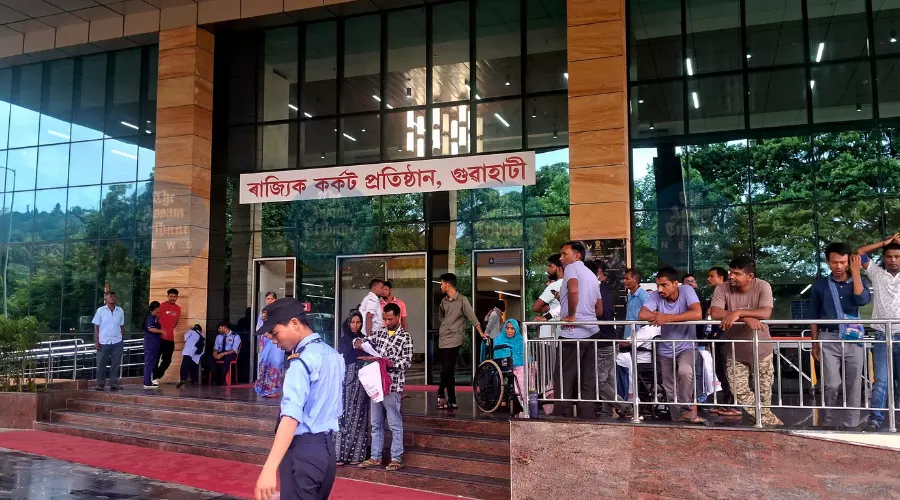
The Assam Cabinet approved Rs 600 crore to install a proton beam therapy accelerator at the State Cancer Institute in Gauhati Medical College and Hospital. This advanced machine will provide precise cancer treatment for patients across India. It also supports multidisciplinary scientific research, marking a major step for medical technology.
Proton accelerators enable precise cancer treatment, minimise damage to
healthy tissue, and advance multidisciplinary scientific and medical research.
proton beam therapy accelerator will be installed at the State Cancer Institute within Gauhati Medical College and Hospital (GMCH), with the Assam Cabinet recently approving an investment of Rs 600 crore for the project. The machine will cater to the cancer-treatment needs not only of people from the Northeast but also of patients from other parts of India.
This would be the third such facility in India after those at Tata Memorial Hospital in Mumbai and Apollo Hospital, Chennai, which have been using this technology in cancer treatment for many years.
Proton accelerators are also used in nuclear physics, accelerator physics, particle physics, atomic physics, material science, astrophysics and other fields for research and scientific advancements.
Accelerator development and humanity are closely interconnected. Without human beings, technology cannot prosper.
Technology can fascinate us and help save human beings from peril, but it can also destroy. The mysterious tiny building block of matter is the nucleus, which consists of protons and neutrons at its core, with electrons revolving around it.
The study of the structure and dynamics of protons, neutrons and electrons is inevitable in science and technology.
Accelerator science is the bridge connecting many multidisciplinary scientific fields, such as nuclear and particle physics. This interdisciplinary field is being pursued across the world and has applications ranging from energy production to medicine.
A major aspect of these interdisciplinary applications is their use in medical science, such as cancer treatment and the treatment of thyroid disorders, for human health and survival.
The proton beam has an advantage in the precise targeting of cancer cells with minimum damage to surrounding healthy tissue compared with an X-ray beam.
There are other accelerators, such as Pelletron accelerators, cyclotrons and the Large Hadron Collider, through which various ions are accelerated to study high-energy physics and experiments worldwide and to unravel the mysteries of the universe.
With the growing incidence of cancer in humans, the application of accelerator physics is paramount. Cancer incidence and mortality rates are increasing in Northeast India and across the country.
Radiation therapy is the use of ionising radiation, such as high-energy photons or particles, to treat patients with cancer. Radiation therapy is an effective way to treat many kinds of cancer in almost any part of the body. The goal is to kill cancer cells with as little risk as possible to normal cells.
The basic principle of radiotherapy is to deliver the maximum possible dose to the tumour while protecting normal structures to the maximum possible extent.
Before any radiation treatment, doctors may recommend a Computed Tomography (CT) scan, positron emission tomography (PET) or three-dimensional imaging using Magnetic Resonance Imaging (MRI) to study a patient's affected area.
In MRI, the protons from water in the human body are excited by radio-frequency (RF) magnetic fields, producing signals that are used to map the affected area.
The proton accelerator is quite useful in cancer treatment because of its ability to deliver high-energy particles in a highly conformal and precise manner. The Tata Memorial Centre (TMC), Mumbai, installed a proton accelerator in 2023 and has been using it for cancer treatment.
With the recent step taken by Chief Minister Himanta Biswa Sarma, the State Cancer Institute within GMCH is going to install a proton accelerator in the coming days; this could be a significant milestone for cancer treatment in Northeast India.
The proton accelerator application is multifaceted and has the potential to serve humanity in a better way. It is expected that the establishment of such a facility in Assam will ensure advanced cancer treatment in the Northeast.