
JNU scientists found that a human protein called p38-MAPK helps malaria and kala-azar parasites thrive. Published on June 11 in Communications Biology, the study showed that removing this protein from lab cells stopped the parasites. This new approach targets human cells instead of the germs, which often get resistant.
For as long as there have been medicines for malaria, the parasite behind it has been learning to outwit them. That parasite is Plasmodium, a single-celled organism passed on by the bite of an infected female Anopheles mosquito. Chloroquine, once the mainstay of treatment, is now largely ineffective against the deadliest Anopheles species in many parts of the world, and the medicines that followed it are beginning to wobble too. So a team at Jawaharlal Nehru University (JNU) in Delhi asked a different question. What if, instead of chasing the parasite, you took away what it borrows from you?
Their answer, published on June 11 in Communications Biology, is a human protein called p38-MAPK, a messenger inside our cells that parasites seem to lean on. When it was removed from human cells grown in the lab, both the kala-azar and malaria parasites struggled. No animal or patient has been treated yet. But the way it worked surprised even the scientists.
Professor Shailja Singh and Professor Anand Ranganathan lead the team, and have explored the host-first idea before in a 2022 kala-azar study. That study looked at SUMOylation, in which a cell fastens a tiny protein called SUMO onto other proteins, like a sticky note that changes what they do or where they go. It found that this process helps kala-azar parasites survive by dampening protective immune responses. The new study moves from a whole process to a single protein, p38-MAPK, destroys it outright, and tests malaria too.
WHY DO MALARIA AND KALA-AZAR NEED A NEW KIND OF TREATMENT?
Malaria caused an estimated 6,10,000 deaths and 282 million cases worldwide in 2024, according to the World Health Organization (WHO), which says drug resistance is now confirmed or suspected in at least eight African countries. Resistance means the parasite has changed enough to shrug off a medicine that once worked.
Kala-azar, medically called visceral leishmaniasis, takes its second name from the internal organs it attacks. It is spread by sandflies, tiny blood-feeding insects, and brings fever, weight loss, anaemia, which is a shortage of healthy red blood cells, and a swollen spleen and liver. It is fatal in over 95 per cent of untreated cases. An estimated 50,000 to 90,000 people develop it each year, and in India it clings to Bihar, West Bengal, Uttar Pradesh and Jharkhand.
Almost every drug for these diseases attacks the parasite itself, and parasites evolve. Host-directed therapy turns that logic around. Instead of fighting the intruder, it changes the home, targeting a human protein the parasite cannot do without. "A parasite can change its own proteins to escape a drug, but it cannot easily alter an essential human protein on which it depends," Professor Shailja Singh told India Today Digital.
WHAT IS P38-MAPK, AND WHY DO PARASITES NEED IT?
Think of p38-MAPK as a stress sensor in human cells, carrying news of injury and infection from the surface inward. The name is short for p38 mitogen-activated protein kinase, but the job is simple: it passes instructions along. It helps control cytokines, the chemical alarm signals immune cells use to talk to one another.
Kala-azar parasites hide inside macrophages, immune cells whose name comes from the Greek for big eaters, because their job is to swallow invaders. Malaria parasites take shelter in red blood cells. In both, the parasite appears to lean on this one protein.
WHAT IS A PROTAC, AND HOW DOES IT DESTROY A PROTEIN?
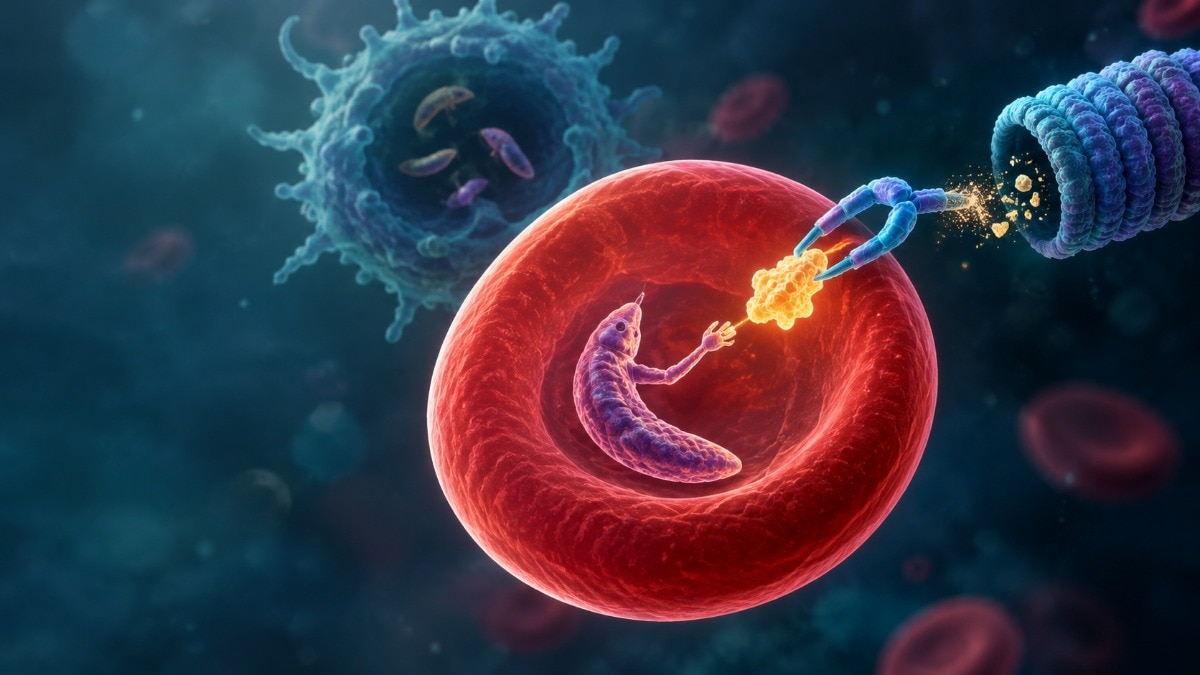
Most drugs block a protein, like jamming a machine so it cannot run. A PROTAC, short for proteolysis-targeting chimaera, is more drastic. Proteolysis means the breaking down of proteins, and a chimaera is something stitched together from two different parts. The molecule is, quite literally, two-handed. One hand grabs the target protein. The other grabs an enzyme, a protein that speeds up a chemical task, which tags unwanted proteins for disposal. The cell's own shredder, a barrel-shaped machine called the proteasome, does the rest.
The molecule used here, NR-7h, came from researchers at the Institute for Research in Biomedicine in Barcelona. It removed about half the p38-MAPK in human macrophages and red blood cells, leaving a close cousin, ERK1/2, untouched. That is called selectivity, and it matters, because a drug that damages everything nearby is rarely a good drug.
DID REMOVING THE PROTEIN REALLY WEAKEN THE KALA-AZAR PARASITE?
In the lab dish, yes. In infected macrophages, NR-7h cut parasite levels by up to about 16-fold, which means roughly 16 times lower. It did not poison the parasite directly, since parasites growing alone were unaffected and the macrophages stayed healthy. The damage came through the host, as though the house had been made uninhabitable.
The surprise lay in a control experiment, the kind scientists run to check that an effect is real. A standard drug that switches off p38-MAPK, known as an inhibitor, but leaves the protein standing, did nothing. “Removing the protein altogether did,” Professor Ranganathan said. “Earlier studies had suggested p38-MAPK activation helps the host fight this parasite, so we expected the inhibitor to behave differently.”
The researchers think timing matters. The protein’s activity rose six hours into infection and fell by 12. It may help defence early, while its continued presence later helps the parasite.
The immune signals shifted too. In infected cells treated with NR-7h, genes for TNF-alpha and IL-12, alarm signals that call immune cells to battle, are switched on about five-fold and three-fold more. IL-10, a calming signal that parasites tend to exploit, fell about four-fold. The idea, Professor Ranganathan said, is to “make the host cell less favourable for the parasite while also influencing the cell’s ability to fight infection.”
A combination test followed. Amphotericin B, originally an antifungal medicine and now an established first-line drug against kala-azar, makes the parasite’s outer membrane leak. On its own, it cut parasite load, the number of parasites inside cells, by roughly 70 per cent, and so did NR-7h. Together, they cleared parasites more effectively than either alone.
The team calls this an enhanced effect rather than synergy, a word for combinations that do more than the sum of their parts. It may allow lower amphotericin B doses and slow resistance, but “both possibilities need to be tested experimentally before we can draw firm conclusions.”
DOES THIS WORK AGAINST MALARIA TOO?
In the dish, yes. Mature red blood cells have no nucleus, the control room that holds a cell’s DNA and issues instructions for making proteins, so they cannot make fresh ones. A destroyed protein is therefore hard to replace. “This could help explain why targeting p38-MAPK in red blood cells may have a sustained effect on malaria parasite development,” Professor Singh said.
In treated red cells, the malaria parasite’s ability to invade fell about one and a half times at a low dose and about threefold at a higher one. Put plainly, it entered about two-thirds as many cells at the first dose and a third at the second.
WHEN COULD A HOST-DIRECTED DRUG REACH PATIENTS?
Not soon. Everything so far was done in human cells and cultured parasites, grown in the lab. No animal has been treated, no clinical trial exists, and NR-7h is, in Professor Ranganathan’s words, “a proof of concept," an early demonstration that an idea can work, not yet a medicine.
Safety is the obvious question, because p38-MAPK is a normal, useful human protein. “Completely blocking it throughout the body could have unwanted effects,” the team said, and “we need to establish how selectively and safely it can work” before patients are involved. Preclinical research, the lab and animal testing that must precede any human trial, “could take several years”, with clinical development taking “many more”, so “it is too early to predict a timeline.”
A parasite can rewrite its own proteins. It cannot easily rewrite ours. Whether that advantage becomes medicine is a question for animal studies, but it is the right one to be asking.