
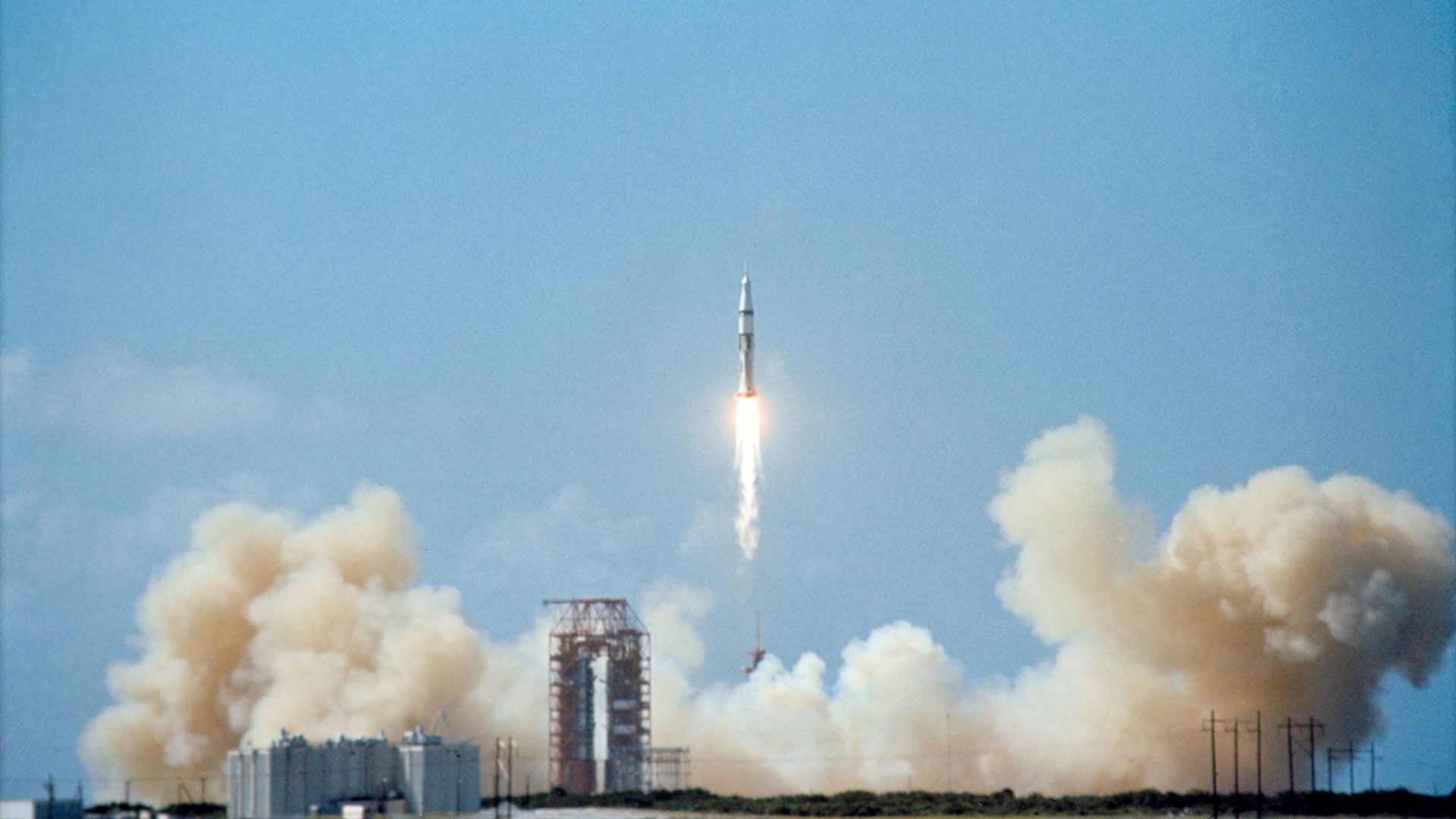
On Oct. 11, 1968, Apollo 7 launched into space with NASA astronauts Wally Schirra, Donn Eisele and Walter Cunningham. This mission rebooted the Apollo program after a deadly fire. It served as a vital test flight to prove the spacecraft worked, helping NASA move closer to landing on the moon.
On. Oct. 11, 1968, Apollo 7 launched into space with NASA astronauts Wally Schirra, Donn Eisele and Walter Cunningham. This was the first mission of the Apollo program that carried a crew into space.
Apollo 7 rebooted the Apollo program after a fire killed three astronauts during a launch rehearsal 20 months earlier.
NASA needed to prove that their Apollo spacecraft worked with this mission, which was really more of a test flight. Though the spacecraft seemed to work alright, the crew got a little snippy during their 11 days in space. First they suffered from motion sickness after launch, then Schirra came down with a cold, and the crew was constantly arguing with mission control and each other. None of the Apollo 7 astronauts went back to space after that.
Why it mattered
Had Apollo 7 not succeeded, the chances of NASA being able to fulfill President John F. Kennedy's 1961 goal, "before this decade is out, of landing a man on the moon and returning him safely to the Earth" would be called into question — not just because the clock was ticking down, but because of increasing political pressure to shut down the expensive moon program.
In the wake of the January 1967 Apollo 1 fire, NASA and North American Aviation, the prime contractor for the Apollo command module, needed to overhaul the spacecraft to make it safe for crews to fly in space. Apollo 7 provided a "shakedown cruise" for the vehicle, to confirm the fixes worked and that the command module was space worthy.
"In its day, the Apollo command module was the most complex machine ever built by man to be operated by man," said Walt Cunningham, Apollo 7 pilot, on the 40th anniversary of the flight in 2008. "We launched on the longest and most ambitious engineering test flight in history, testing the spacecraft systems, verifying the operating procedures, checking out the worldwide tracking network, and that's not to mention testing our crew."