
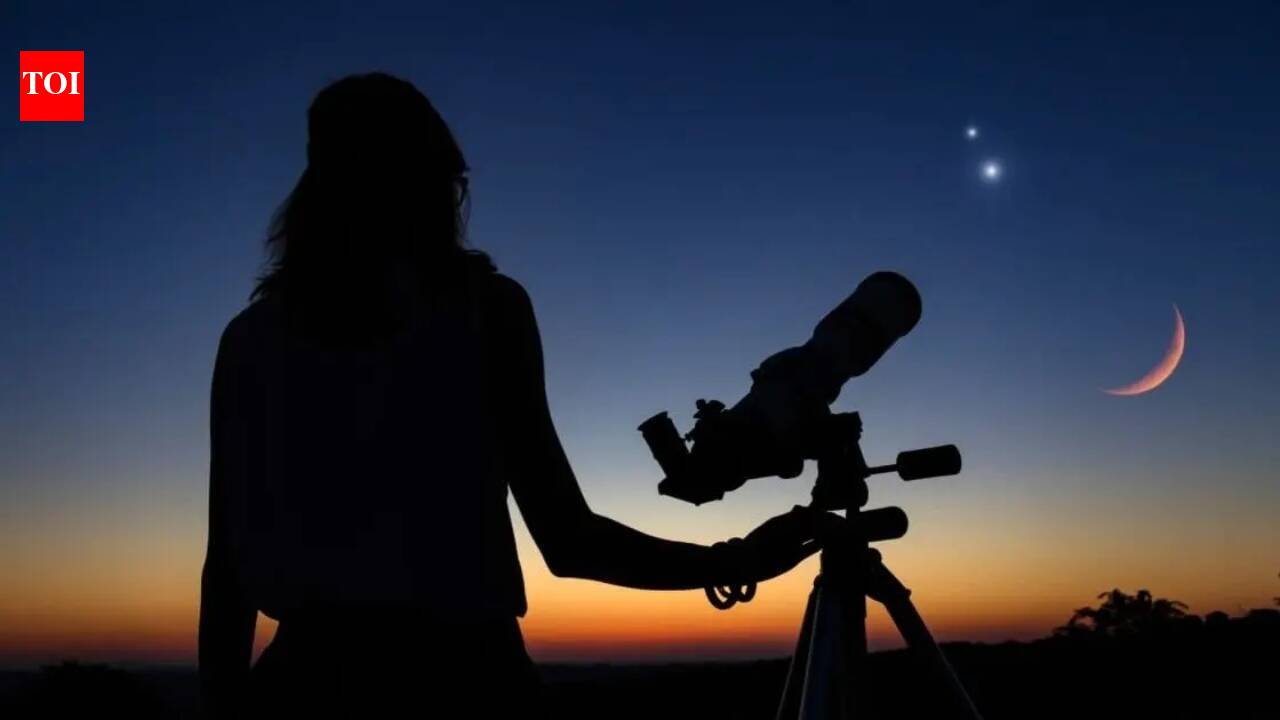
October 2026 brings exciting celestial events including the Orionid meteor shower and the Hunter's Moon. The Orionids peak overnight on October 21-22, though bright moonlight may affect visibility. Later, the Moon gets close to Saturn on October 24 and 25. You do not need fancy gear to enjoy these sights.
October usually sweeps in with some great reasons to get outside after dark, whether you're a dedicated stargazer or just someone who loves a little cosmic spectacle. As we step into the second half of the month, it's a full calendar of celestial events: meteors streaking from the remnants of Halley's Comet, the full Hunter's Moon rising, the Moon sidling up close to Saturn, and a stunning rendezvous with the Pleiades cluster. Saturn itself is hard to miss, putting on a show all month after opposition in early October.
What's even more interesting? You don't need a fancy telescope or expensive gear, either. In most cases, just a clear, dark sky and a little patience do the trick. Timing matters, though; you'll want to pay attention to when the Moon's up, how bright it is, what time things rise, and your local weather. Especially in India, these factors can change what's visible from night to night. Here's a rundown of the main events from October 14 through the end of the month, plus a few quick tips on getting the best view.
The Orionids are one of those classic "can't-miss" meteor showers, peaking overnight on October 21-22, per NASA. Every fall, Earth plows through the debris trail left by Halley's Comet, and tiny comet fragments slam into our atmosphere, burning up as sudden streaks of light. It's basically Mother Nature's fireworks: if the sky is dark enough, you might count 10 to 20 meteors per hour at the peak.
But there's a catch in 2026: the Moon, nearly full and bright in its waxing gibbous phase, will drown out the faintest meteors. Still, for observers in India, your best bet is those quiet, pre-dawn hours after the Moon sets but before the sky brightens with sunrise. Just grab a blanket, find a spot free from streetlights, let your eyes adjust to the dark, and scan wide sections of the sky. Forget binoculars and telescopes; they'll only limit your view.
Saturn has been easy to spot most nights since early October. During this time, Earth is lined up right between Saturn and the Sun, making the ringed giant shine extra bright all night long. On the nights of October 24 and 25, the Moon comes in for a close approach, which is known as a conjunction, as astronomers call it. The Moon will slide right next to Saturn in the sky, and if you look up after dusk, you'll spot Saturn as a steady, yellowish dot close to the Moon's glow.
Anywhere with a clear horizon and minimal city lights should give you a decent view. If you have a telescope, this is the perfect time to zoom in on Saturn's spectacular rings. Everyone else can just enjoy the show with the naked eye, as no special equipment is required.
Venus is usually the "morning star" or "evening star," but on October 24 it ducks hidden from sight, lining up almost directly between Earth and the Sun in what's called an inferior conjunction. This means Venus disappears in the Sun's glare, so it's unsafe and nearly impossible to try spotting it at this moment. But this celestial maneuvering is a good reminder: planets aren't fixed; they migrate, vanish, and reappear in totally different parts of the sky as the weeks pass.
After October 24, keep an eye out. Venus will swing to the other side of the Sun's glare and start popping up again in the pre-dawn sky, gradually growing brighter through November.
October's full Moon is famously called the Hunter's Moon, following the Harvest Moon in September. It climbs into the eastern sky right after sunset on October 25 and 26, painting the night in silvery light. If you catch the Moon just as it rises, you might see it glowing orange or even slightly red, which is a trick of the atmosphere that makes the Moon look bigger and more dramatic near the horizon.
Why call it the Hunter's Moon, though? Centuries ago, that extra-bright moonlight was a lifesaver for hunters tracking animals across harvested fields. The name's a nod to tradition, not any change in the Moon itself. One thing to note: the Moon's brilliance means fainter stars and some meteors will fade in comparison, but it's always a sight worth stepping outside for -- and a great reason to try some nighttime photography.
The last week of October brings a cosmic double act: the Moon passing near the Pleiades. Sometimes called the Seven Sisters, the Pleiades cluster sparkles in the constellation Taurus and has been an object of wonder since ancient times. On the nights of October 27 to 28, both the Moon and the Pleiades will rise together in the eastern sky. The Moon will probably wash out some of the cluster's fainter stars, but with just your eyes or a pair of binoculars, you should still see that trademark bluish haze and several bright points clustered together.
From myth to science, the Pleiades have a long story, featured in everything from Greek legends to wintertime festivals in India. Take a moment to connect with that history while you watch.
On October 29, the Moon comes closer to Earth, closer than at any other point in its elliptical orbit this month. Astronomers call this point perigee. Sometimes, when perigee lines up with a full Moon, people call it a "supermoon." In fact, the Moon actually looks a little bigger and brighter. This time, though, perigee lands a few days after the full Moon, so don't expect any dramatic changes in size. Still, it's a great excuse to gaze up, compare the Moon's look at perigee to other nights, and ponder the simple fact that the Moon's distance from us is always changing.