
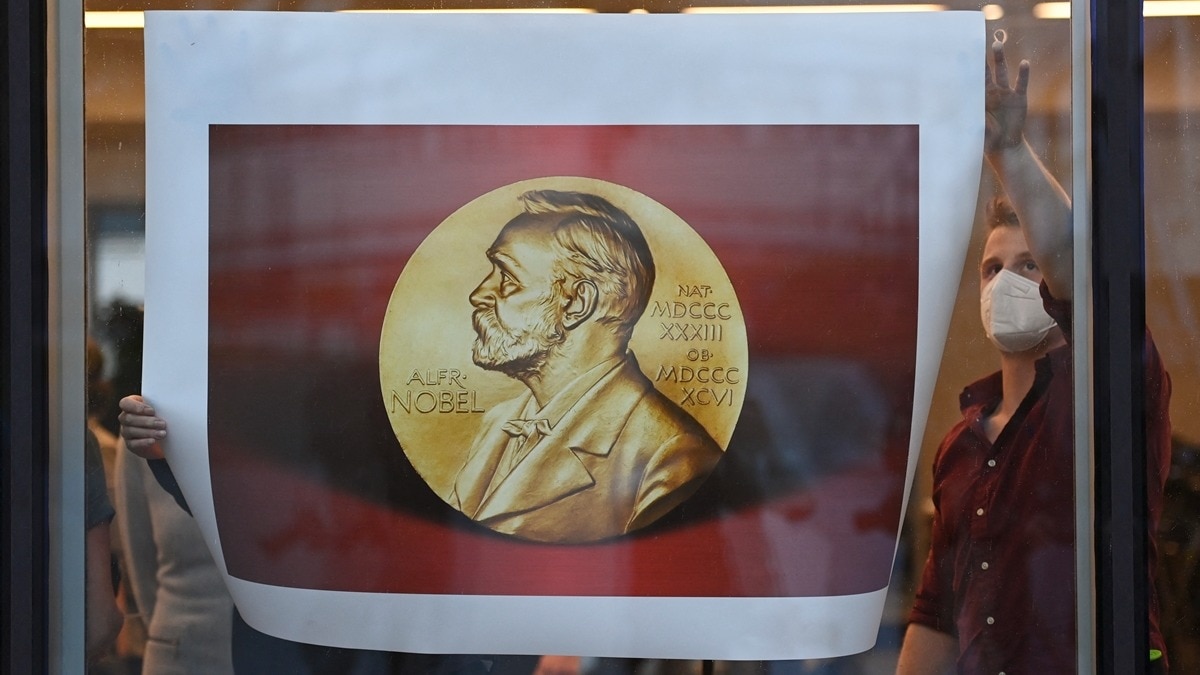
The Royal Swedish Academy of Sciences will announce the 2026 Nobel Prize in Chemistry on Wednesday. The event is scheduled for 3:15 pm IST at the earliest. This follows recent awards for Physics and Medicine. Chemistry holds a special place in history, as Alfred Nobel’s own work relied heavily on it.
The Nobel Week will move to its third science prize on Wednesday, when the 2026 Nobel Prize in Chemistry is announced by the Royal Swedish Academy of Sciences in Stockholm.
The announcement is scheduled for or 3:15 pm IST, at the earliest.
WATCH NOBEL PRIZE IN CHEMISTRY ANNOUNCEMENT LIVE HERE
The Chemistry Nobel comes after two very different scientific breakthroughs have already been recognised this year.
On Monday, the Nobel Prize in Physiology or Medicine went to Karl Deisseroth, Peter Hegemann and Georg Nagel for discoveries involving light-gated ion channels and optogenetics, a technique that allows scientists to control specific nerve cells using light.
On Tuesday, the Physics Nobel was awarded to Francis Halzen for his decisive contributions to the IceCube Neutrino Observatory and the discovery of high-energy neutrinos of astrophysical origin.
IceCube uses a cubic kilometre of Antarctic ice to detect the extremely rare interactions of these elusive particles, opening a new way of studying violent events in the universe.
Now, attention turns to chemistry.
Chemistry has a particularly close connection to Alfred Nobel himself. Nobel was an inventor, entrepreneur and industrialist whose work depended heavily on chemical knowledge. His inventions and the industrial processes he developed were rooted in chemistry. It was therefore no coincidence that Chemistry was the second prize field mentioned in his 1895 will, after Physics.
Since 1901, the Chemistry Nobel has been awarded 117 times to 200 laureates. The prize has recognised discoveries ranging from the structure of molecules and biological processes to catalysts, materials and technologies that have transformed modern life.
The field has also had relatively few women laureates. Only eight women have received the Chemistry Nobel so far. The youngest Chemistry laureate was Frdric Joliot, who was 35 when he won in 1935, while the oldest was John B. Goodenough, who was 97 when he received the prize in 2019.
What will this year's committee choose? The nominations remain secret for 50 years, meaning any names circulating before the
announcement are speculation rather than official shortlists.