
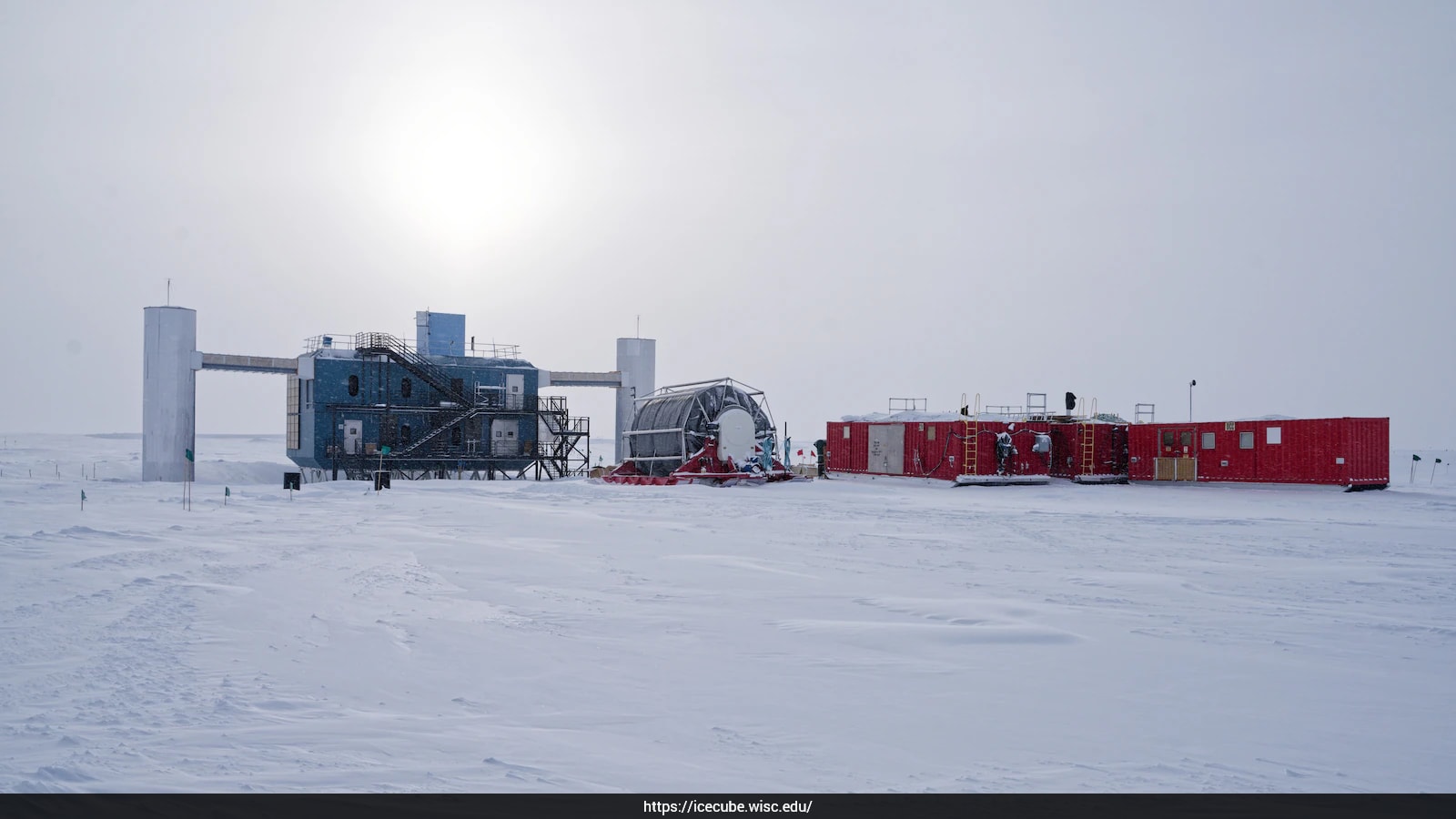
Belgian-American physicist Francis Halzen won the 2026 Nobel Prize in Physics for his work on the IceCube Neutrino Observatory. He used a cubic kilometre of Antarctic ice to detect elusive high-energy neutrinos. The Royal Swedish Academy of Sciences said his vision was fundamental to the development of this giant detector.
The IceCube Neutrino Observatory is built into about a cubic kilometre of clear Antarctic ice.
Belgian-American physicist Francis Halzen has won the 2026 Nobel Prize in Physics for his decisive contributions to the IceCube Neutrino Observatory and the discovery of high-energy neutrinos of astrophysical origin. Halzen's work helped transform a huge volume of ice beneath the South Pole into a giant detector capable of observing some of the most elusive particles in the universe. The Royal Swedish Academy of Sciences said his vision and scientific leadership were fundamental to the development of IceCube.
The IceCube Neutrino Observatory is built into about a cubic kilometre of clear Antarctic ice. Thousands of light sensors buried deep below the surface watch for tiny flashes produced when neutrinos interact with matter.
The idea dates back to 1988, when Halzen proposed using the ice at the South Pole to detect these extremely difficult-to-observe particles. IceCube was eventually completed in 2011.
What are neutrinos?
Neutrinos are tiny, electrically neutral particles that rarely interact with matter. Huge numbers of them pass through the Earth and through our bodies every second without being noticed.
Most neutrinos travel through matter without leaving a trace. Very occasionally, however, one interacts with an atomic nucleus. When this happens inside IceCube, it can create particles that produce a brief flash of light.
The sensors buried in the ice can detect these flashes. Scientists can then use the signals to work out the direction from which the neutrino came and investigate the cosmic event that produced it.
Why Antarctic ice matters
The South Pole may appear to be an unlikely place for a telescope, but its deep, clear ice provides an enormous natural detector.
Instead of looking up at the sky, IceCube effectively looks through the ice for the rare signals left behind by neutrinos.
This is important because neutrinos can travel enormous distances without being deflected by magnetic fields or easily absorbed by matter. They can therefore carry information from powerful events in distant parts of the universe.
Scientists hope to use these particles to study some of the most energetic environments in the cosmos, including distant galaxies and other extreme astronomical objects.
A new kind of astronomy
The Nobel Committee said Halzen's work has paved the way for a new kind of astronomy.
IceCube's observations have allowed researchers to detect high-energy neutrinos arriving from beyond the Solar System. The particles act as cosmic messengers, giving scientists information that cannot always be obtained from ordinary light-based telescopes.
The observatory has also detected neutrinos associated with our own Milky Way, adding another way for researchers to study our galaxy.
BBC reported that Halzen first presented his vision for detecting neutrinos at the South Pole in 1988. Nobel Committee for Physics chair Mark Pearce described his work as providing scientists with a "fantastic instrument" and said his scientific vision had helped create a new form of astronomy.
What happens next?
IceCube's work is continuing. An upgrade to the observatory was installed during 2025 and 2026 to improve its sensitivity and the accuracy with which scientists can determine the direction of neutrinos.
Scientists are also looking at the possibility of IceCube-Gen2, a much larger detector that could expand the search for high-energy neutrinos.
Halzen's Nobel Prize recognises a simple but ambitious idea: that the frozen landscape beneath the South Pole could be turned into a telescope.
By detecting particles that pass almost invisibly through the universe, IceCube has given scientists a new way to investigate some of the most powerful and mysterious events in space.
The Antarctic ice is no longer simply a remote frozen landscape. It has become a window through which scientists can explore the universe.
How may i help you today
Show full article
Track Latest News Live on NDTV.com and get news updates from India and around the world
Nobel Physics 2026, Francis Halzen, IceCube Neutrino Observatory, Antarctic Ice, Neutrinos, South Pole, Cosmic Particles