
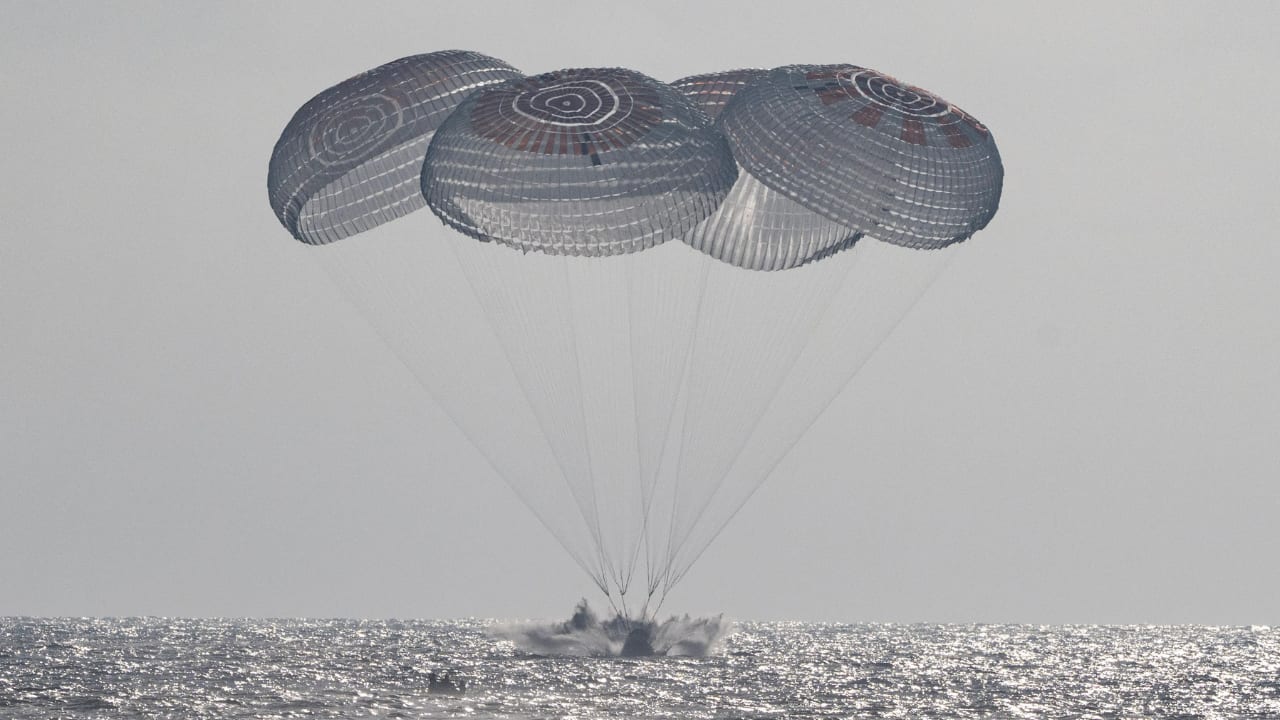
NASA’s SpaceX Crew-12 returned safely to Earth on October 8, 2026, after 237 days in space. The four astronauts splashed down in the Pacific Ocean after completing over 3,792 orbits. They will share mission highlights during a news conference on October 15 at the Johnson Space Center in Houston.
NASA's SpaceX Crew-12 mission has returned safely to Earth after more than seven months aboard the International Space Station (ISS), bringing an end to a 237-day stay in orbit. The four-member crew splashed down in the Pacific Ocean off the coast of Los Angeles on October 8, 2026, and is scheduled to discuss its scientific work during a news conference on October 15. The crew included NASA astronauts Jessica Meir and Jack Hathaway, European Space Agency (ESA) astronaut Sophie Adenot, and Roscosmos cosmonaut Andrey Fedyaev. Their spacecraft, SpaceX's Crew Dragon Freedom, returned to Earth at 8:34 am Pacific Daylight Time, after the astronauts travelled more than 100 million miles and completed over 3,792 orbits around the planet. Recovery teams aboard SpaceX vessels retrieved the spacecraft and its crew shortly after splashdown. Following routine post-flight medical checks, the astronauts were scheduled to return to NASA's Johnson Space Center in Houston. NASA SpaceX Crew-12: When and where to watch the crew briefing NASA has scheduled a news conference for 3:30 pm EDT on October 15, 2026, at the agency's Johnson Space Center in Houston. The astronauts will discuss their mission and the scientific research conducted aboard the ISS. The briefing will provide an opportunity to hear more about the crew's work during its seven-month mission, including experiments designed to support future human exploration beyond low Earth orbit. European Space Agency astronaut Sophie Adenot will return to Europe and will not participate in the news conference. Crew-12 astronauts complete 237 days aboard the ISS Crew-12 launched on February 13, 2026, at 5:15 am EST and docked with the International Space Station the following day. The mission marked the second spaceflight for Meir and Fedyaev, while Hathaway and Adenot made their first journeys to space. During their time aboard the orbiting laboratory, the astronauts supported scientific research, tested new technologies and carried out activities aimed at improving the safety of future space missions. NASA Administrator Jared Isaacman said the crew's work demonstrated the expertise and cooperation required to sustain human spaceflight. He also highlighted the importance of building the experience needed for repeated missions farther into the solar system. What scientific experiments did Crew-12 conduct in space? The Crew-12 astronauts spent hundreds of hours conducting research aboard the ISS. Their work covered human health, medical technology and the challenges of keeping astronauts healthy during long-duration spaceflight. Key areas of research included: Stem cell production: Investigating methods to produce stem cells in space that could support the development of cell-based therapies for cancer and other diseases. On-demand IV fluid generation: Testing technology that could help future crews produce intravenous fluids during missions where resupply from Earth is limited. Pneumonia and heart health: Studying how bacteria responsible for pneumonia may contribute to long-term heart damage. Nutrition research: Examining nutritional factors that can affect astronaut health during spaceflight. Blood flow in microgravity: Investigating how physical characteristics may influence blood flow, helping researchers develop ways to protect astronauts during extended missions. Research aboard the ISS helps scientists understand how the human body responds to spaceflight while testing technologies that may be needed for future missions to the Moon and Mars. Jessica Meir and Sophie Adenot set spacewalk milestones Crew-12 also made notable contributions to spacewalk operations. NASA astronaut Jessica Meir completed four spacewalks during the mission, bringing her career total to seven. She now ranks third among NASA women astronauts for the total number of spacewalks, behind former astronauts Peggy Whitson and Suni Williams. ESA astronaut Sophie Adenot completed three spacewalks, becoming the first French woman to venture outside the International Space Station. Their work contributed to the maintenance and operation of the orbital laboratory, which continues to serve as a platform for scientific research and technology development. How Crew-12 supports future Moon and Mars missions NASA's Low Earth Orbit Program works with commercial partners, including SpaceX, to maintain reliable access to the International Space Station and support research in orbit. Missions such as Crew-12 allow astronauts and scientists to test equipment, study the effects of long-duration spaceflight and reduce risks associated with future exploration. The findings are expected to contribute to preparations for human missions beyond Earth's immediate orbital environment. With the Crew-12 astronauts safely back on Earth, NASA will continue to assess the mission's results and share details of the scientific work conducted during their 237 days in space.