
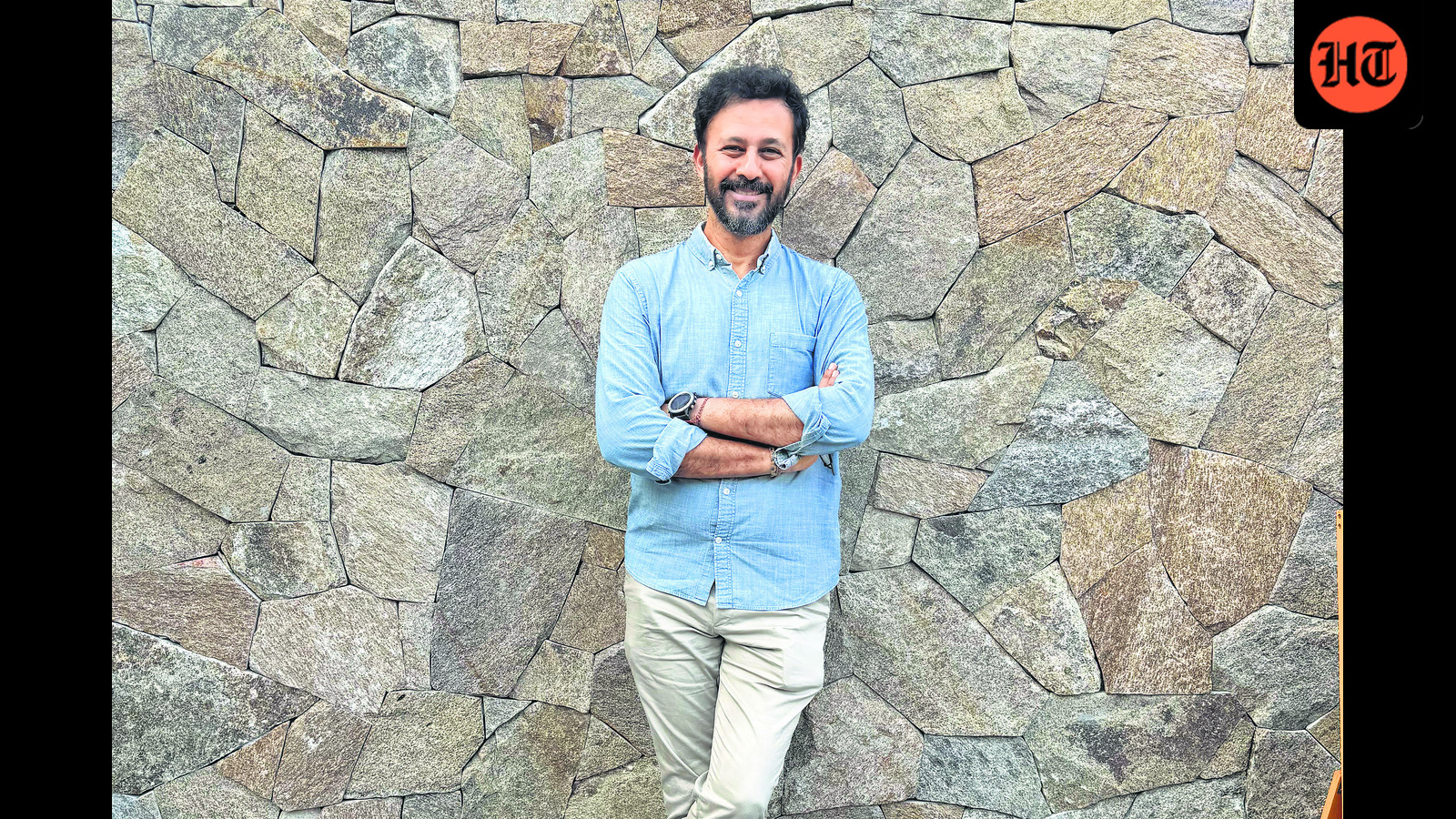
Epidemiologist Ramanan Laxminarayan released his new book, Bacteria to Buddha, last month. The Princeton scholar explores how cooperation shaped human consciousness over billions of years. "Cooperation is a fundamental pattern of life and is why life became complex," he said. His work connects biology, philosophy, and our modern digital lives.
Consciousness, perhaps, began not with a thought, but with our desire to speak to each other.
For most of his life, epidemiologist Ramanan Laxminarayan, 55, has devoted his time a world that is too small for the human eye. He has studied microorganisms that talk to each other through signals, exchanging vital information about energy sources and potential dangers - even when they were not genetically related.
Within this microscopic world of the petri dish, the senior research scholar at Princeton University, whose work sits at the intersection of public health, economics and infectious disease, saw echoes of a larger idea.
"Cooperation is a fundamental pattern of life and is why life became complex," Laxminarayan says. From the earliest single-celled bacteria to humans, evolution has involved greater complexity and connection. Even fungi that provide plants with phosphorus and nitrogen in exchange for carbon exhibit a sense of justice, he adds.
The president of the global public health research organisation One Health Trust has since spoken to the Dalai Lama about meditation and interviewed Buddhist monks in India and Japan about their inward journeys. He has also worked with evolutionary neuroscientists studying how we developed neural pathways that help us engage with our own nervous systems.
His sweeping examination of research across cognitive science, neuroscience and evolutionary biology, alongside philosophy, religion and literature including Basho's poetry, René Descartes' Treatise on Man and the Taittiriya Upanishad, has culminated into his latest book, Bacteria to Buddha: How Cooperation Shaped Consciousness - and Makes Us Human that released last month.
It marks a sharp departure from his previous three books, The Value of Information, Choosing Health in India (2009; co-authored with Prabhat Jha), and Extending the Cure (2007; co-authored with Anup Malani and David Howard).
"Once I started looking for consistencies in life, from bacteria to primates, it became clear that awareness of the world and other organisms is the skill life has been perfecting for nearly four billion years and is also the basis for many ideas in spirituality in both East and West," Laxminarayan says.
The book traces how the nervous system was shaped by neurochemicals and emotions, as life grew in complexity from the first single-celled organisms. It also explores how the emergence of cooperative consciousness helped humans build civilisations, languages and traditions, and how these connections are now at risk of being eroded by attention-consuming technology.
Just as bacteria react to their environment, he writes, more complex forms of life, such as dolphins, can recognise their own bodies, while great apes can read intentions and respond to the actions of others. Humans, however, can think about their own reactions to the world and attempt to regulate them through meditation and contemplation - a capacity that he argues is rooted in our evolutionary history.
Excerpts from an interview.
If cooperation is a fundamental impulse of life, why do nations, economies and individuals find themselves in so much strife?
It is a fair question. Shashi Tharoor, after reading the book, also asked me: "Do you really feel like we're cooperating?"
I think we are doing much better than we appreciate. For example, a bunch of chimpanzees could never convene a global institution like the United Nations.
And the human condition is actually improving.
Together over the last few centuries, we have vastly reduced the chance of dying early in life, eliminated major infectious diseases, improved human rights, tackled the ozone hole, and so much more.
Could the decline of liberalism be signalling a return to a more competitive natural order?
Plants that are stingy don't get enough nutrients. So these are not moral values - they are simply how nature works at all levels.
Without cooperation, there is simply no complex life. And it relies on a balance of two kinds. First, cooperation between individuals demands fairness and equity, even if it seems like it's a long way away.
Equally important is a sense of balance within individuals so we can be in harmony with others, which helps our survival. That is where contemplative practices, meditation or perhaps even music play a role.
Journalists such as Michael Pollan argue that AI can never be truly conscious...
The more relevant question is what AI is doing to our consciousness. AI may do better than us on thinking over time, but that has been happening for a long time.
The real threat, I think, is that AI performs relationships for us with others, unbinding us and hampering our ability to cooperate.
Take language, for instance. Why do Large Language Models (LLMs) threaten our identity as humans? It is likely because they do something that we thought was uniquely us - the ability to connect with others.
Consciousness evolved as a way for us to understand others, and if AI mediates relationships with others, then we get less adept at doing this.
How do you scientifically study something as intangible as consciousness?
Consciousness is something everyone has an experience of and perspectives change depending on whether one is a philosopher, neuroscientist, biologist or a monk.
For my part, I came to this question because of a conversation with the Dalai Lama, who encouraged me to better understand the purpose of meditation. I couldn't tackle that question without first anchoring that enquiry to some truth that I could hold onto as a scientist. That truth was evolution.
You presented the book to your high school English teacher. Why was that important to you?
I think we all seek our high school English teacher's approval in writing, because they're the ones who first taught us what good writing could be.
After reading the draft, she encouraged me to provide something actionable for how we educate and raise children. From the viewpoint of building consciousness - and yes, it can be expanded - education cannot just be the cultivation of intellect but needs to train perception or tuning of a nervous system to the social world.
This matters most to children early in life. When education shifts too quickly toward screens, we don't let children read faces or tones. And, in turn, they lose the chance to develop the intuition to know whom to trust. These are the skills they will need as adults to focus, cooperate, and to tolerate failure and frustration.
By constantly editing their engagement with the world, particularly in cities where we actively train children not to engage with others, especially adults, we deny them this essential skill.
We will crack climate change and likely tackle AI. But the loss of person-to-person connection worries me most. Without that substrate of connection, every other problem becomes much harder to solve.
What might the future of consciousness look like?
A billion years from now, consciousness will undoubtedly be much more expansive and sentient life will be as different from us as we are from fungi.
Those creatures may or may not be related to us, depending on our survival, but there will be creatures extraordinarily able to cooperate in ways we can't imagine.