
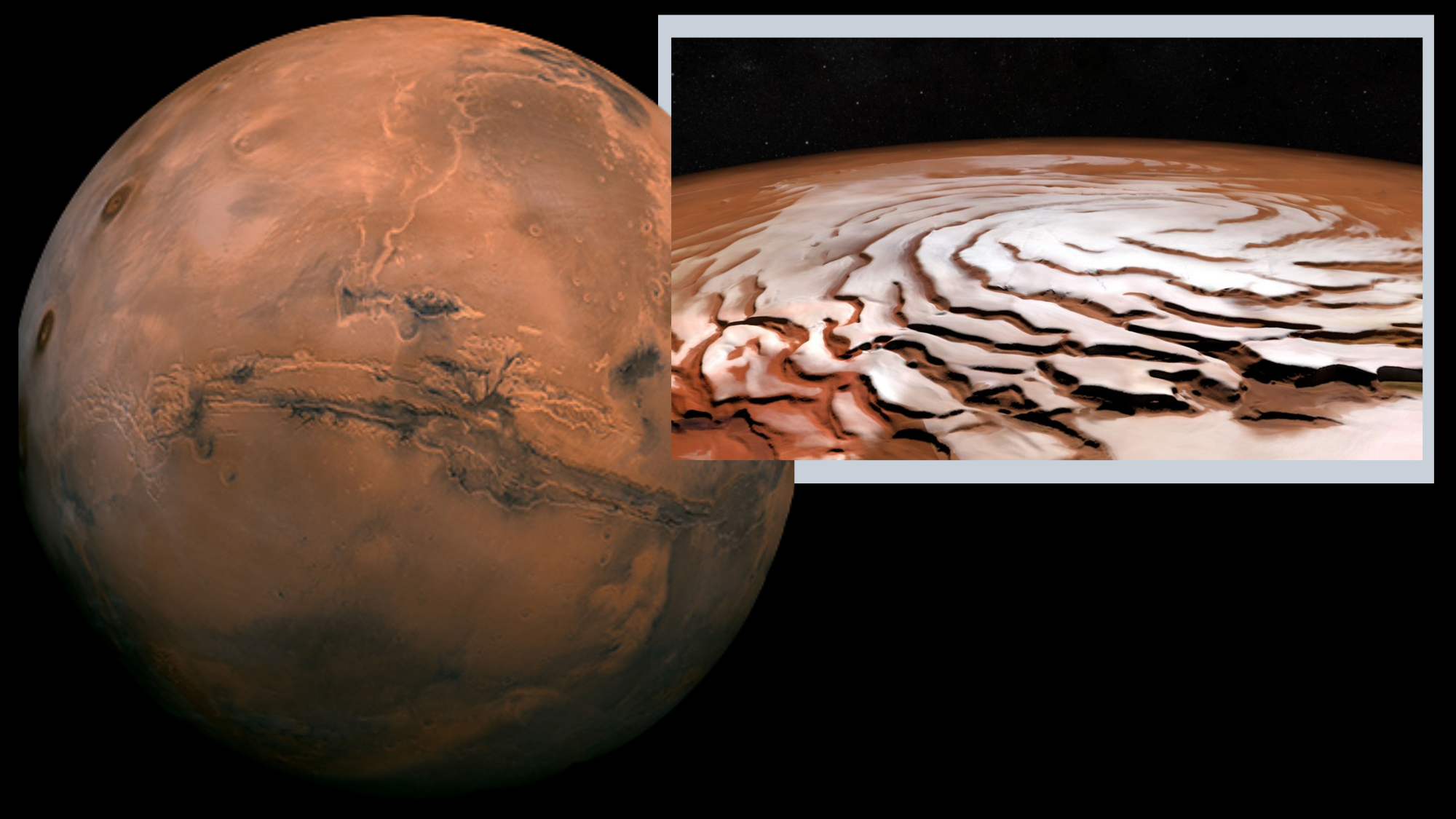
Mars’s north pole ice contains only 3% dust, much less than the 25% previously estimated. Aditya Khuller said, "We know there is water-ice in the area surrounding the north pole of Mars, but there has been widespread disagreement as to how dusty that ice is." This cleaner ice reflects more sunlight.
The water ice at Mars’s north pole is not as dusty as planetary scientists thought, which could change how we think about the Red Planet’s past and present climate. That could, in turn, improve our understanding of Mars' prior habitability.
When dust is present in ice it acts as an insulator, absorbing sunlight and consequently causing the ice to melt or sublimate depending on the air pressure. Previous estimates suggested that the water-ice in Mars’ north polar cap and extended polar regions contained as much as 25% dust by mass.
"We know there is water-ice in the area surrounding the north pole of Mars, but there has been widespread disagreement as to how dusty that ice is," Aditya Khuller of the University of Washington said in a statement. "If it is dustier, the ice will be darker. Just like a dark t-shirt in the sun makes you warmer, dusty ice gets warmer and vaporizes faster on Mars."
However, a new analysis by Khuller and graduate student Pari Mohan using an alternate method has now concluded that the ice contains merely 3% dust by mass.
This means that not only does the ice absorb less sunlight, reducing the amount of ice that vaporizes into the Martian atmosphere, it also reflects more sunlight back into space because it is cleaner and therefore brighter.
The reflectivity of a planet is referred to as its albedo, and the more sunlight is reflected, the less is retained to help warm Mars, which needs all the warmth it can get sitting on the outer edge of the solar system's habitable zone.
A new way to look a Martian ice
This new conclusion is a consequence of Khuller realizing that the technique previously used by planetary scientists to determine the properties of Mars’ water ice was not the best model.
That technique was based on the properties of lunar regolith (dirt) on Earth’s Moon, but when Khuller applied it to ice on Earth, he found the results were not accurate. If it had problems describing the properties of Earth’s ice, was it really suitable for deducing the properties of Mars’ ice?
So Khuller and Mohan applied a tried and trusted technique derived by Steve Warren, professor emeritus at the University of Washington.
"His methods had been used successfully to study snow and ice on Earth for decades," said Khuller. "So I thought it would be interesting to adapt these Earth-tested methods to Mars."
Khuller and Mohan ran the numbers, which is when they came to the conclusion that the ice at Mars’ north pole was not as dusty as previous models had suggested. But what does that mean for Mars’ climate history?
Mars has ice caps at both its poles, and during winter they are covered in a frosty layer of carbon dioxide ice.
At the south pole, this layer is tens of feet deep, but at the north pole it is shallower, about a meter deep. In summer, that carbon dioxide ice sublimates into the air, and this happens faster at the north pole because of the relative thinness of the carbon dioxide. Exposing the more permanent water-ice cap beneath.
This is called the North Polar Residual Cap, which sits on top of numerous mile-thick layers of water-ice deposits, some dustier than others, collectively called the North Polar Layered Deposits. The residual cap is just the most recent active layer of what Khuller refers to as an "ice-cream sandwich."
The different layers of ice in this sandwich contain different amounts of dust, with dirtier layers sandwiching cleaner ones. Depending upon which layer was exposed to the air at the time, it would have affected Mars’ climate differently. The current residual cap appears to be scarce in dust and is contributing to Mars’ cold environment. However, these differences can even occur on an annual timescale with the coming and going of the carbon dioxide frost.
Orbiting satellites such as Europe’s Mars Express and NASA’s Mars Reconnaissance Orbiter and Mars Odyssey have been imaging and mapping the Martian surface, including the polar caps. These observations have noted the ice caps changing in brightness seasonally as the carbon dioxide ice builds up and then sublimates.
"By looking at how the brightness changed over time, we figured out that there is a frost that forms in the winter and it’s more dusty," said Khuller. "In the Martian summer it goes away, exposing cleaner, older ice."
There could also be a connection with possible habitable environments on Mars.
Mars wasn't always so barren and dry
In the past, when the dustier layers of the polar cap’s ice-cream sandwich were exposed, they would have absorbed enough sunlight to melt the bottom of their particular layer of ice. This would have created pockets of liquid water that would be rich in nutrients provided by the dust.
On Earth, shallow pools of dusty meltwater are usually teeming with microbes that become dormant when the water freezes again in winter and then reactivate when the ice melts in summer.
Mars' ice caps could therefore have provided the perfect habitat for microbial life, but as of yet we have not found any life on the Red Planet.
"The fact that Mars and Earth both have these similar layers of water-ice and dust is interesting," said Khuller. "Why does one planet have life and the other doesn’t?"