
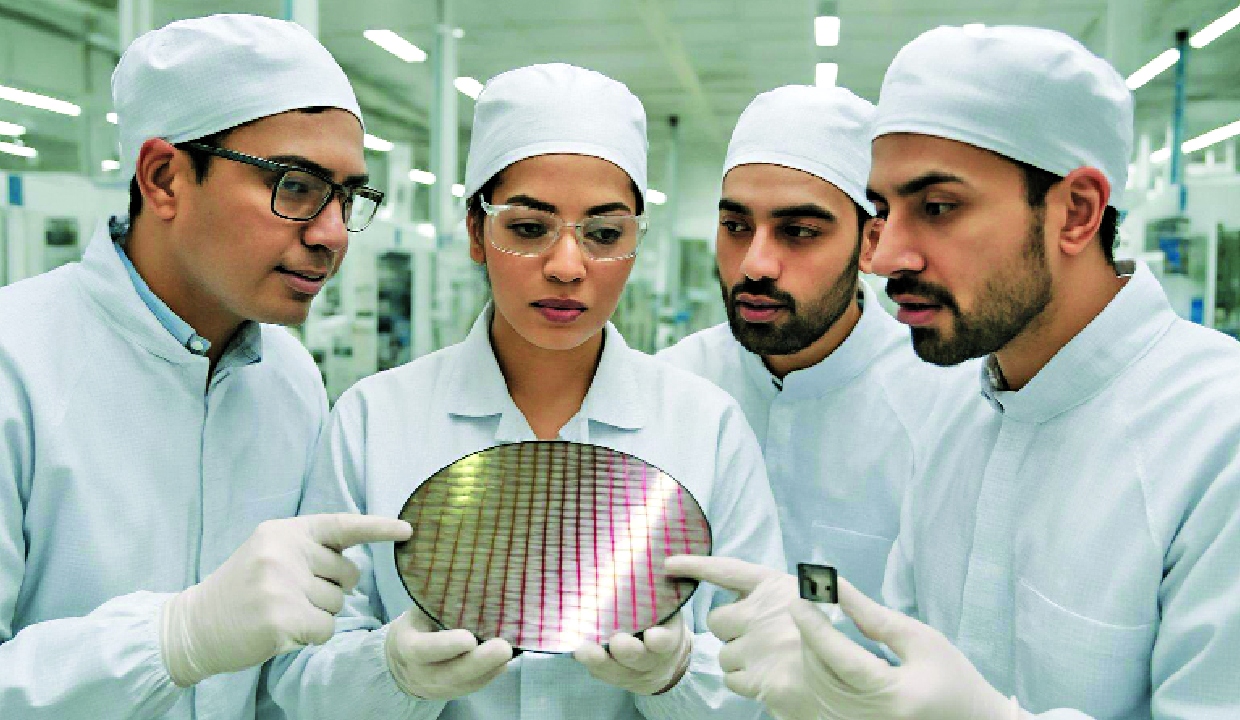
India is starting a chip revolution to stop relying on foreign imports. At Semicon 2026 in Delhi, held from September 17 to 19, many local firms showed off homegrown designs. Companies like Netrasemi displayed affordable AI chips, proving that India now makes the smart technology needed for our modern world.
Every nation that has reached the front rank did so through a revolution of its own. The countries that seized the Industrial Revolution still shape the world's politics and markets. India has its own examples. The Green Revolution ended our dependence on imported grain, and the White Revolution turned a milk-short country into a dairy giant. The formula is consistent: the entrepreneur reads the market, the government reads the technology, both read the world, and together they make bold calls. A third such moment is arriving now, and it is etched in silicon.
Chips are the brains of every machine. For decades, India mostly bought them from abroad. Only a handful of specialised chips, built for research, defence and space, were made at home, which kept us on the consumer side of the electronics world. That is changing fast. Cars and buses now carry layers of electronics, kitchens and clinics run on embedded intelligence, and in the age of AI, a chip's worth lies in making complex decisions both accurately and quickly. No country wants to depend on others for something so central to daily life and national security.
Consider what a chip actually does. Wired to the other components on a board, it weighs the available options and decides how to carry out each instruction, one task after another, in a fraction of a second. That ability to decide turns a plain device into a smart one, and it is why demand for advanced chips keeps climbing worldwide.
I got a close look at this shift at Semicon 2026 in Delhi, held from September 17 to 19. Thousands of young people from across the country filled the halls, and the mood was unmistakably that of a nation finding its feet. At one Indian company's stall, a homegrown chip priced at just '100 caught my eye. Called Ahisa, it is the core component behind devices that spread a broadband connection across a housing society or an office. India used to import such parts; now it exports Ahisa to several countries. Entrepreneurs designing chips for very different jobs were also on show, and the sheer variety made the point plainly: a chip revolution is under way.
Other stalls told similar stories. Netrasemi, an Indian firm, displayed a chip priced at around '1,000 that powers AI cameras for residential societies, alerting a control room the moment rules are broken. The same company makes a chip that watches a driver's face and sounds an alarm at the first sign of drowsiness, a quiet but potentially life-saving feature for buses and cars. Elsewhere, I saw chips for curtains that open and close from a phone, and one that replaces the costly motor in kitchen appliances, so a young engineer can build a mixer or grinder far more cheaply. Many such components still reach our market from China. What matters is that Indian designers are now building alternatives.
Behind the startups stands the state. The Semiconductor Mission, now in its second phase, is meant to give entrepreneurs room to build. Amitesh Sinha, a senior officer at the Ministry of Electronics and Information Technology, told me that substantial ground has been covered in five years and that the country stands at an inflection point. Public institutions are doing their share. At C-DAC's stall, scientists displayed the supercomputer Param Vidya and the Indian server Rudra, which gives research students access to material from reputed institutions worldwide. Once the indigenous microprocessor Om is ready, servers like Rudra can become fully Indian. At C-MET, I saw hafnium, a metal found in India, where a tiny piece was priced in lakhs. Hafnium oxide serves as an insulator inside chips, particularly memory chips. C-MET works on raising the purity of such materials, and its Director General, R Rateesh, said several entrepreneurs had enquired about them during the show.
Domestic supply and domestic refining of materials like this is how self-reliance reaches the foundations.
The ambition does not stop at meeting our own needs. A democracy with a reputation for reliability is well placed to supply the world, especially developing countries that want assurance that the chips behind their everyday electronics will not run dry. The India Semiconductor Mission 2 is built around that promise. Even a simple phone assistant needs two things: a language model that understands Indian languages, and a powerful chip underneath it.
I belong to Generation X, which remembers being denied advanced computing technology from abroad. That denial pushed our scientists to build Param, India's first supercomputer, in the transistor era. Today Param Vidya extends that lineage, a foundation laid for the generations after us. For Gen Z and Gen Alpha, the opportunity is larger still. Engineers, designers, materials scientists and scholars from many fields can find a place in this ecosystem. The next few years will decide how far we go. Technology has been bent to destructive ends before, which is why a peace-loving country like India carries a particular responsibility to lead in it. Our culture, traditions and lived experience hold a deep understanding of how to ease ordinary lives.
What is needed is an environment where responsible technology and a trusted global image reinforce each other. If we pair the chip revolution with the old Indian wisdom of balanced development, jobs will follow, everyday hardships will ease at low cost, and India will earn its place as a responsible digital nation.