
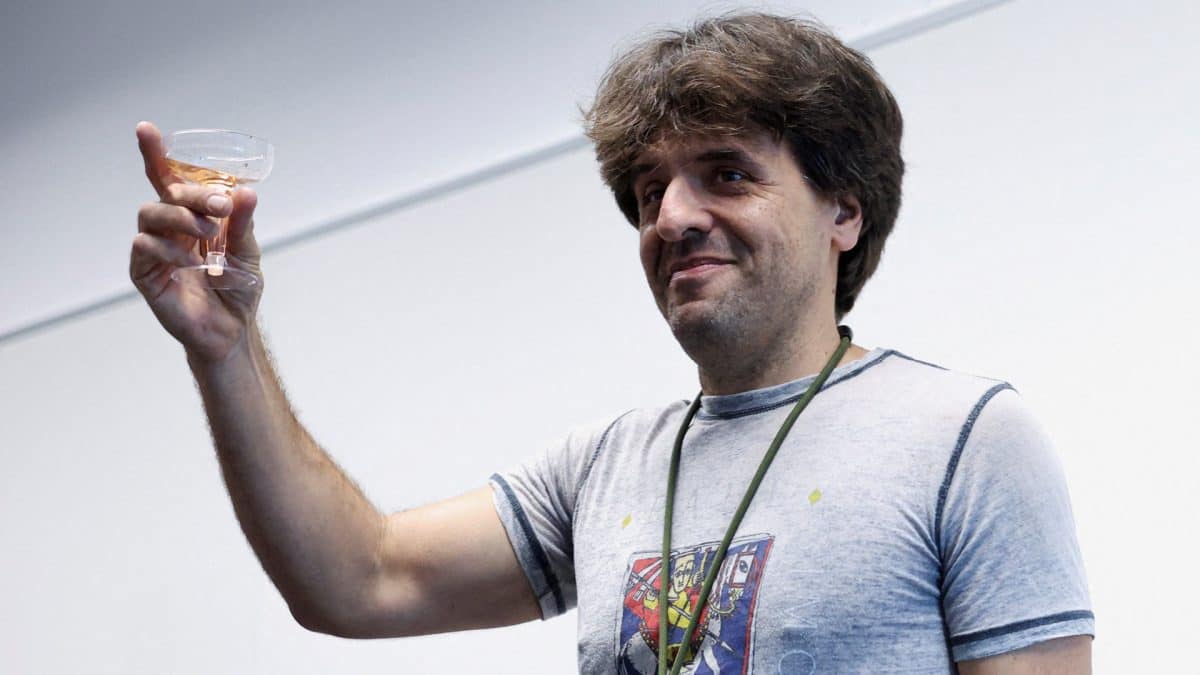
On October 5, Karl Deisseroth became one of the three scientists to win the 2026 Nobel Prize in Physiology or Medicine. His work helped develop optogenetics, a technique that uses light to control brain cells. Deisseroth said, "The work we have been able to advance is the common property of humanity."
In an exclusive interview with Firstpost, Deisseroth spoke about the science behind his work, its potential to improve medical treatment and why he hopes to make complex scientific discoveries easier for the public to understand.
On October 5, Karl Deisseroth became one of the three scientists to win the 2026 Nobel Prize in Physiology or Medicine for discoveries that helped develop optogenetics, a technique that uses light to control the activity of specific brain cells.
The method has opened new ways to study how the brain works and could help scientists develop treatments for various diseases.
In an exclusive interview with Firstpost, Deisseroth spoke about the science behind his work, its potential to improve medical treatment, his family's reaction to the Nobel announcement and why he hopes to make complex scientific discoveries easier for the public to understand.
Edited excerpts:
Firstpost: What does it feel like to be introduced as a Nobel Prize winner? Is it a pinch-me moment?
Karl Deisseroth: It takes some getting used to. Honestly, it feels a little surreal. From the very first moment, when I got the call, I was in a dream-like state because I was half asleep. I still feel like I am in that dream-like state now.
Firstpost: The moment you told your family about winning the prize has gone viral around the world. How special was that moment for you?
Karl Deisseroth: It was very meaningful. I let the children sleep for a few more hours before waking them up because it was a school day. When we woke them up, the people who were there wanted to record a video of the moment. The purity of their reaction was so heartwarming.
They are young, but they know how hard we have been working to study the natural world, medicine and the brain. They had some sense of how exciting it was.
Firstpost: How important is your family in pushing you to explore new boundaries in your professional life? Are you working for them, in a sense?
Karl Deisseroth: Yes, I do try to make sure of that. It is certainly for my family, but also for the broader human family. I think the work we have been able to advance and accomplish is the common property of humanity.
But my children come first. I wanted to make sure nothing else was different about that day. I make their lunches and breakfast every morning, so I wanted to make sure I still did that. I wanted them to know that nothing had changed and that they would always come first.
Firstpost: Could you describe the work that won you this award in the simplest terms possible? What have you done, and how important could it be for humanity?
Karl Deisseroth: It is all about the brain and its mysteries. The brain is a very complicated organ. We do not really know exactly what it is doing in the way we know the heart is meant to pump blood. When the heart fails as a pump, you can treat it as a failed pump.
With the brain, it is much less clear what it is actually doing. There are so many different kinds of cells intertwined with one another, and they are very small. You cannot target them precisely to understand what they do.
Optogenetics allows us to do that. It lets us influence these cells and turn them on or off using light. This is the opposite of how we normally think about light. We usually think of light as a way to collect information or create images. Here, we send light into a system to make something happen and turn cells on or off.
The key is making this process specific to one kind of cell or another. To achieve that precision, we had to use a gene from algae, from photosynthetic single-celled organisms.
These organisms produce a small protein, a biomolecule that regulates the flow of ions, or electrical activity, across cell membranes when activated by light. That is what these organisms do for their own purposes, but it is useful to us because neurons are electrical.
If we can target that gene to a particular cell type, we can shine light on it and make only that cell type respond. We can turn the cells on or off and then observe what they actually do and what role they play in the brain.
Firstpost: What could this research lead to? What information could it give us, and what could it help us understand?
Karl Deisseroth: It helps us understand how the brain works and what its cells are actually doing. That is valuable in itself, but it also helps us think about new treatments.
Once you know which cells matter, you can design medications that target those cells. This is now being done. There are advanced-stage clinical trials moving into Phase III, the final stage, for autism and schizophrenia, with other developments coming for Parkinson's disease and anxiety.
The approach is very general. If you know which cells matter, you can develop different kinds of new treatments.
Firstpost: You were part of a team of three scientists behind this achievement. What does it feel like to be part of a team working on a project of this magnitude and to share the celebrations with your colleagues?
Karl Deisseroth: It is wonderful. These are friends and colleagues. I have written many papers with each of them over the years. We have had beers together and deep discussions at conferences. They are wonderful people.
It has been a long journey, with more than 20 years of work. For me, it is incredibly fulfilling to share this with them.
Firstpost: Looking ahead, will you take some time off to celebrate, or do you already have something new in the pipeline?
Karl Deisseroth: We still want to discover. We still want to help people.
I do think this will change my ability to communicate better with the public, which I have wanted to do for a long time. I have written a book called Projections about this, but I want to do more. I want to reach out to the general public, share these insights and help people appreciate this very interesting scientific development: how a plant-like organism helps us understand ourselves.
Firstpost: Thank you for speaking with us, Karl. Congratulations on the award, and thank you, on behalf of humanity, for the work you have done.
Karl Deisseroth: Thank you so much. It means a lot. I appreciate it.