
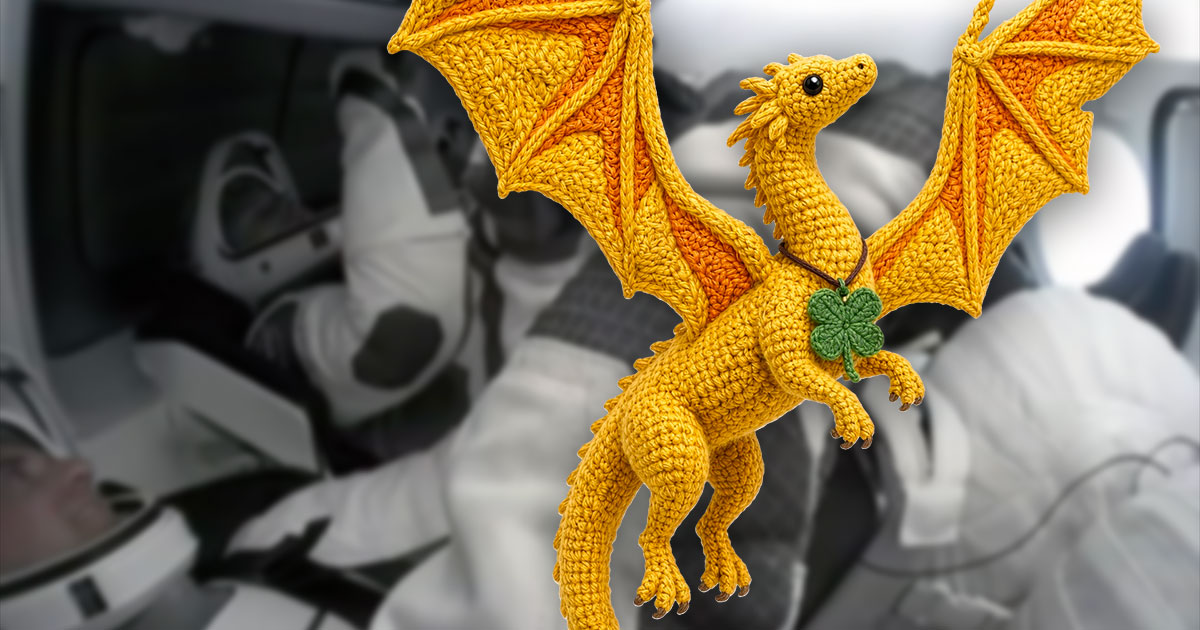
On October 1, 2026, the Crew-13 mission reached orbit inside the Dragon capsule Grace. To show they reached zero-g, the astronauts used a golden dragon doll named Lucky. Commander Jessica Watkins said, "Our Crew-13 zero-gravity indicator is a golden dragon named 'Lucky'." The toy honors the legacy of Apollo 13.
October 1, 2026
— Joshua Kutryk could not quite fathom he had left the planet.
A mission specialist on SpaceX's Crew-13 flight to the International Space Station, Kutryk stated his disbelief just after the Dragon capsule "Grace" — his ride into orbit — separated from its Falcon 9 rocket on Thursday morning (Oct. 1). Seated alongside the Canadian Space Agency astronaut were Crew-13 commander Jessica Watkins and pilot Luke Delaney, both with NASA, and mission specialist Sergey Teteryatnikov of Roscosmos.
"While everyone tells me I'm in space, I don't really believe it yet. It does feel weird, though," Kutryk said. After a moment, he added, "it's good to be here."
Had Kutryk not trusted what he was feeling, all he needed to do was look for "Lucky" to know that he was now in the weightless environment of outer space.
"Our Crew-13 zero-gravity indicator is a golden dragon named 'Lucky,'" explained Watkins during a later call to SpaceX Mission Control in southern California. "She was hand-crocheted by my talented sister-in-law to represent the dragon at the center of our crew patch, which honors the brave and resilient legacy of Apollo 13 atop which we stand."
A tradition borrowed from the early Soviet (and later Russian) space program, NASA crews flying on U.S. space capsules bring with them a doll or small toy to suspend on a tether attached inside their vehicle. When they cross into space as crew members, they are still strapped into their seats, restraining their movement. By releasing the tethered doll, they can see it floating about the cabin, "indicating" they are in "zero-g."
Usually, the choice of doll is related to a theme or message the crew wants to convey, or is the choice of a family member. For Crew-13, Lucky taps into being NASA's first mission to be numbered "13" since the April 1970 flight of Apollo 13 that suffered an in-flight explosion and went from attempting a moon landing to surviving the trip back to Earth.
"Of course, as Crew 13 in Capsule 213, we figured it wouldn't hurt to bring a little of our own luck, just in case," said Watkins, hinting at triskaidekaphobia, or the fear of the number 13. "But clearly, we don't need it from our vantage point. Crew 13 consists of four of the luckiest humans on or off Earth, and we're so grateful for the opportunity to explore the unknown for the benefit of humanity."
To add even more luck to Lucky, the crocheted dragon wears a four-leaf clover, SpaceX's lucky charm ever since it was added to the mission patch for the company's fourth launch — its first to successfully reach orbit — in 2008. As a result, the green clover has been included on every SpaceX flight insignia to date.
The astronauts also chose the license plate "LUCKY 13" for their Tesla Model X crew transport vehicles that drove them from their crew quarters to Space Launch Complex 40 at Cape Canaveral Space Force Station, where they lifted off at 11:10 a.m. EDT (1510 GMT) Thursday.
Lucky is the first zero-g indicator known to have been inspired by the crew's mission patch. The emblem's design borrows from and pays homage to the Apollo 13 insignia, as Watkins acknowledged when she and her three crewmates arrived in Florida on Sep. 26 ahead of their launch.
"We took a lot of inspiration from the Apollo 13 crew as Crew-13. We have a couple of nods in terms of just the Roman numerals, the golden color [and] the dragon looking upward," she said. "We really wanted to honor their legacy, honor their resilience and their grit and bring a little bit of that with us on our crew. We stand on the shoulders of giants."
Crew-13 docked at the International Space Station — their home for the next five and a half months — in 7 hours and 55 minutes, setting a new record for the shortest rendezvous by a Dragon spacecraft. The expedited arrival was a function of orbital mechanics: the alignment between the station in orbit and the launch pad on the ground.
"And Josh, we can confirm we are in space," said Watkins as she concluded her remarks about Lucky.