
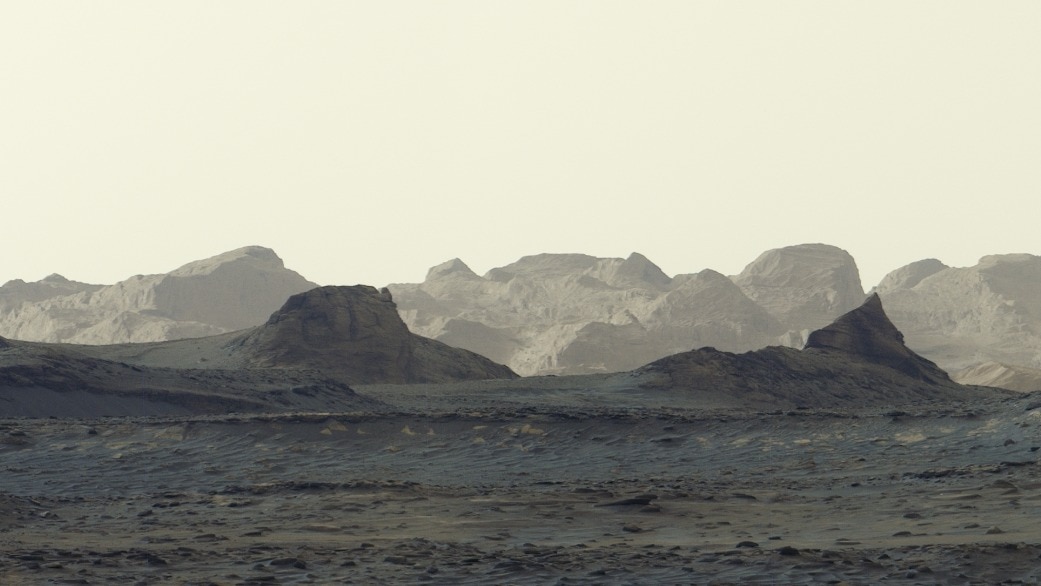
Nasa’s Curiosity rover captured a stunning early-morning view of Mars on August 11, 2026. The panorama showed wind-carved cliffs called yardangs near Mount Sharp. Scientists said these rocky formations could reveal how the planet changed over time. The rover used its main camera to show blue hues across the landscape.
Nasa’s Curiosity rover has captured an early-morning view of Mars, giving Earth a detailed look at wind-carved cliffs on the Red Planet as bright morning light illuminated the scenic landscape.
The newly released panorama was captured by Curiosity on August 11, 2026, and shows a distant layer of rocky formations known as yardangs, which are cliffs and ridges carved by wind over long periods.
HOW DOES A SUNRISE LOOK ON MARS?
The image is actually a panorama made by joining six photographs taken by Curiosity's Mastcam, its main camera system.
Nasa processed the pictures without its usual colour adjustment, allowing the scene to retain the appearance of the early Martian morning.
The result shows blue hues in the foreground, with sunlight falling on the distant yardangs.
The formations stretch for about 16 kilometres across the northwestern part of Mount Sharp, a mountain inside Gale Crater that rises about 5 kilometres above the surrounding terrain.
Curiosity has been climbing Mount Sharp since 2014 and recently reached an elevation gain of 1 kilometre, the most the rover has climbed on Mars.
WHY ARE ROCKS ON MARS IMPORTANT?
The yardangs are more than a scenic feature in a photograph.
They have prompted numerous scientists to want to understand how this unusual layer formed and what it can reveal about Mars' past.
Mount Sharp is made up of layers of rock and sediment deposited during different periods of Martian history.
Curiosity's investigations have shown that this part of Mars once had lakes and streams billions of years ago.
Those wetter conditions eventually disappeared, leaving behind minerals formed as the water dried up. Later, wind may have removed some of the material, helping create the yardangs seen today.
Scientists are not yet certain how the yardang layer formed. One possibility is that it contains ash left behind by ancient volcanic eruptions.
Curiosity is expected to spend much of the next year travelling through layers containing sulphates and carbonates, which are minerals that can provide clues about how Mars changed as its ancient surface became drier.
Nasa scientists hope the rover will reach the base of the yardangs sometime in 2027.
There, Curiosity's robotic arm could examine the formations more closely and collect new information about their origin.