
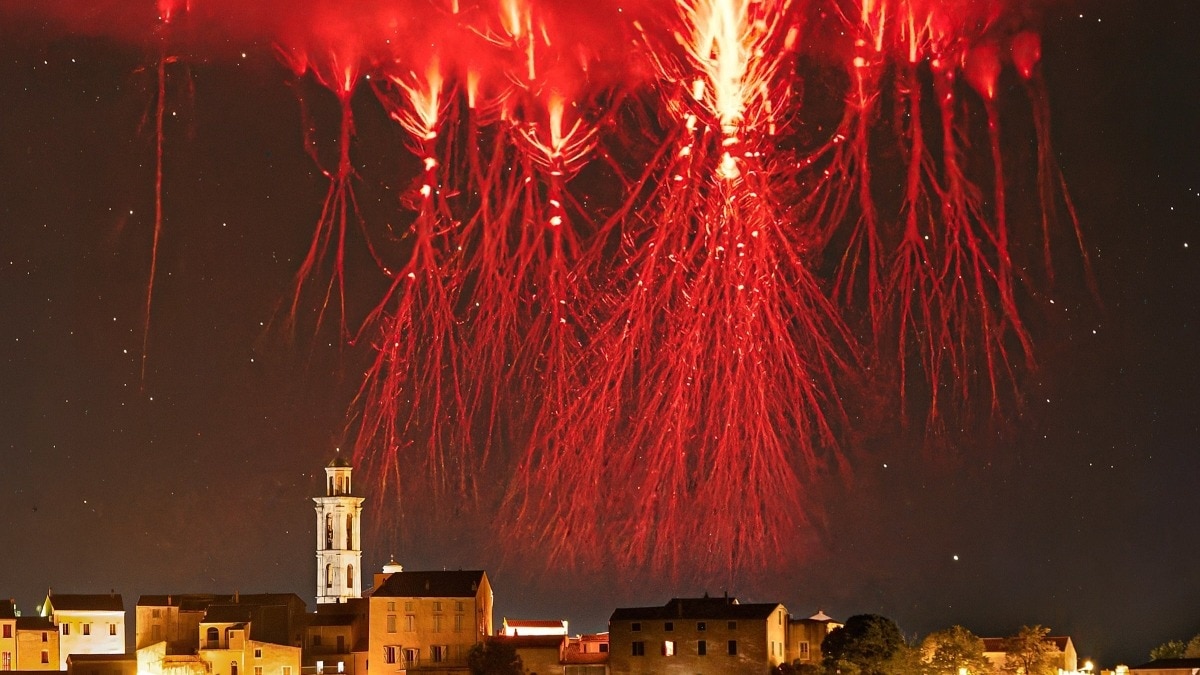
Massive red pillars of light appeared over the Mediterranean after French photographer Florian Riou captured the rare phenomenon. These red sprites, which occur high above powerful thunderstorms, showed up in a photograph taken near Calvi. Riou said, "I had studied the location of thunderstorms and calculated viewing angles before attempting."
Massive red pillars of light appearing to fall from the sky have been captured in a rare photograph over the Mediterranean, revealing a spectacular electrical phenomenon that occurs high above powerful thunderstorms.
French photographer Florian Riou captured the unusual display from Corsica, near the village of Calvi, after carefully predicting thunderstorm activity off the coast of Spain. The photograph shows red, pillar-like flashes high above distant storm clouds, resembling giant streaks of light descending from space.
Riou said on LinkedIn that he had studied the location of thunderstorms and calculated viewing angles from different positions before attempting the shot.
He identified a possibility of capturing the village of Calvi alongside brief luminous phenomena occurring over thunderstorms approximately 500-700 kilometres away.
The result was a rare glimpse of red sprites, among the most elusive electrical phenomena in Earth's atmosphere.
WHAT ARE RED SPRITES?
Red sprites are short-lived electrical discharges that occur high above thunderstorm clouds, typically at altitudes of around 50-90 kilometres.
They form in the upper atmosphere, in the region extending towards the mesosphere, rather than between clouds and the ground like ordinary lightning.
These flashes are triggered by powerful lightning discharges below. The resulting electric field accelerates electrons in the upper atmosphere, exciting molecules in the surrounding gas and causing them to emit light.
Sprites usually appear red because of the emission from molecular nitrogen. Their shapes can vary dramatically, appearing as vertical pillars, branching threads or structures resembling jellyfish.
Despite their enormous size, these flashes last only a few milliseconds. They can extend tens of kilometres vertically, making them spectacular but extremely difficult to observe and photograph.
WHY ARE THEY SO DIFFICULT TO CAPTURE?
Red sprites are often hidden by thunderstorm clouds when viewed from the ground. Their brief duration also means photographers must capture the right moment, often over distant storms and under favourable viewing conditions.
Unlike the familiar lightning bolts seen during thunderstorms, sprites occur far above the clouds and do not strike the ground. They are also not simply streams of hot plasma like conventional lightning; their glow results from atmospheric gas molecules becoming excited by energetic electrons.
Scientists obtained the first convincing instrumental evidence of sprites in 1989, helping establish that these unusual flashes were real atmospheric events rather than visual illusions.