
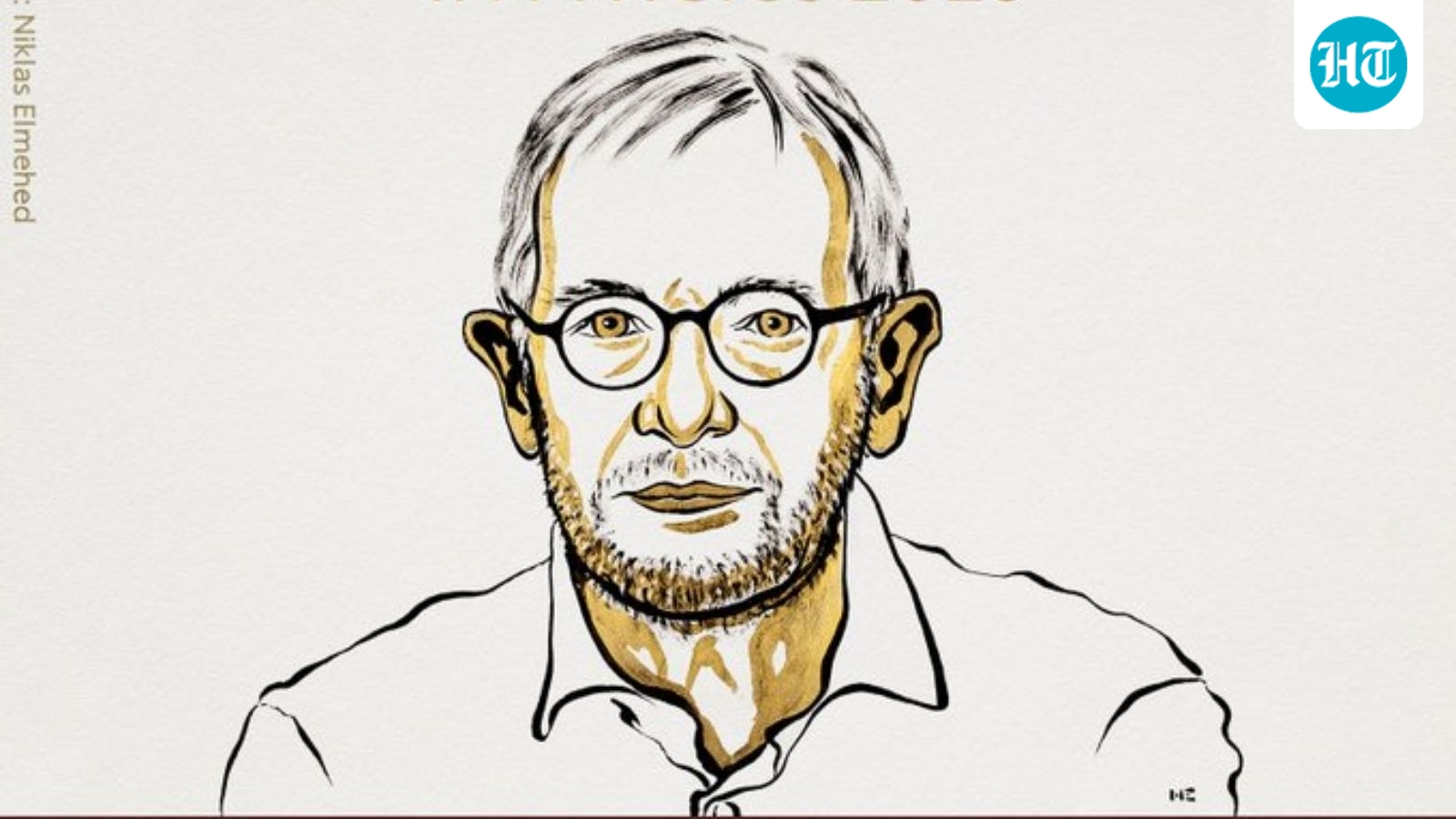
Francis Halzen won the 2026 Nobel Prize in Physics for his work on the IceCube Neutrino Observatory. He realised that South Pole ice could track neutrinos from the distant universe. The jury said, "The neutrino interactions that are continuously collected by IceCube will provide researchers with novel knowledge about the settings."
Francis Halzen won the the 2026 Nobel Prize in Physics "for decisive contributions to the IceCube Neutrino Observatory and the discovery of high-energy neutrinos of astrophysical origin."He realised that ice at the South Pole could be used to track particles known as neutrinos.
His vision and scientific leadership have been fundamental for the IceCube Neutrino Observatory - a cubic kilometre of ice that is equipped with light sensors.
Using IceCube, researchers can capture neutrinos from extremely energy-rich processes in the distant universe, the jury said.
The IceCube Neutrino Observatory tracks neutrinos that originate in the distant cosmos.
"The neutrino interactions that are continuously collected by IceCube will provide researchers with novel knowledge about the violent settings in which high-energy neutrinos can be created - and could even reveal previously unknown cosmic phenomena," the award-giving body said.
Nobel Prize in Physics 2025 winners
John Clarke, Michel H Devoret and John M Martinis won the 2025 Nobel Prize in Physics "for the discovery of macroscopic quantum mechanical tunnelling and energy quantisation in an electric circuit."
The Royal Swedish Academy of Sciences said the laureates used a series of experiments to demonstrate that the bizarre properties of the quantum world can be made concrete in a system big enough to be held in the hand.
"Their superconducting electrical system could tunnel from one state to another, as if it were passing straight through a wall. They also showed that the system absorbed and emitted energy in doses of specific sizes, just as predicted by quantum mechanics," the release said.
2026 Nobel Prize in Medicine
Karl Deisseroth, Peter Hegemann and Georg Nagel won the 2026 Nobel Prize in Physiology or Medicine for their discoveries concerning light-gated ion channels and optogenetics on Monday.
The three scientists were recognised for pioneering work that enabled researchers to control the activity of specific cells using light. Their discoveries have transformed neuroscience and opened new avenues for studying how the brain and nervous system function.
"Optogenetics makes it possible to switch on, or off, the activity of individual nerve cells in a living brain. This method is now being used in laboratories around the world to reveal the brain's mysteries", the the Nobel Assembly said.