
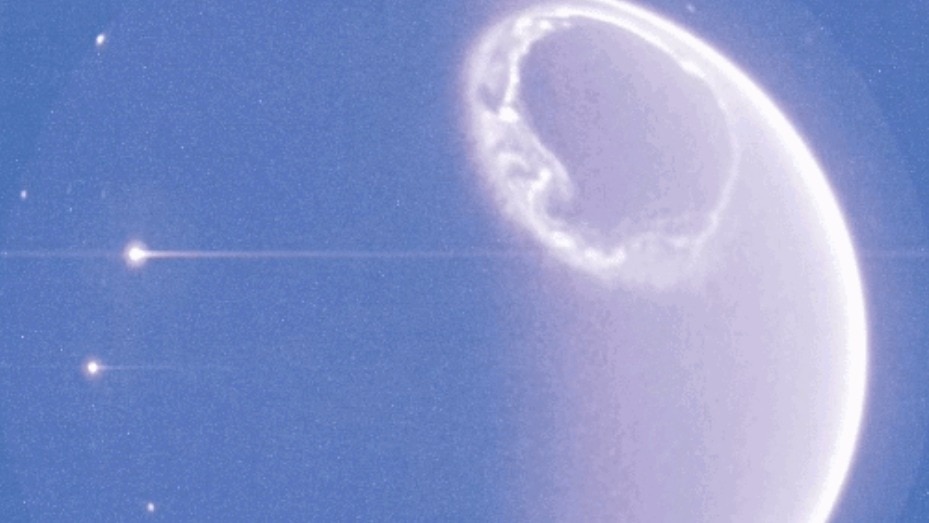
The European-Chinese Smile spacecraft captured its first ultraviolet view of the northern lights on July 24. This mission shows a glowing ring around Earth’s North Pole as the magnetic field responded to solar particles. Launched on May 19, 2026, the craft now helps scientists study how solar activity affects us.
A new European-Chinese spacecraft has captured its first ultraviolet view of the northern lights, revealing a glowing ring around Earth's North Pole as the planet's magnetic field responded to a burst of particles from the Sun.
The footage was recorded on July 24, just two weeks after the ultraviolet imager aboard the Solar wind Magnetosphere Ionosphere Link Explorer, or Smile, was switched on.
It shows activity in the auroral ring triggered by a disturbance in Earth's magnetic field as solar wind particles rushed towards the planet.
The observation is an early glimpse of what Smile was built to study; how Earth's invisible magnetic shield responds to the constantly changing activity of the Sun.
NEW WAY TO WATCH NORTHERN LIGHTS
Auroras occur when disturbances in Earth's magnetic environment send charged particles towards the polar regions, where they interact with the upper atmosphere and produce the familiar northern and southern lights.
What makes Smile different is how long it can watch this process. Its ultraviolet aurora imager can observe the full ring of northern lights around the North Pole continuously for up to 45 hours.
That is a significant improvement over earlier spacecraft, which could observe the auroras for only about 15 hours at a time. Smile is also the first spacecraft since 2008 capable of capturing the complete northern auroral ring in ultraviolet light.
The uninterrupted observations should help scientists track how the auroral ring changes as solar activity disturbs Earth's magnetic field.
SMILE BEGINS SCIENCE MISSION
Smile was launched on May 19, 2026, from Europe's Spaceport in French Guiana, and reached its target orbit on June 20, after which European and Chinese teams spent several months commissioning its instruments and spacecraft systems.
The mission was officially cleared to begin science operations on September 23.
The mission is a joint project between the European Space Agency (ESA) and the Chinese Academy of Sciences (CAS).
Its four instruments include the ultraviolet aurora imager, a magnetometer, a light ion analyser and a soft X-ray imager. Together, they will study how solar activity interacts with Earth's magnetic environment.
The X-ray camera has already taken its first test images, but unwanted light is currently interfering with observations of Earth.
Teams are adjusting its settings and software, with ESA expecting conditions for useful images of the boundary where the solar wind meets Earth's magnetic field to improve by mid-October.
By combining these observations with the auroral images, Smile could give scientists a more complete picture of space weather, and help improve our understanding of how solar storms affect technology and astronauts around Earth.