
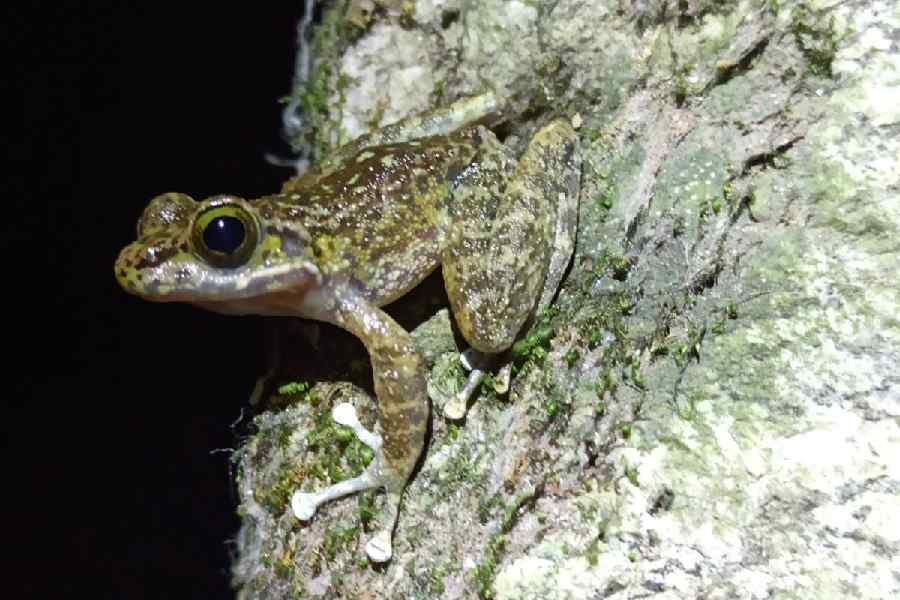
The marbled cascade frog in Darjeeling faces survival risks due to low genetic diversity and local consumption. A study published Thursday in BMC Genomics showed this lineage diverged 11.2 million years ago. Researchers said, "This frog is facing a dual threat: a low genetic diversity and the local practice."
Study traces the Himalayan lineage to 11.2 million years ago and warns that isolation, habitat pressures and wild collection could further weaken the population
A frog found in the eastern Himalayas diverged from other Southeast Asian populations around 11 million years ago and has low genetic diversity in the Darjeeling hills, where it also faces the threat of being consumed as food.
A genetic study of the marbled cascade frog from around Darjeeling and Kalimpong by researchers at the University of Calcutta and collaborating institutions has suggested that geographic isolation and limited fresh gene flow have contributed to its low genetic diversity.
Their study, published on Thursday in the journal BMC Genomics, has revealed that the frog from the Darjeeling hill region has the lowest genetic diversity compared to frogs of the same species from Myanmar, Southeast Asia and China.
Their analysis points to a common ancestor shared by these frogs in Asia 17.4 million years ago. The South Asian or the Darjeeling lineage diverged 11.2 million years ago from Myanmar and southeast Asian lineages. The frog, which is found in Nepal, north Bengal, Sikkim and Bhutan, typically lives in rocky rivulets or streams at altitudes ranging from 200 metres to 2,400 metres above sea level.
"This frog is facing a dual threat: a low genetic diversity and the local practice of consuming wild frogs for food," Rakesh Tamang, an associate professor of zoology at the University of Calcutta who led the study, told The Telegraph.
It is common practice among some residents of the Darjeeling hills to catch the frogs while they're perched on rocks or near bushes at night, especially in the monsoon season, Tamang said. Catching the frogs from the wild may further exacerbate the already depleted genetic diversity.
"No work had been done until now on the genetics of this frog in the Himalaya," said Gyaneswer Chaubey, a genome researcher at Banaras Hindu University who collaborated in the study. "Populations with low genetic diversity are more vulnerable to disease, climate change and inbreeding. Conservation efforts will need to involve local communities."
One option, Tamang said, would be to explore commercial breeding efforts to support local consumption on the lines of aquaculture farms. "The goal would be to curb direct harvesting of these frogs from the wild," he said.
The researchers collected 60 frogs from 57 locations in the Darjeeling hill region and analysed the genomes of 35 frogs. Scientists from the Zoological Survey of India, Darjeeling Government College, and Tamralipta Mahavidyalaya collaborated in the study.
The analysis suggests that the Darjeeling lineage emerged from a small founder population and subsequently expanded rapidly, said Kumaresh Mandal, the study's lead author. He said conserving these genetically unique Himalayan populations and their stream habitats is essential for maintaining their capacity to adapt to future environmental changes.