
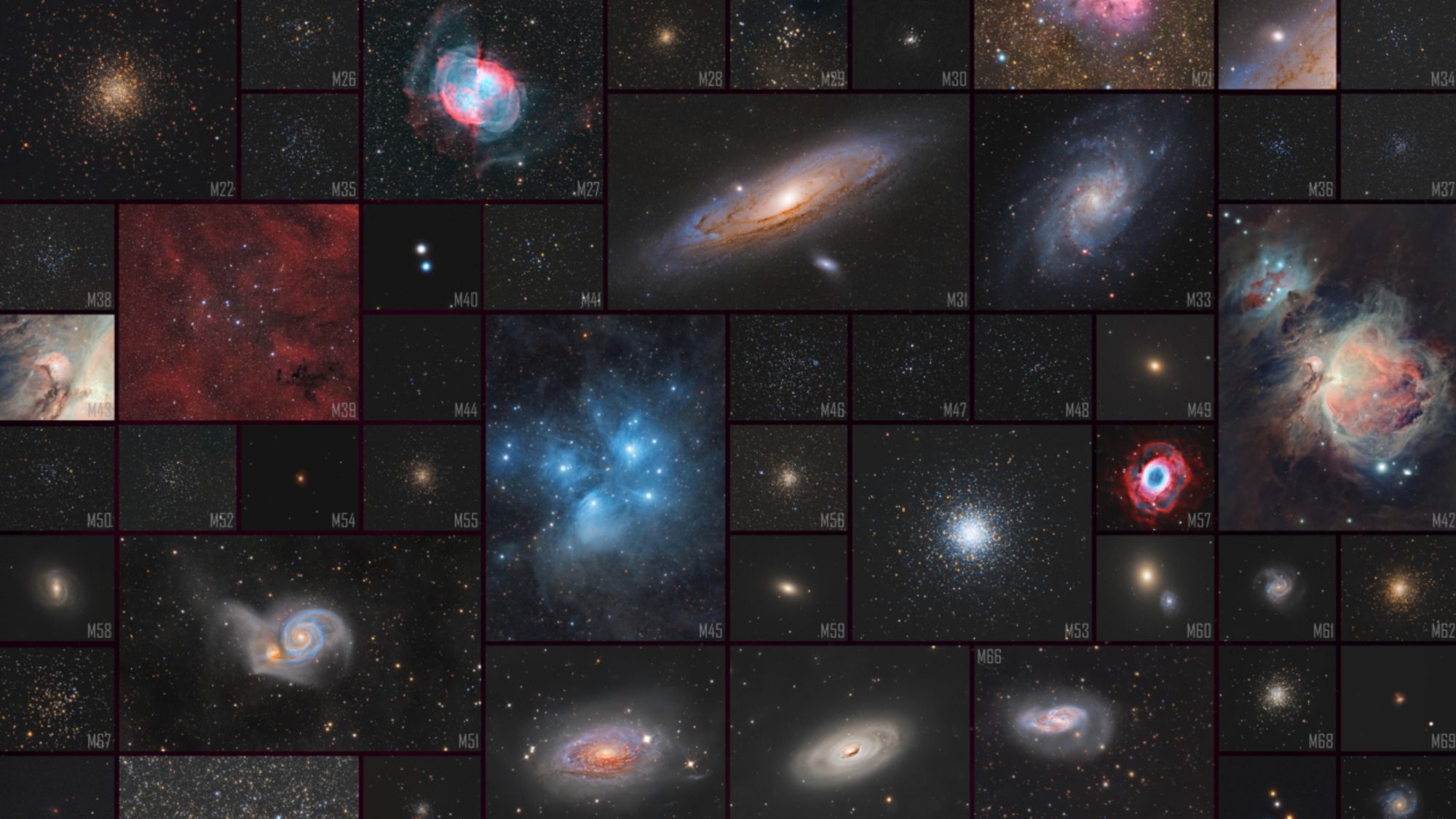
Astrophotographer Cornelis van Zuilen captured 110 galaxies, star clusters and nebulas in a 352-hour mosaic. He used an Askar 103APO telescope and ZWO cameras to complete the project. "Doing this from the Netherlands was quite a challenge," van Zuilen said. He often slept in his car to get clear views.
Behold! Amateur astrophotographer ing. Cornelis van Zuilen has created a stunning cosmic mosaic of all 110 galaxies, star clusters and nebulas of the Messier catalog — a leviathan effort that took hundreds of hours and many nights of sleeping in his car to complete.
"One of the first Messier objects I photographed was Messier 45 (the Pleiades) back in 2024, when I had just purchased my cooled deep-sky camera and was beginning my deep-sky astrophotography journey," van Zuilen told Space.com in an email. "About a year and a half ago, I decided to capture the entire catalogue."
Van Zuilen spent 352 hours and 13 minutes imaging the menagerie of deep-sky objects using an Askar 103APO telescope and a William Optics Redcat 51 MK2.5, before artfully editing each subject using photoshop and the astronomy software PixInsight.
The ancient light collected by the telescopes was captured with a range of ZWO astronomy cameras and filters.
Van Zuilen observed many of the objects directly from his balcony from the town of Heiloo in the Netherlands, while others required van Zuilen to take his telescopes further afield to avoid capturing treetops and farm buildings in his field of view.
"Doing this from the Netherlands was quite a challenge," explained van Zuilen. "I often had to travel to a semi-dark field nearby to get a clear view of the horizon, which meant many nights of sleeping in my car. But to be honest, I actually really enjoyed that part, it felt like camping."
What is the Messier catalog?
The Messier catalog was first compiled by 18th-century astronomer Charles Messier, who sought to create a list of deep-sky objects that could be mistaken for comets as they glowed in the night sky, according to NASA.
Messier's catalog has been revised several times since its creation and includes some of the most famous deep-sky objects that can be spotted from the Northern Hemisphere, including the Andromeda Galaxy (M31), the Pleiades open star cluster (M45) and the Orion Nebula (M42).
Each of the objects can be spotted with a modest backyard telescope under dark sky conditions, which has made the Messier catalog a popular sightseeing checklist for amateur astronomers looking to explore the wonders beyond our solar system.
"As you might notice, some images are larger than others, and there's a reason for that too," continued van Zuilen. "Those are my favorite images! And most of them have a personal story behind how they came to be, which makes the collage a bit more personal and meaningful to me."
Want to start out on your own astrophotography journey? Then be sure to read our beginner's guide to capturing the night sky, along with our selection of the best cameras and lenses for astrophotography.