
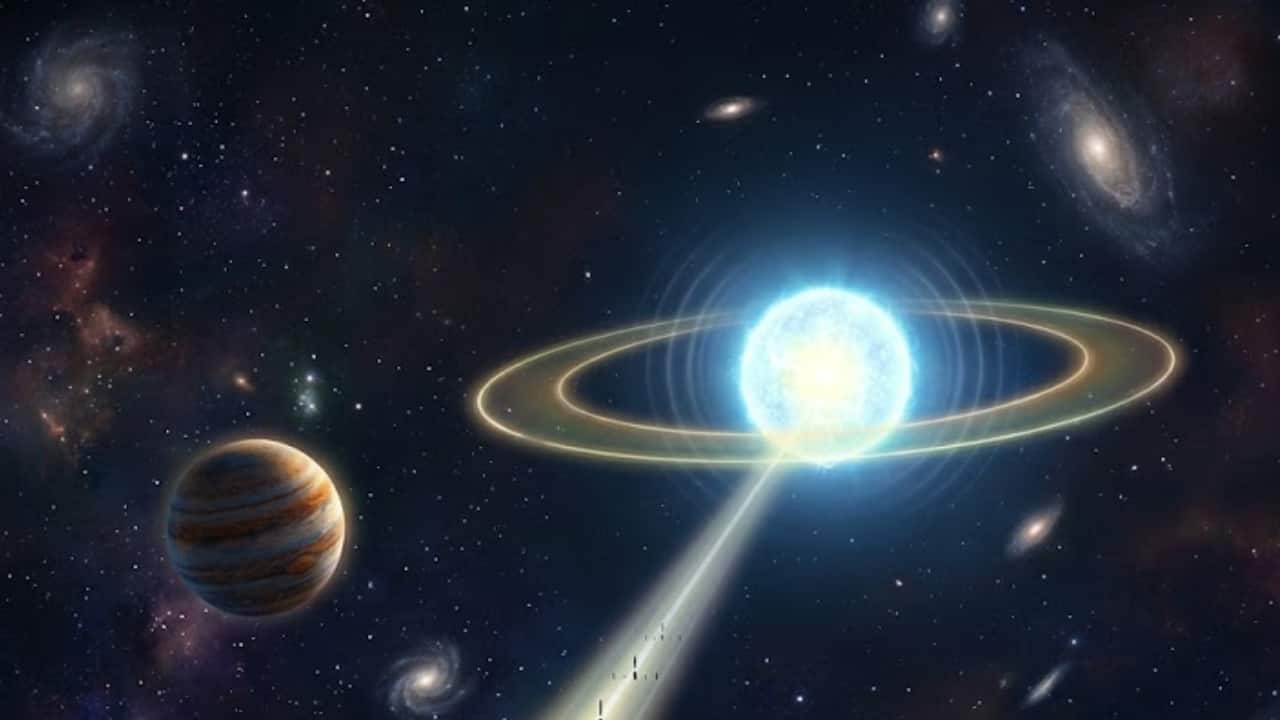
Astronomers may have found a giant planet named HD 156295 b about 140 light-years from Earth. This candidate planet orbits a hot star in the habitable zone. It has 6.3 times the mass of Jupiter. Researchers used star pulsations to find it, but they need more data to confirm it.
Astronomers may have spotted an unusual giant planet about 140 light-years from Earth, orbiting in the habitable zone of a star far hotter and brighter than our Sun. The candidate planet, named HD 156295 b, is estimated to have a mass about 6.3 times that of Jupiter and takes roughly 2,200 days, or about six Earth years, to complete one orbit around its star. It sits around 3.9 astronomical units from its host star, close to the outer edge of the system's habitable zone. That does not mean astronomers have discovered another Earth. HD 156295 b is thought to be a gas giant, making it a very different world from our rocky planet. In astronomy, the "habitable zone" simply describes the region around a star where temperatures could theoretically allow liquid water to exist under the right conditions. What makes the possible discovery particularly interesting is the star it orbits. HD 156295 is an A-type star, part of a class of stars that are generally hotter, more massive and brighter than the Sun. The star is about nine times as luminous as the Sun and has a temperature of roughly 7,500 degrees Celsius. If the planet is confirmed, HD 156295 would be the hottest star known to host a planet in its habitable zone. Finding planets around stars like this is difficult. Astronomers commonly discover exoplanets by looking for the slight dimming produced when a planet passes in front of its star, or by measuring the tiny gravitational wobble a planet causes. Both techniques can be challenging with hot A-type stars because of their properties and variability. Instead, researchers used the star's own pulsations as a kind of cosmic clock. HD 156295 belongs to a class of variable stars whose brightness pulsates with sufficient regularity that astronomers can look for tiny changes in the timing of those pulses. An orbiting object gravitationally tugs the star backwards and forwards, subtly altering when its light reaches Earth. Researchers analysed observations of more than 16,000 pulsating stars from NASA's Transiting Exoplanet Survey Satellite, or TESS, to search for such signals. There is, however, a big caveat: HD 156295 b remains only a candidate. The researchers estimate the probability that the planetary signal is genuine at only a little over 50 per cent, and further observations will be needed to establish whether the object really exists and pin down its properties. Even so, the finding could demonstrate a useful new way of discovering worlds around stars that have traditionally been difficult for planet hunters to investigate. And with the European Space Agency's PLATO mission expected to study stellar oscillations with high precision, pulsation timing could eventually reveal more planets hiding around some of the hottest stars in our neighbourhood.