
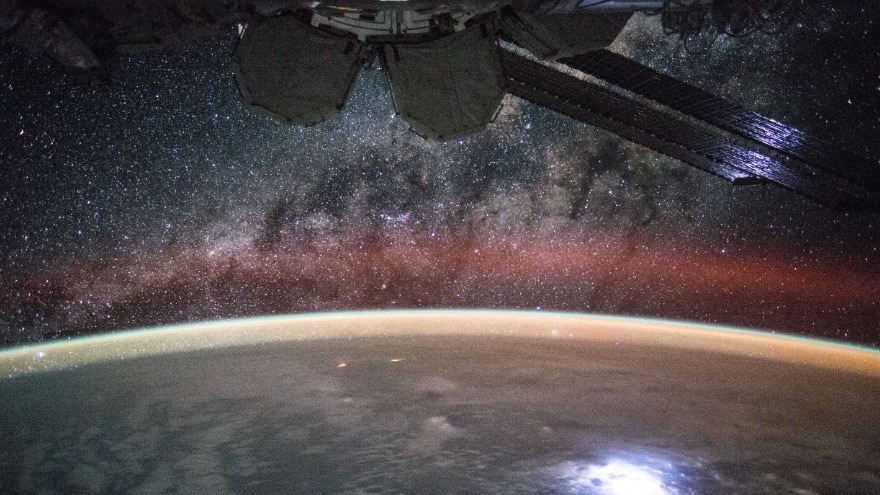
Group Captain Shubhanshu Shukla shared a video from space showing Earth’s glowing horizon. The Indian astronaut, who flew on Axiom Mission 4 in June 2025, explained that this phenomenon is airglow. It is a natural, faint light produced by gases high in the atmosphere when atoms release energy as light.
A thin, glowing line separating the dark sky from Earth offered Group Captain Shubhanshu Shukla a chance to explain what the breathtaking phenomenon is, along with a stellar view from space.
The Indian astronaut took to social media platform X and shared a video showing Earth's curved horizon, city lights below and a faint band of light along the edge of the planet.
The phenomenon is known as airglow, which is a natural, extremely faint light produced by gases high in Earth's atmosphere.
Shukla is the first Indian to visit the International Space Station (ISS) who flew as the mission pilot of Axiom Mission 4 in June 2025.
As part of that mission, he spent 18 days aboard the station, conducting scientific experiments and sharing glimpses of life in orbit.
WHAT IS AIRGLOW?
Airglow is a continuous glow produced by atoms and molecules in the upper atmosphere.
Sunlight, particularly ultraviolet radiation, provides much of the energy that drives the processes behind it.
During the day, solar radiation energises or breaks apart atmospheric molecules.
Later, as atoms and molecules undergo chemical reactions and return to lower-energy states, they can release some of that energy as light.
On the night side, these reactions continue, producing what is often called "nightglow".
The glow is extremely faint, so subtle that it's not normally noticeable with the naked eye. But astronauts looking across Earth's edge from orbit can see it as a delicate, luminous band.
Airglow can appear in several colours. Green is strongly associated with atomic oxygen around 95–100 km above Earth, while sodium can produce yellow-orange light around 85–90 km.
Other atmospheric molecules and reactions can produce red and other wavelengths.
HOW ARE AIRGLOW AND AURORAS DIFFERENT?
Airglow and auroras can look similar, but they have different causes.
Auroras are produced when energetic particles associated with the solar wind interact with gases in Earth's upper atmosphere, particularly around the polar regions.
Airglow, however, is a much fainter and more widespread phenomenon associated largely with ordinary solar radiation and chemical processes in the atmosphere.
It's present around Earth all the time, although it is difficult to see from the ground.
From the International Space Station, the viewing angle and dark surroundings make the thin atmospheric glow much easier to spot.
Beyond its beauty, airglow is also scientifically useful.
Its changing colours and intensity can provide information about the composition, temperature and movements of Earth's upper atmosphere, a region that plays an important role in the environment surrounding our planet.