
Tiny magnetic fossils dating back 97 million years reveal the earliest known animal navigation system. Researchers from the University of Cambridge used 3D imaging to show these structures helped ancient creatures track Earth’s magnetic field. Professor Rich Harrison said, "Whatever creature made these magnetofossils, we now know it was most likely capable."
The evidence comes from tiny magnetic fossils dating back 97 million years. They were preserved in ancient seafloor sediments and appear to have been produced by an organism whose identity remains unknown.
Known as magnetofossils, the microscopic structures come in shapes resembling spearheads, spindles, bullets, and needles. Each is no larger than a bacterial cell. Scientists believe they have a biological origin, although exactly what organism created them and what purpose they served has long remained uncertain.
Now, researchers have uncovered evidence that the structures may have functioned as a sophisticated navigation system, allowing an ancient animal to interpret Earth's magnetic field much like a map.
A Magnetic Navigation System From 97 Million Years Ago
Scientists from the University of Cambridge and the Helmholtz Zentrum Berlin produced the first 3D images of the magnetic structure inside the fossils. Their analysis revealed features that appear optimized for detecting both the direction and strength of Earth's magnetic field, two types of information that could have helped an animal determine where it was and where it was going.
"Whatever creature made these magnetofossils, we now know it was most likely capable of accurate navigation," said Professor Rich Harrison from Cambridge's Department of Earth Sciences, who co-led the research.
The findings provide the first direct evidence that animals were navigating with Earth's magnetic field at least 97 million years ago. They could also help scientists understand how this remarkable sense, known as magnetoreception, evolved. The results are reported in the journal Communications Earth & Environment.
Magnetoreception remains one of the least understood senses found in nature. Birds, fish, and insects can use Earth's magnetic field to travel enormous distances, yet scientists still do not fully understand the biological mechanisms that make this possible.
One leading idea involves magnetite, a magnetic mineral that may form tiny crystals inside an animal's body. These particles could align with Earth's magnetic field and behave like microscopic compass needles.
Bacteria Offer a Simpler Magnetic Compass
Some bacteria living in lakes and other aquatic environments already use a basic version of this system. Chains of magnetic particles inside the cells allow the bacteria to orient themselves with Earth's magnetic field, helping them swim toward the depth of water they prefer.
"At just 50-100 nanometers wide, these particles are the perfect compass needles," said Harrison. "If you want to create the most efficient magnetic sense, smaller is better."
The magnetofossils examined in the new research, however, are much larger. Retrieved from a location in the North Atlantic Ocean, they are roughly 10 to 20 times bigger than the magnetic particles used by bacteria.
Scientists had previously suggested that these unusually large magnetofossils might have acted as protective spines. Computer simulations, however, hinted that the structures could possess far more sophisticated magnetic properties.
"It looks like this creature was carefully controlling the shape and structure of these fossils, and we wanted to know why," he said.
Seeing Inside the Magnetic Fossils
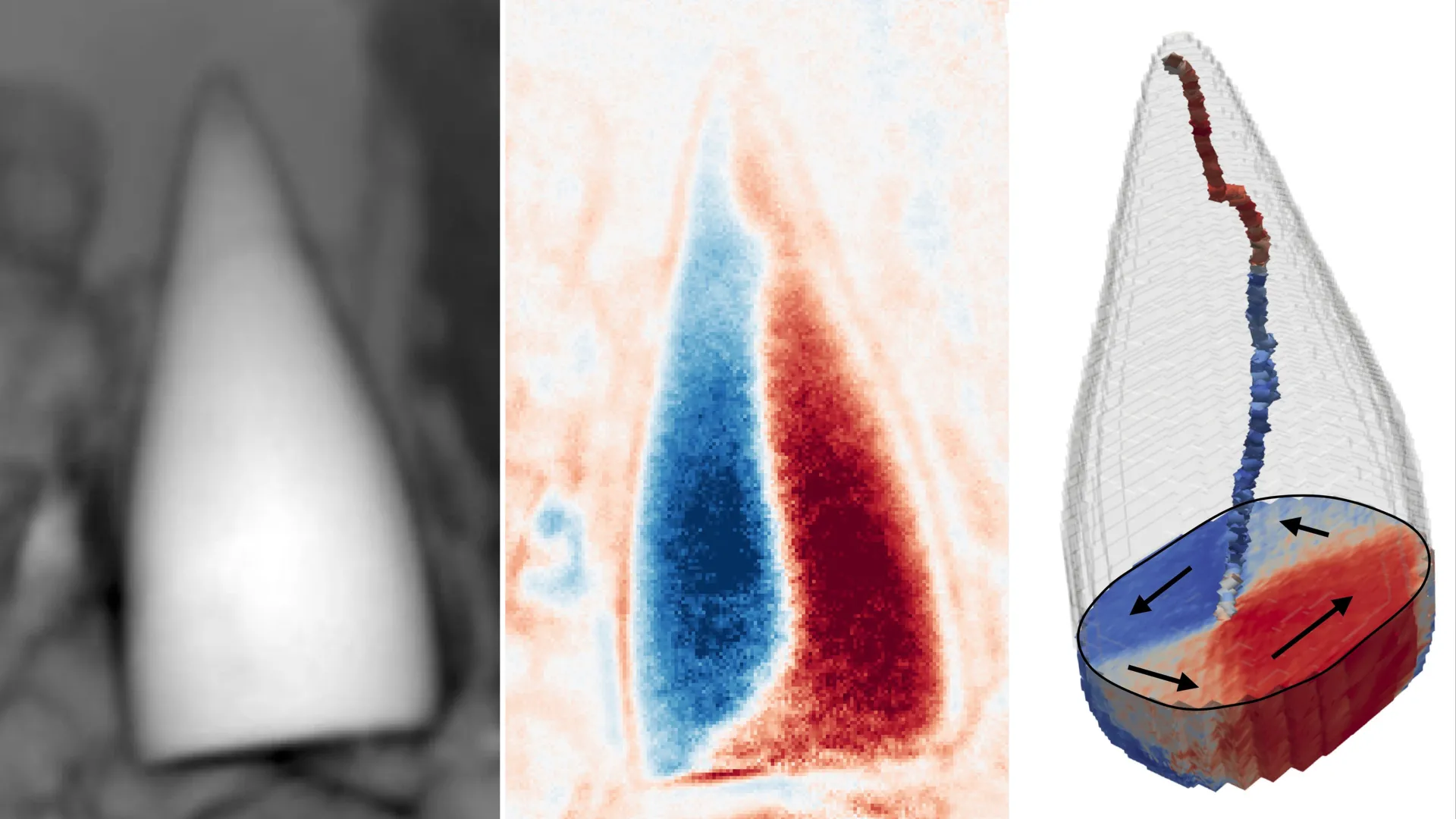
To investigate, the researchers used a new imaging method that allowed them to see how magnetic moments (tiny magnetic fields generated by spinning electrons) are arranged throughout the magnetofossil.
Scientists had previously been unable to obtain 3D magnetic images of large particles such as giant magnetofossils because conventional X rays could not penetrate them effectively.
The new work became possible through a technique developed by co-author Claire Donnelly at the Max Planck Institute in Germany. The measurements were carried out at the Diamond X-ray facility in Oxford.
"That we were able to map the internal magnetic structure with magnetic tomography was already a great result, but the fact that the results provide insight into the navigation of creatures millions of years ago is really exciting," said Donnelly.
The resulting images revealed an unexpectedly complex internal magnetic pattern. Magnetic moments spiral around a central line extending through the fossil, producing a structure that resembles a tornado-shaped vortex.
A Particle Built for Navigation
According to Harrison, this type of vortex magnetism has properties that are exceptionally well suited to navigation. Small variations in magnetic field strength cause the structure to produce a subtle "wobble," potentially allowing an organism to extract detailed information about its geographic position.
"This magnetic particle not only detects latitude by sensing the tilt of Earth's magnetic field but also measures its strength, which can change with longitude," he said.
The vortex geometry is also extremely stable. That stability could allow the magnetic system to resist small environmental disturbances that might otherwise interfere with its ability to provide reliable navigational information.
"If nature developed a GPS, a particle that can be relied upon to navigate thousands of kilometers across the ocean, then it would be something like this," he said.
By revealing what the fossils may have been used for, the research also provides clues about the mysterious animal that produced them.
"The next question is what made these fossils," said Harrison. "This tells us we need to look for a migratory animal that was common enough in the oceans to leave abundant fossil remains."
Could Ancient Eels Be Responsible?
Harrison suggests that eels are one possible candidate. Eels evolved around 100 million years ago and remain among the most elusive and poorly understood animals living today.
Modern European and American eels undertake extraordinary migrations, traveling thousands of kilometers from freshwater rivers to reproduce in the Sargasso Sea. Researchers know that eels can detect Earth's magnetic field, but exactly how they sense it remains uncertain.
Magnetite particles have been found in eels, although scientists have not yet directly imaged those particles inside their cells and tissues. Their extremely small size makes them difficult to locate, particularly because they could be hidden almost anywhere in the animal's body.
Harrison worked closely with Sergio Valencia from Helmholtz Zentrum Berlin while designing the study.
"This was a truly international collaboration involving experts from different fields, all working together to shed light on the possible functionality of these magnetofossils," said Valencia.
Although the identity of the organism that created the structures remains unknown, the fossils may represent an important stage in the evolution of one of nature's most remarkable navigational abilities.
"Giant magnetofossils mark a key step in tracing how animals evolved basic bacterial magnetoreception into highly-specialized, GPS-like navigation systems," Harrison said.
The research was supported in part by the European Union, the European Research Council and the Royal Society. Rich Harrison is a Fellow of St Catharine's College, Cambridge.