
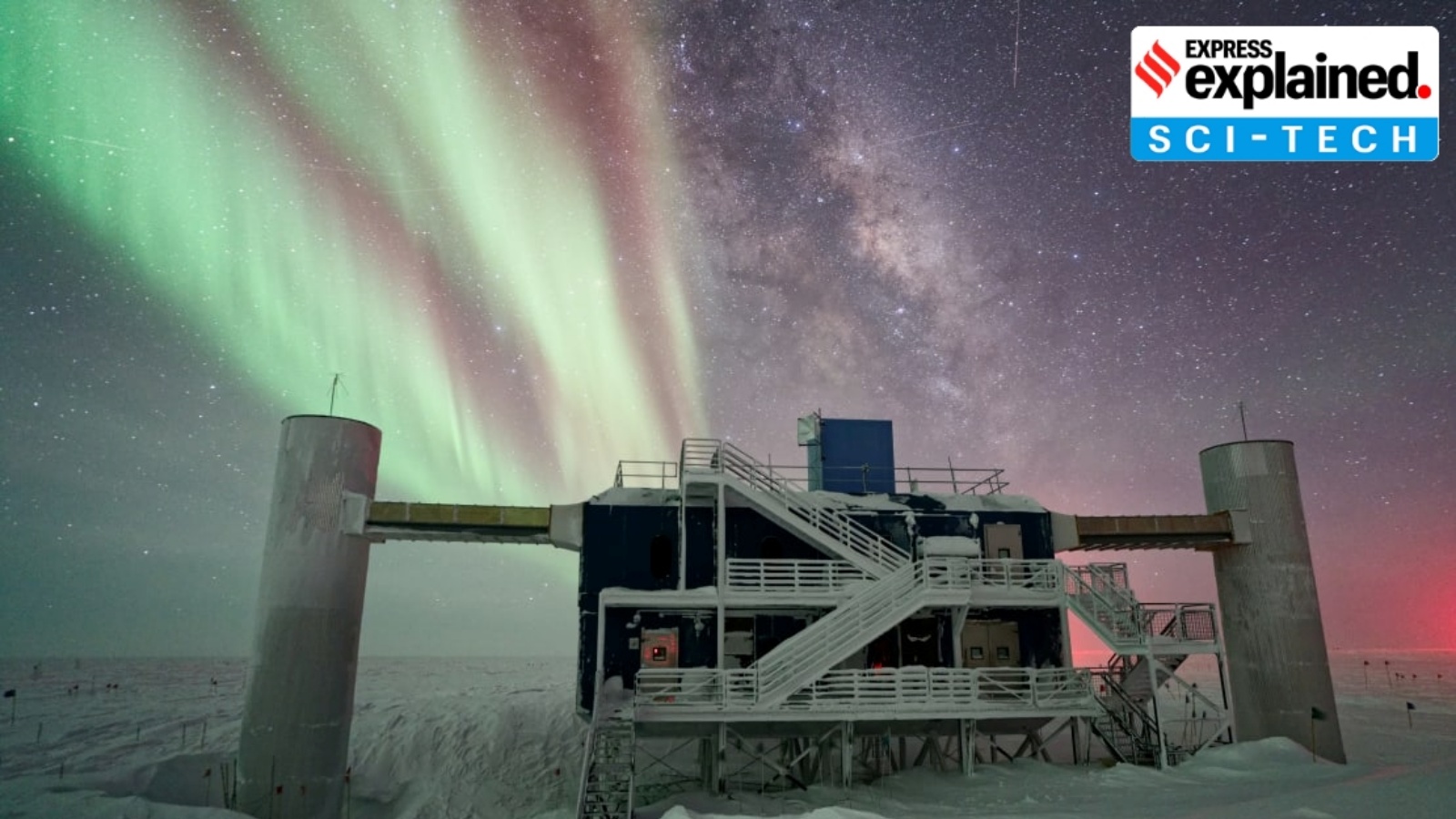
The 2026 Nobel Prize in Physics went to Francis Halzen on Tuesday for his work on neutrinos. These ghost particles are hard to detect because they rarely interact with matter. Halzen used the IceCube facility in Antarctica to find high-energy neutrinos from space, helping scientists learn more about the universe.
Neutrinos, very small sub-atomic particles produced mainly in nuclear reactions in stars, are among the most abundant particles in the universe, second only to photons (or light particles). And they can reveal a huge amount of new information about the universe. The problem has been that they are extremely difficult to detect, the reason they are often described as ghost particles.
The quest to detect neutrinos, and attempts to study them, have already led to several Nobel Prize wins. Another one was added on Tuesday, with the 2026 Nobel Prize in Physics being awarded to Francis Halzen, a Belgian-American scientist who designed an elaborate set-up under ice sheets in Antarctica to detect these elusive particles.
The IceCube facility in Antarctica is not the first observatory to detect neutrinos. Neutrinos were first proposed in the 1930s and first detected in the 1950s. Several observatories around the world are dedicated to detecting and studying these particles.
Studying distant space
What the IceCube facility managed to do was something unique. It was successful in detecting a special variety of high-energy neutrinos that was coming from far away in space. Till now, only those neutrinos that originated in the close vicinity of the Earth, primarily being produced in the Sun, were being detected. Most of the neutrinos passing through the Earth are produced in the nuclear processes inside the Sun.
For scientists, the detection of extra-galactic neutrinos has opened a new source of information about the universe. Initially, visible light was the only tool available to scientists to study the cosmic phenomena. Then, detectors were developed for the full electromagnetic spectrum of radiation and for cosmic rays. The detection of gravitational waves in 2015 opened an entirely new window for scientists looking at the universe. Extra-galactic neutrinos add another dimension of possibilities.
Also in Explained | Medicine Nobel goes to scientists who can 'control brain using light': What their work is
Together these different kinds of signals enable what is called multi-messenger astronomy, the ability to study the same cosmic event using different kinds of signals, said D Indumathi, a scientist at the Bengaluru-based Indian Institute of Astrophysics who was formerly associated with India's effort to build a neutrino detector.
'Shy' particles
The reason neutrinos are so difficult to detect is that they have an extremely low propensity to interact with matter. The Nobel Prize committee described them as the "shyest particle". They simply pass through very dense regions of matter without any disturbance.
A very common example often cited is the fact that nearly 65 billion neutrinos pass through human finger nails every second without anyone ever noticing. Because they are also electrically neutral, they do not respond to electromagnetic fields the way charged particles do.
The detections happen on the very rare occasions that they do interact with matter. That happens to, maybe, one in billions or trillions of neutrinos. That is why neutrino observatories the world over are very large facilities, built in extremely isolated, often underground locations, that maximise the chances of interaction and minimise noise.
The elusive nature of neutrinos is also what makes them particularly interesting to study. They pass through regions of cosmic space that other signals may never be able to cross. Very dense regions in space, for example, can absorb or scatter all electromagnetic radiations, but neutrinos simply flow through. They can thus reveal processes happening within or beyond that dense region, which are otherwise inaccessible to scientists.
The IceCube facility
The 82-year-old Halzen, who had been studying cosmic rays since the 1960s, came to know of the attempts of Soviet researchers to build a neutrino detector in Antarctica, a press release from the Nobel Prize committee said. When a neutrino collides with an atomic nucleus in the ice, it creates an electric spark. This produces radio waves which could be detected using radio antennas.
Halzen thought of a slightly different idea. He realised that light sensors could be installed in glacier ice. These sensors could produce flashes of light from collisions of neutrinos with the nucleus of ice atoms. The area around the South Pole was a favourable location. It was isolated and, at significant depths, there was a lot of darkness with no disturbance from other radiations or signals.
He discussed his ideas with some of his colleagues and did most of the theoretical work on designing an observatory deep below the ice-sheets. IceCube is one cubic kilometer of ice equipped with over 5,000 light sensors on long cables, along with an overground facility where signals are collected. On the rare occasion when the neutrino interacts with an atomic nucleus of ice, a charged particle is produced. If that charged particle travels faster than the speed of light in ice, it produces a faint glow. From the characteristics of this glow, scientists are able to reconstruct the energy and direction of the neutrino involved in the collision.
This exquisite set-up became operational in 2011. By that time, it had already recorded a couple of events that suggested the involvement of extra-galactic neutrinos. In 2013, the observatory presented the first evidence of having detected very high-energy neutrinos. Since then several such incidents have been recorded and verified.
"It's a very special detector and the work that Halzen has done is really very exciting. It has opened new avenues for astronomy and astrophysics," said Naba K Mondal, former project director of India-based Neutrino Observatory (INO), a much-delayed effort to build a neutrino detector in India. "In neutrino research circles, this award to Halzen was expected for a few years." INO was supposed to be located initially in Kerala and then in Tamil Nadu but ran into opposition from local and political groups over land acquisition and environmental grounds. A new location is yet to be finalised.