
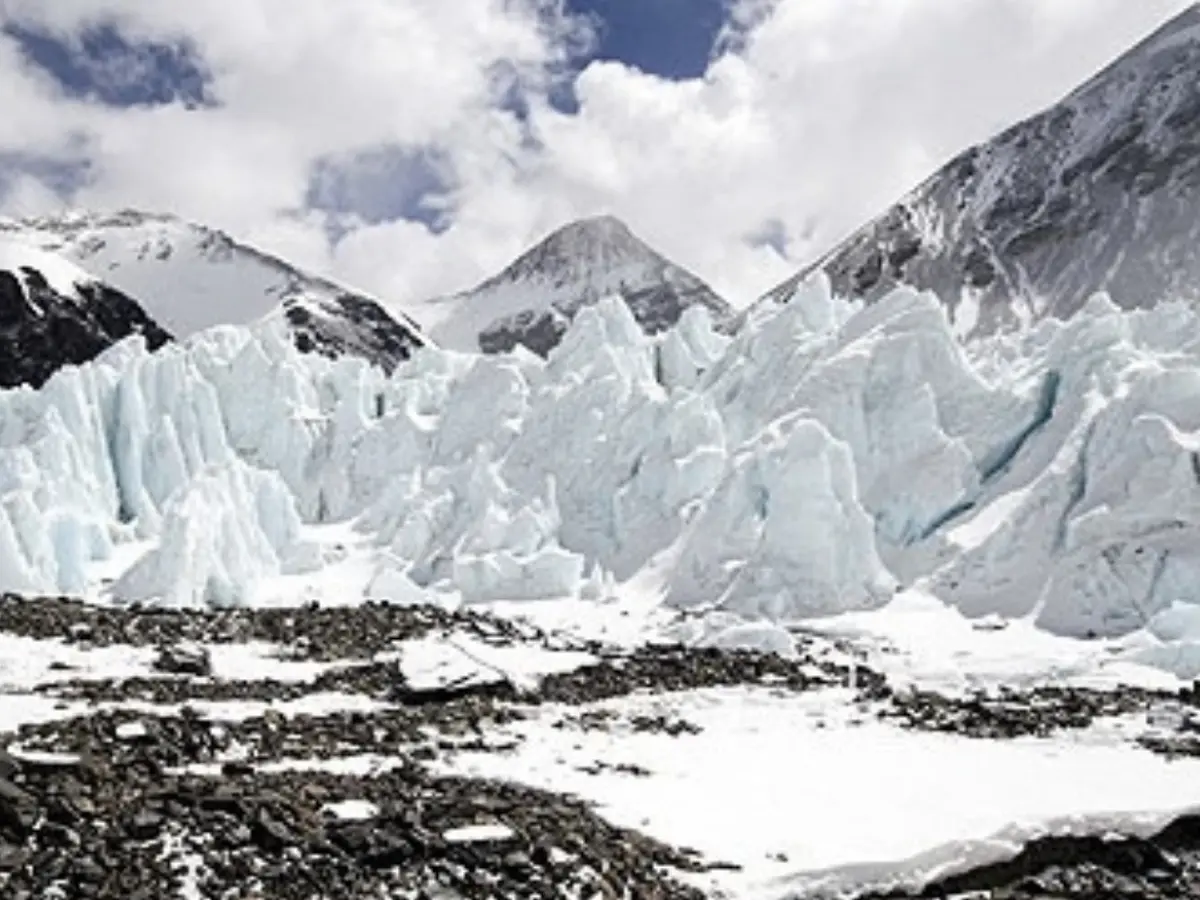
Scientists discovered 128,000-year-old glacial ice on Tibet’s Guliya Plateau, dating back to the last ice age. This rare find helps experts understand past climate changes. Lead author Lonnie Thompson said, "If you get an identical record a quarter of a century later, it can tell you a lot about the behaviour."
On the Tibetan plateau, deep inside a mountain, ice from the last ice age has survived for 128,000 years. This makes it the oldest ice to be present on any mountain aside from the poles. Scientists plan to use the finding to understand climate changes in the region.
Researchers have found that the ice on Tibet's Guliya Plateau could be more than 128,000 years old and likely belongs to the last ice age. This ice is buried deep in a mountain glacier and could be a rare record of the period, hinting that the glacier persisted through the last ice age, SciTech Daily reported.
Finding mountain ice that dates so far back is rare outside the polar regions. Andes ice cores go back approximately 30,000 years, making Guliya the holder of one of the longest continuous climate records found on a mountaintop.
Previous studies had raised questions about Guliya's oldest ice, and whether it could be older than 12,000 years. The latest study shows that some of the ice present here could date as far back as the last glacial period. Lonnie Thompson, lead author of the study, said, "If we only had Holocene-era ice in Tibet, that would mean that the big ice sheets from the last ice age didn't persist through the early Holocene." But strangely, it survived.
The team analysed cores drilled from the Guliya ice cap in 1992 and 2015. Despite being dug out at an interval of 23 years, both had similar patterns in their oxygen isotopes that act as a window into its environmental conditions in the past. This showed that the climate signals preserved in the ice were not artifacts of a single drilling site.
"Reproducibility of the records within a given ice cap is extremely important," Thompson said. "If you get an identical record a quarter of a century later, it can tell you a lot about the behaviour of the ice over time."
To determine the age of the ice, scientists used radioactive isotopes of beryllium and chlorine. They are known to preserve records of environmental events over long periods. They successfully identified signatures of the Laschamp Geomagnetic Excursion, a major Earth magnetic shift that occurred 41,000 years ago, as a primary time anchor.
They also compared the ice core results with oxygen isotope records from cave deposits on the Tibetan Plateau. Both records combined showed that the oldest Guliya ice may be more than 128,000 years old.
The discovery confirms that major high-altitude glaciers survived the transition between epochs. This updated timeline gives scientists a clearer natural baseline to study past atmospheric, biological, and temperature shifts across multiple glacial cycles.